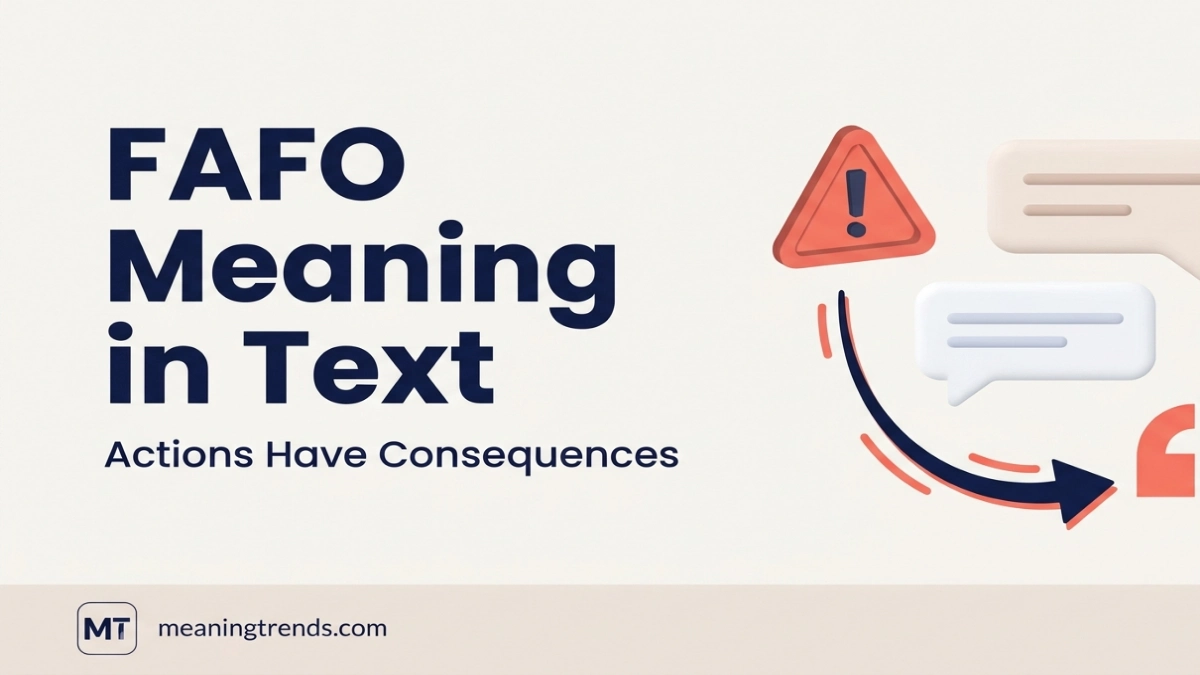
FAFO stands for “Fuck Around and Find Out.” In text messages, it’s a blunt way of saying that someone who takes a risk, ignores a warning, or behaves recklessly may have to deal with the consequences. Depending on the conversation, FAFO can express a warning, criticism, humor, or satisfaction when someone’s actions backfire.
Example: “He kept ignoring the rules. FAFO.” Here, the sender suggests that the person experienced predictable consequences.
You might see FAFO in a group chat after someone makes a risky decision, in a comment about an argument, or in a meme about a plan that went wrong. The four letters are short, but they can carry a surprisingly strong tone.
The challenge is figuring out If the person using FAFO is joking, criticizing someone, or issuing a serious warning. A message between close friends can sound playful, while the same expression during a heated disagreement can feel hostile.
Understanding the surrounding conversation matters more than the abbreviation alone.
What Does FAFO Mean in Text?
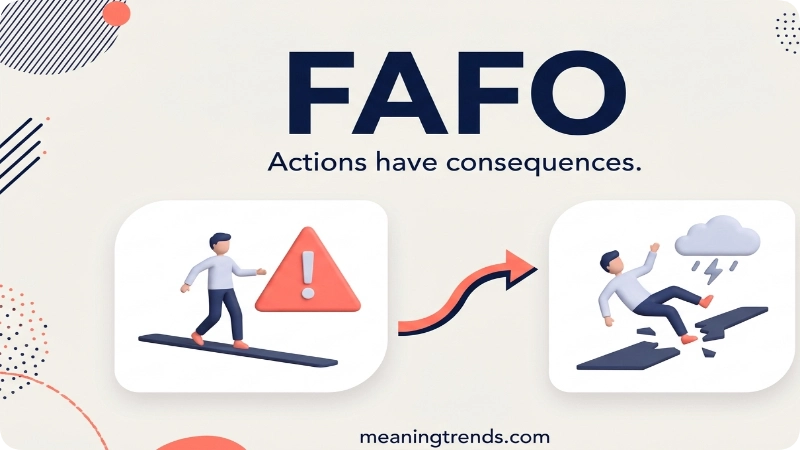
FAFO is an informal slang initialism that means “Fuck Around and Find Out.” Its underlying message is that actions have consequences, especially when someone knowingly pushes boundaries or disregards possible risks.
The phrase usually has two connected ideas:
- Taking a risk or pushing limits: Someone acts carelessly, challenges a warning, or does something likely to cause trouble.
- Facing the outcome: That person discovers what happens as a result of their behavior.
For example, imagine someone repeatedly parks in a clearly marked no parking zone despite receiving warnings. When their car gets towed, a friend might text, “Well, FAFO.”
The message suggests that the outcome was predictable.
However, FAFO doesn’t automatically mean that the sender is threatening someone. It can describe consequences that have already happened, warn about possible consequences, or make light of an embarrassing mistake.
A more neutral way to express the same basic idea is “Actions have consequences.”
What Does Each Letter in FAFO Stand For?
FAFO consists of four letters representing four words.
| Letter | Word |
| F | Fuck |
| A | Around |
| F | Find |
| O | Out |
The complete expression is “Fuck Around and Find Out.”
Although the first word is profanity, the expression isn’t always intended as a direct insult. In casual conversation, it can function as a sarcastic observation or a warning about consequences.
The phrase is also sometimes written as “FA & FO,” although FAFO is the more compact spelling.
Because it contains an explicit word when expanded, the abbreviation may still be inappropriate in professional or formal communication.
Why Do People Use FAFO in Text Messages?
People use FAFO because it communicates a larger idea in just four letters. Instead of explaining that someone made a questionable decision and experienced an unpleasant result, the sender can summarize the situation with a short, pointed expression.
Its conversational purposes include:
1. Warning someone about consequences
FAFO can suggest that a particular behavior is likely to create problems.
For example:
“Keep skipping those deadlines and you’ll FAFO.”
This is a warning that repeatedly missing deadlines may lead to consequences.
2. Reacting to a predictable outcome
Sometimes the consequences have already happened.
For example:
“He ignored the weather warning and got soaked. FAFO.”
The sender is pointing out that the result could have been anticipated.
3. Making a sarcastic joke
Friends might use FAFO to exaggerate the seriousness of a minor mistake.
For example:
“I put way too much hot sauce on my food. FAFO.”
Here, the expression is self directed humor rather than a threat.
4. Expressing disapproval
FAFO can also communicate that the sender believes someone acted irresponsibly and deserves criticism.
For example:
“They kept breaking the agreement, and now they’re surprised about the consequences. FAFO.”
The wording emphasizes personal responsibility, although it doesn’t establish If the sender’s judgment is fair.
How Does Context Change the Meaning of FAFO?
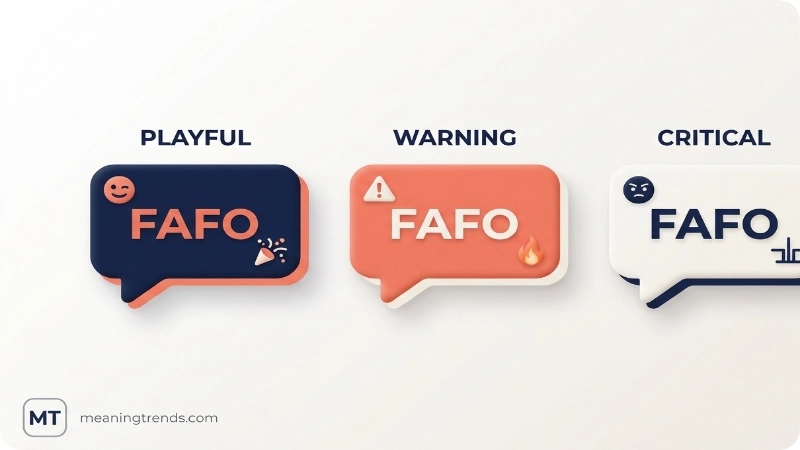
The definition remains broadly consistent, but the sender’s intention can change considerably.
A useful way to interpret FAFO is to examine what happened before the message, who sent it, and If the expression refers to a past event or a possible future action.
FAFO between friends
Among friends, FAFO can be playful, particularly when the situation involves an embarrassing but relatively harmless mistake.
Example:
“I tried that extra spicy sauce after everyone warned me. FAFO 😂”
The sender is laughing at their own decision.
FAFO during an argument
During a disagreement, FAFO may sound confrontational.
Example:
“Keep messing with my stuff. FAFO.”
Here, the expression is directed at another person and suggests consequences if the behavior continues. Depending on the surrounding messages, it may reasonably be interpreted as an intimidating warning.
Don’t assume the sender is joking simply because the phrase is slang.
FAFO after something goes wrong
When someone has already experienced an unpleasant outcome, FAFO often expresses an “I told you so” attitude.
Example:
“He didn’t back up his files, and now everything is gone. FAFO.”
This is commentary about a completed event rather than a warning directed at the reader.
FAFO in a meme or social media caption
FAFO can serve as a short punchline accompanying a video, image, or story about a decision that backfires.
For example, a caption reading “FAFO moment” may frame an incident as an example of someone discovering the consequences of their actions.
However, a caption alone doesn’t establish the full facts of an incident or If the outcome was deserved.
Examples of FAFO in Text Conversations
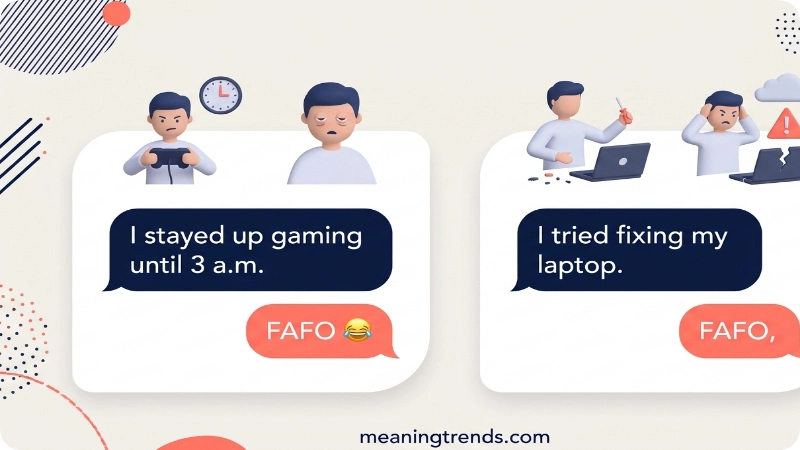
These fictional conversations illustrate how FAFO can work in everyday messaging.
Example 1: A playful mistake
Person A: “I stayed up gaming until 3 a.m. and now I can barely stay awake.”
Person B: “FAFO 😂”
Meaning: Person B is teasing their friend about the predictable result of staying up late.
Example 2: A serious warning
Person A: “I’m thinking about ignoring the safety instructions.”
Person B: “Don’t. That’s how you FAFO.”
Meaning: Person B is warning against risky behavior.
Example 3: Consequences at work
Person A: “He kept missing important meetings, and now he’s on a performance plan.”
Person B: “FAFO.”
Meaning: Person B believes the outcome followed from repeated behavior.
Example 4: Self directed humor
Person A: “I tried fixing my laptop without reading the instructions. Now it won’t turn on. FAFO.”
Meaning: Person A is acknowledging their own questionable decision with humor.
Example 5: An uncomfortable message
Person A: “I don’t want to argue about this anymore.”
Person B: “Then stop pushing me. FAFO.”
Meaning: Person B’s response may sound threatening. The surrounding conflict and any specific threats matter more than the abbreviation itself.
These examples show why a single definition cannot tell you exactly what someone intends.
Is FAFO Rude, Offensive, or Threatening?
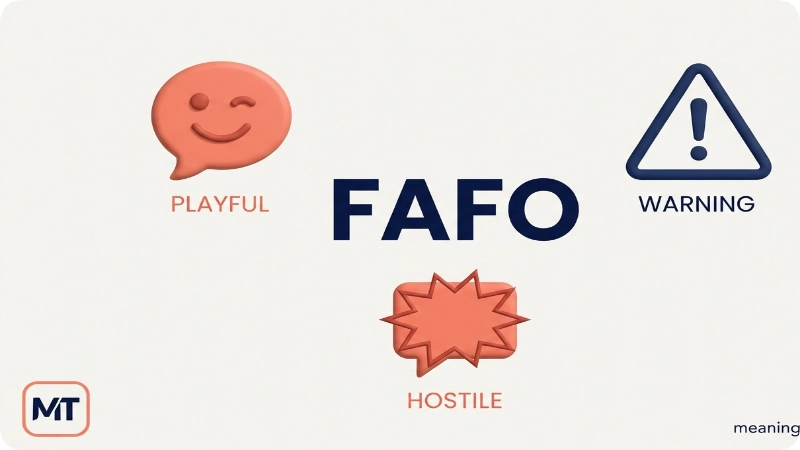
FAFO can be rude because its full form contains strong profanity. It also carries a confrontational edge, even when the explicit word is hidden behind an abbreviation.
If it is offensive or threatening depends on how it’s used.
| Situation | Possible tone |
| Friends discussing a silly mistake | Playful or sarcastic |
| Someone commenting on a rule violation | Critical or disapproving |
| A person warning against risky behavior | Cautionary or blunt |
| Someone saying “FAFO” during an argument | Hostile or potentially threatening |
| A person describing their own mistake | Self deprecating humor |
FAFO isn’t inherently flirty or romantic. If it appears in a playful conversation between romantic partners, the relationship and surrounding messages may make it teasing, but the abbreviation itself doesn’t indicate attraction.
Likewise, capitalization alone doesn’t prove anger. Someone might type “FAFO” simply because that’s how initialisms are normally written.
If the message is directed at you and includes specific threats, intimidation, or references to harm, take those details seriously rather than treating the expression as harmless internet slang.
How Do You Reply When Someone Texts FAFO?
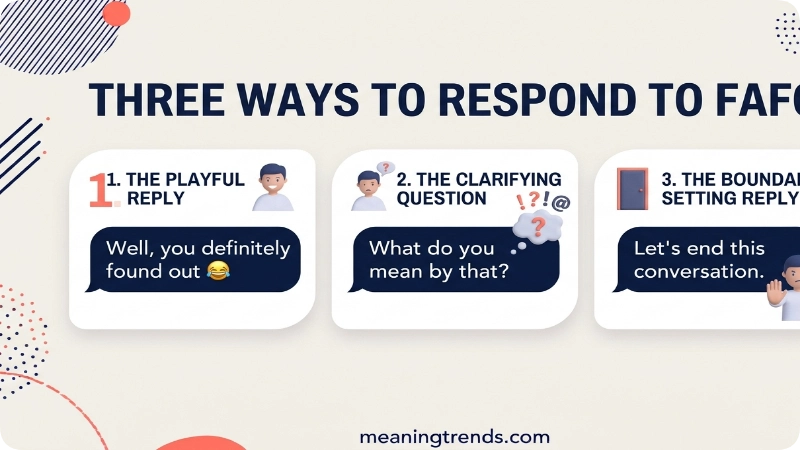
The best response depends on If the message is funny, confusing, cautionary, or hostile.
Here are a few natural options.
| Situation | Possible reply |
| A friend jokes about their own mistake | “Well, you definitely found out 😂” |
| Someone comments on predictable consequences | “Yeah, that was bound to happen.” |
| You don’t understand the reference | “Wait, what happened?” |
| You’re unsure If it’s a warning | “What do you mean by that?” |
| Someone uses it aggressively | “I’m not comfortable with threats. Let’s end this conversation.” |
You don’t have to respond with the same slang.
If someone uses FAFO in a way that feels intimidating, you can choose not to engage. A short boundary setting response, or no response, may be more appropriate than escalating the exchange.
When Should You Use or Avoid FAFO?
FAFO works best in informal situations where the audience understands the expression and the tone is clear.
It may fit casual messages between friends, humorous captions, or lighthearted commentary about your own decisions.
However, it is usually better to avoid FAFO in:
- Professional emails or workplace announcements.
- Academic assignments or formal presentations.
- Customer support conversations.
- Sensitive discussions about accidents, injuries, or serious personal difficulties.
- Disagreements where the wording might be interpreted as a threat.
Even among friends, the expression can seem unnecessarily harsh when the consequences are serious.
For instance, joking “FAFO” about someone losing an important opportunity may sound dismissive rather than funny.
A useful rule is to consider If the person receiving the message will understand both the words and your intended tone.
What Are Other Ways to Say FAFO?
If you want to express the same general idea without profanity, several alternatives work well.
| Alternative | Typical use |
| Actions have consequences. | Neutral explanation |
| You knew the risks. | Direct but less vulgar |
| You reap what you sow. | Emphasizing consequences of behavior |
| Play with fire and you’ll get burned. | Warning about dangerous choices |
| That’s what happens when you take that risk. | Explaining a predictable outcome |
| Learn the hard way. | Describing experience through consequences |
These alternatives aren’t interchangeable in every sentence.
“Actions have consequences” is relatively neutral, while “You reap what you sow” can sound judgmental. “Play with fire and you’ll get burned” works particularly well as a warning before something goes wrong.
If you want to communicate a concern without sounding confrontational, a specific sentence is often clearer.
For example, instead of texting “FAFO” to someone who is ignoring instructions, you could write, “Please follow the instructions so nothing gets damaged.”
How Is FAFO Different From Similar Expressions?
FAFO overlaps with several familiar phrases, but each emphasizes something slightly different.
| Expression | Meaning | Typical use | Key distinction |
| FAFO | Risky actions may bring consequences | Warnings, criticism, humor | Blunt and often confrontational |
| YOLO | You only live once | Encouraging an experience or risk | Focuses on taking opportunities |
| I told you so | My earlier warning was correct | Reacting after an outcome | Emphasizes a previous warning |
| Play stupid games, win stupid prizes | Poor choices produce unpleasant results | Sarcastic criticism | Explicitly judges the choice |
| Actions have consequences | Behavior can produce results | General explanations or warnings | More neutral and formal |
The main difference between FAFO and YOLO is particularly useful.
YOLO can encourage someone to take a chance, while FAFO emphasizes what may happen when a chance goes badly.
They can even describe different stages of the same situation: someone takes a risk with a “YOLO” attitude and later describes the consequences as a “FAFO moment.”
Where Did FAFO Come From?
FAFO is an abbreviation of the longer English expression “fuck around and find out.”
The phrase existed in spoken and informal language before its abbreviated form became familiar in online communication. Its wording connects provocative or careless behavior with discovering the resulting consequences.
Merriam Webster recognizes FAFO as slang associated with that expression.
However, the abbreviation’s precise first use, original creator, and single point of origin are not firmly established here. It would be misleading to attribute the expression to one particular person, community, or social media platform without stronger historical evidence.
Today, the abbreviation can appear in texts, online discussions, memes, and captions. The basic meaning remains recognizable across these settings, while the speaker’s tone and purpose depend on context.
FAQs About FAFO Meaning in Text
Does FAFO always mean “Fuck Around and Find Out”?
That is its established slang expansion. An unusual conversation or specialized setting could use the same letters differently, but don’t assume an alternate meaning without clear supporting context.
What does FAFO mean when a guy texts it?
The meaning doesn’t change based on the sender’s gender. It can be a joke, warning, or comment about consequences. Look at the surrounding conversation rather than assuming a particular intention.
What does FAFO mean when a girl texts it?
It has the same basic meaning regardless of who sends it. The sender’s words, relationship with the recipient, and situation help determine If the tone is playful, critical, or serious.
Is FAFO a bad word?
FAFO contains an abbreviation of a strong swear word. Although the four letter form may appear less explicit, it can still sound vulgar or aggressive.
What does “FAFO moment” mean?
A “FAFO moment” describes a situation where someone experiences the consequences of a risky, careless, or provocative decision. The phrase often appears in humorous or sarcastic commentary.
Does FAFO mean someone is threatening me?
Not necessarily. FAFO can describe past consequences or function as a joke. However, when directed at someone during a conflict, especially alongside intimidating language, it may reasonably be interpreted as a threat.
Can FAFO be used as a joke?
Yes. Someone might use it while laughing about a harmless mistake, such as eating food that was much spicier than expected. The joke works because the person knowingly took a risk and experienced the result.
Conclusion
FAFO means “Fuck Around and Find Out,” a blunt expression connecting someone’s behavior with the consequences that follow. In texting, it can serve as a warning, sarcastic reaction, criticism, or joke. The most important distinction is If the sender is describing something that already happened or suggesting what might happen next.
When you encounter FAFO, read the messages around it before deciding how to respond. If a friend is joking about a harmless mistake, a playful reply may be appropriate. If someone uses the expression during an argument, asking “What do you mean by that?” can help clarify their intention, provided you feel comfortable continuing the conversation.
The abbreviation is useful to recognize, but it isn’t always suitable to use. When clarity, respect, or professionalism matters, plain language usually communicates the message better.

Alex writes about the words and shortcuts people use in texts, group chats, and social media. Each guide explains the meaning with everyday examples and tips on when to use it