QUICK ANSWER
IDM in text usually means “I Don’t Mind.” It’s an informal texting abbreviation people use to show they have no strong preference, are comfortable with a suggestion, or are happy to let someone else decide. For example, if someone asks, “Pizza or burgers?” and you reply “IDM,” you’re saying either option is fine.
When you receive IDM in a message, the surrounding conversation helps you understand the sender is expressing flexibility, acceptance, or simple indifference.
A short abbreviation can communicate quite a bit in a conversation. Imagine asking a friend where they want to eat, which movie they prefer, or you’re allowed to change a plan. Instead of writing a complete sentence, they might simply respond with “IDM.”
That response can be perfectly friendly, but it doesn’t necessarily mean they’re excited about your suggestion. They may simply have no particular preference.
Understanding the difference between being comfortable with something and being enthusiastic about it is useful when interpreting short messages. The same three letters can also have specialized meanings outside everyday texting, so the subject of the conversation matters.
What Does IDM Mean?
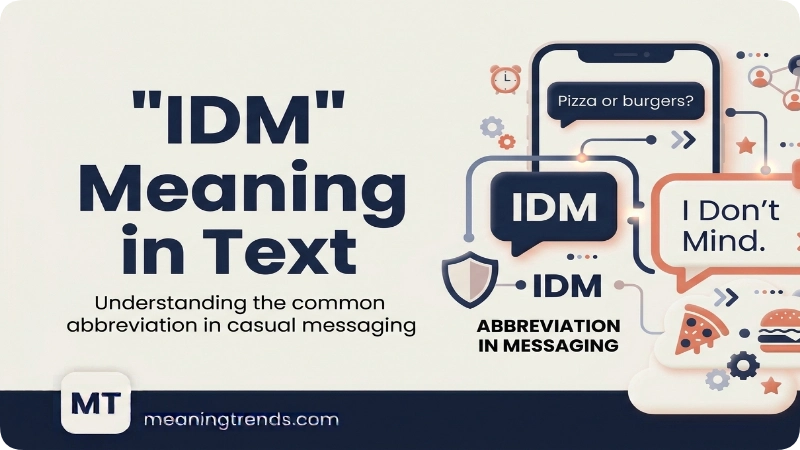
In everyday texting and online conversations, IDM is an initialism for “I Don’t Mind.” It communicates that something is acceptable to the sender or that they don’t have a strong preference about a particular choice.
People use it when discussing plans, activities, invitations, decisions, or small everyday questions.
Depending on the sentence, IDM can communicate:
- No strong preference: Either option works for me.
- Acceptance: I’m okay with that.
- Flexibility: You can make the decision.
- No objection: That doesn’t bother me.
- Willingness: I’m comfortable going along with the suggestion.
For example:
A: “Would you rather meet on Friday or Saturday?”
B: “IDM.”
is saying that either day is acceptable.
The abbreviation doesn’t necessarily communicate excitement or strong agreement. It simply indicates that the person doesn’t object to the options being discussed.
What Does Each Letter Stand For?
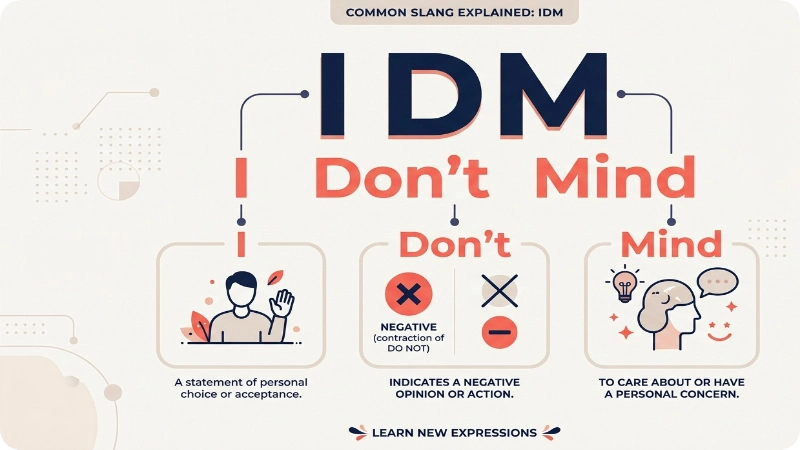
IDM represents the first letters of three words:
| Letter | Word |
| I | I |
| D | Don’t |
| M | Mind |
Together, they form “I Don’t Mind.”
IDM is technically an initialism because its letters are read individually rather than pronounced as one word.
Unlike abbreviations that shorten a single word, IDM represents an entire expression. Writing the complete phrase can make the message clearer, particularly when the conversation involves an important decision.
Why Do People Use IDM in Text Messages?
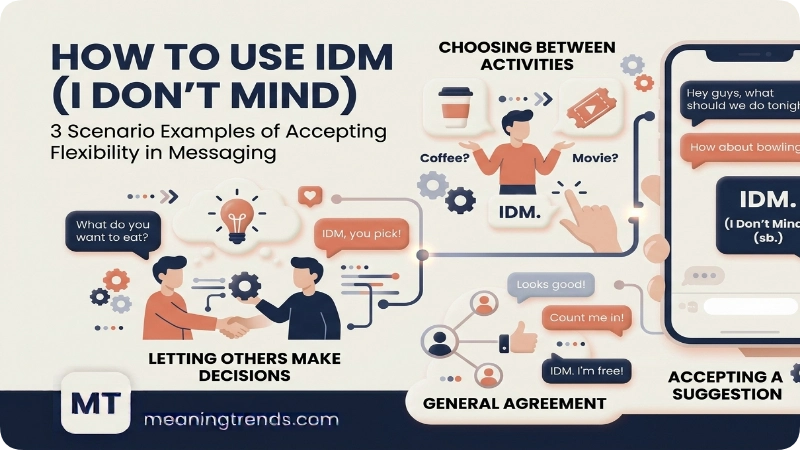
People use IDM because it offers a quick way to express flexibility without typing a complete sentence.
Instead of writing, “I don’t have a preference, so you can choose,” someone can simply respond with IDM.
There are several conversational purposes behind this expression.
1. To avoid unnecessary decision-making
When someone genuinely doesn’t care which of two acceptable options is selected, IDM lets the other person decide.
Example:
Person A: “Should we watch a comedy or an action movie?”
Person B: “IDM, you pick.”
2. To show acceptance
IDM can communicate that a suggestion or arrangement is acceptable.
Example:
Person A: “I’ll send you the details tonight.”
Person B: “IDM.”
Here, the response indicates that the proposed arrangement is fine.
3. To keep conversations relaxed
In casual conversations, typing a three-letter abbreviation can feel more natural than writing a complete sentence.
4. To avoid unnecessary disagreement
Sometimes people have no strong opinion about a particular choice. IDM communicates that they are comfortable with the other person’s preference.
However, it shouldn’t automatically be interpreted as agreement with every detail of a proposal. Someone may be comfortable with one part of a plan but still have questions about another.
How Does Context Change the Meaning of IDM?
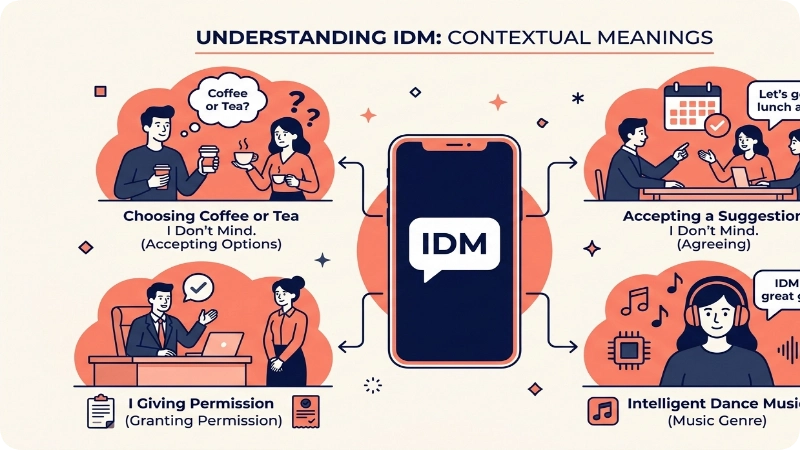
Although IDM generally means “I Don’t Mind” in ordinary texting, its conversational meaning depends on what the sender is responding to.
The most useful clues are the previous message, the subject being discussed, the relationship between the people, and the sender adds any explanation.
When Someone Asks You to Choose
This is a straightforward situation for IDM.
Person A: “Do you want coffee or tea?”
Person B: “IDM.”
Interpretation: Person B has no strong preference and is comfortable with either drink.
When Someone Makes a Suggestion
IDM can indicate that the sender doesn’t object to an idea.
Person A: “We could meet a little earlier tomorrow.”
Person B: “Yeah, IDM.”
Interpretation: Person B is comfortable with the suggested change.
When Someone Asks for Permission
IDM can also communicate that an action is acceptable.
Person A: “Do you mind if I share this picture?”
Person B: “IDM.”
Interpretation: Person B is indicating that they don’t object to sharing the picture.
For personal information or photographs, however, it’s better to make sure the intended permission is clear rather than relying on an ambiguous abbreviation.
When Someone Sends Only IDM
A standalone response requires a little more attention.
Person A: “Where should we go tonight?”
Person B: “IDM.”
Interpretation: Person B probably has no particular preference and is leaving the decision to Person A.
However, a very short response can sometimes feel less engaged than a fuller answer. That doesn’t prove the sender is annoyed or uninterested.
When the Conversation Is About Music or Technology
The texting meaning shouldn’t automatically be applied to every occurrence of IDM.
For example, in a discussion about electronic music, IDM can refer to Intelligent Dance Music. In a technology discussion, it may refer to identity management or Internet Download Manager.
The subject matter provides a stronger clue than the letters alone.
Examples of IDM in Conversation
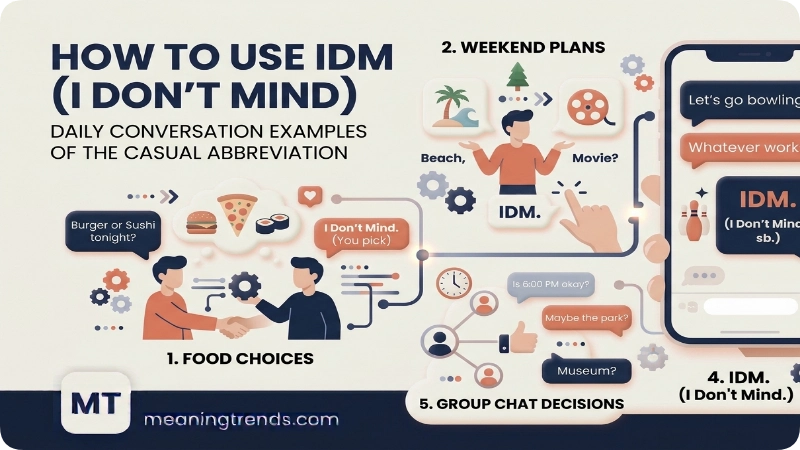
Seeing IDM in realistic conversations makes it easier to recognize how the abbreviation works.
The following examples are illustrative, showing possible uses rather than reporting actual conversations.
Example 1: Choosing Food
Person A: “Should we order pizza or Chinese food?”
Person B: “IDM, whatever you prefer.”
Meaning: Person B is comfortable with either option and lets Person A choose.
Example 2: Making Weekend Plans
Person A: “Are you free to hang out on Sunday instead?”
Person B: “Yeah, IDM.”
Meaning: Person B doesn’t object to changing the plan to Sunday.
Example 3: Choosing a Meeting Time
Person A: “Would 4 PM work, or should we make it 5?”
Person B: “IDM, both are fine.”
Meaning: Either time is acceptable.
Example 4: Asking About an Activity
Person A: “Do you want to play a game or watch a movie?”
Person B: “IDM. You decide.”
Meaning: Person B doesn’t have a strong preference about the activity.
Example 5: Discussing a Small Change
Person A: “I’ll bring my brother along if that’s okay.”
Person B: “IDM.”
Meaning: Person B is indicating that they don’t object to the suggestion.
Example 6: A Casual Group Chat
“Everyone, should we meet at the park or the café?”
Person B: “IDM.”
Café sounds good!”
Meaning: Person B leaves the choice open, while Person C expresses a specific preference.
These examples show an important distinction: IDM communicates that something is acceptable, not necessarily that it’s the sender’s favorite choice.
Is IDM Rude, Flirty, or Offensive?
IDM is generally a neutral, informal expression. It isn’t inherently rude, flirty, or offensive. However, the way it feels can depend on the conversation and the relationship between the people communicating.
Can IDM Sound Rude?
Usually, no. When someone uses IDM to show that they have no preference, it’s a straightforward response.
However, a one-word reply might occasionally sound dismissive if the other person expects a thoughtful answer.
For example:
Person A: “I’ve been planning something special for us. Would you prefer Saturday?”
Person B: “IDM.”
Person B may simply be flexible, but the short response could feel less enthusiastic than expected.
A warmer alternative would be:
“Saturday sounds good to me!”
Does IDM Mean Someone Is Flirting?
No. IDM doesn’t have an established romantic meaning in ordinary texting.
Someone might use it while talking to a romantic interest, but the abbreviation itself doesn’t demonstrate attraction.
For example:
Person A: “Would you like to get coffee with me?”
Person B: “IDM.”
This could mean Person B is comfortable with the invitation. It doesn’t establish they’re romantically interested.
Look at the broader conversation rather than treating one abbreviation as evidence of someone’s feelings.
Can IDM Sound Indifferent?
Yes, depending on how it’s used.
Consider these two responses:
- “IDM, whatever works for you!” — May sound relaxed and accommodating.
- “idm.” — May sound neutral or somewhat detached, depending on the conversation.
The second response doesn’t prove annoyance. Some people naturally prefer short messages.
Capitalization, punctuation, and emojis can influence how a message feels, but none of them independently establishes the sender’s intention.
How Do You Reply to IDM?
Your response depends on what the other person is communicating and you need them to make a decision.
Here are some natural replies.
| Situation | Possible Reply |
| They have no preference | “Okay, I’ll choose!” |
| You’re making plans | “Let’s go with Saturday, then.” |
| They accept your suggestion | “Great, sounds good!” |
| You want their opinion | “Are you sure? I’d like to know what you prefer.” |
| You’re discussing two options | “I’ll pick the one I think we’ll both enjoy.” |
| Their response is unclear | “Do you mean either option works?” |
You don’t need to overthink a simple IDM response. If the conversation is about something unimportant, making the decision yourself is often perfectly reasonable.
If the decision matters, asking a follow-up question can prevent misunderstandings.
When Should You Use or Avoid IDM?
IDM works best in informal conversations where both people understand texting abbreviations.
Good situations to use IDM include:
- Texting friends and family.
- Discussing weekend plans.
- Choosing between food or entertainment options.
- Responding to casual invitations.
- Participating in informal group chats.
- Communicating with people who regularly use texting shorthand.
Situations where you should avoid it include:
- Formal business emails.
- Academic assignments.
- Official applications or documents.
- Important professional discussions.
- Conversations where your exact preference or permission needs to be clear.
For example, instead of writing:
“IDM which date you choose.”
You could write:
“I don’t have a preference. Please choose whichever date works best.”
The complete expression is clearer and more appropriate when the conversation requires a professional tone.
What Are Other Ways to Say IDM?
If you want to communicate the same idea without using an abbreviation, several natural alternatives are available.
| Alternative | Meaning or Purpose |
| Either is fine | Both choices are acceptable. |
| I don’t mind | The original complete expression. |
| Whatever works for you | The other person can decide. |
| I’m okay with that | You accept the suggestion. |
| I have no preference | You don’t favor one option. |
| It’s up to you | You’re leaving the decision to someone else. |
| That works for me | You agree that the arrangement is acceptable. |
These expressions aren’t perfect substitutes in every situation.
For example, “That works for me” communicates acceptance of a specific arrangement, while “I have no preference” emphasizes that you don’t favor one option.
Choosing the right alternative helps make your message sound more natural.
How Is IDM Different From IDK and IDC?
IDM, IDK, and IDC look similar, but they communicate different things. Confusing them can change the meaning of an entire message.
| Expression | Meaning | Typical use | Key distinction |
| IDM | I Don’t Mind | Showing flexibility | No strong preference or objection |
| IDK | I Don’t Know | Expressing uncertainty | The person lacks an answer |
| IDC | I Don’t Care | Expressing indifference | The person says they don’t care about the matter |
IDM vs. IDK
IDM means “I Don’t Mind,” while IDK means “I Don’t Know.”
Example:
Person A: “Do you want tea or coffee?”
Person B: “IDM.”
This means either drink is fine.
But if Person A asks, “Where did I leave my phone?” and Person B replies “IDK,” it means they don’t know the answer.
IDM vs. IDC
IDM means “I Don’t Mind,” whereas IDC means “I Don’t Care.”
Although these expressions can overlap in some situations, they don’t communicate exactly the same attitude.
For example:
Person A: “Where should we eat?”
Person B: “IDM.”
This suggests that the person is comfortable with either choice.
Compare that with:
Person A: “Where should we eat?”
Person B: “IDC.”
Depending on the relationship and tone, the second response may sound more indifferent or dismissive.
The main distinction: IDM usually communicates acceptance or flexibility, while IDC can communicate a lack of interest or concern.
What Else Can IDM Mean?
Although “I Don’t Mind” is the relevant interpretation in ordinary texting, IDM has other documented uses outside casual conversations.
The meaning depends on the subject being discussed.
| Meaning | Context |
| I Don’t Mind | Texting and online conversations |
| Intelligent Dance Music | Electronic music discussions |
| Identity Management | Information technology |
| Internet Download Manager | Download-management software |
These are not alternative interpretations that should automatically be applied to personal messages.
For example:
- “Do you want to come with us? IDM.” — The texting expression.
- “I enjoy listening to IDM.” — A music-related use.
- “The organization is reviewing its identity management system.” — A technology-related use.
Capitalization alone doesn’t reliably distinguish these meanings. The surrounding words and topic are more useful clues.
The texting use of IDM as “I Don’t Mind” is recorded in Wiktionary. Michael Swan’s Practical English Usage also includes “idm” as a text-message abbreviation for “I don’t mind.” These references support the texting interpretation without suggesting that it applies to every specialized use of the letters.
FAQs
1. What does IDM mean from a girl?
IDM generally means “I Don’t Mind” regardless of who sends it. A female sender isn’t using a different established definition simply because of her gender. The conversation determines what she is responding to.
2. What does IDM mean from a guy?
It generally means “I Don’t Mind.” can indicate that he’s comfortable with a suggestion or doesn’t have a strong preference. doesn’t automatically indicate romantic interest or disinterest.
3. Does IDM mean yes?
Not exactly. IDM usually means that something is acceptable or that the sender has no objection. It can function like a yes in some situations, but it doesn’t always communicate enthusiastic agreement.
4. Does IDM mean I don’t care?
Not precisely. IDM means “I Don’t Mind,” which generally communicates flexibility or acceptance. IDC means “I Don’t Care,” which can sound more indifferent.
5. Is IDM an acronym or an abbreviation?
IDM is an initialism because each letter represents the first letter of a word in “I Don’t Mind.” It’s also commonly described more generally as a texting abbreviation.
6. What does lowercase idm mean?
Lowercase idm generally has the same meaning as uppercase IDM: “I Don’t Mind.” Capitalization usually doesn’t change the interpretation in casual texting.
7. What does IDM mean on social media?
In ordinary social-media messages and direct conversations, IDM usually means “I Don’t Mind.” If the discussion involves music or technology, a specialized meaning may be more appropriate.
8. Can I use IDM in professional messages?
You can use it in relaxed workplace chats when the other person understands the abbreviation. For formal emails and important discussions, writing “I don’t have a preference” or “Either option works for me” is clearer.
Conclusion
IDM usually means “I Don’t Mind” in everyday text messages. It’s an informal initialism people use to communicate that they have no strong preference, accept a suggestion, or are comfortable letting someone else make a decision. It’s particularly useful when discussing plans, invitations, activities, and everyday choices.
The most important thing to remember is that acceptance doesn’t always mean enthusiasm. Someone replying with IDM may genuinely be happy with either option, but a short response alone doesn’t reveal their feelings or intentions. The surrounding conversation provides the best clues.
If you receive IDM and aren’t sure what the sender means, consider the question they were answering. You can also ask, “Do you mean either option is fine?” when clarification matters.
For everyday texting, IDM is a simple and convenient expression. For professional or important conversations, writing the complete phrase usually communicates your meaning more clearly.

Alex writes about the words and shortcuts people use in texts, group chats, and social media. Each guide explains the meaning with everyday examples and tips on when to use it