DW usually means “don’t worry” in text messages. It’s a casual abbreviation people use to reassure someone, tell them something is okay, or suggest that a problem isn’t serious. For example, if someone texts “dw, it’s fine,” they’re saying “don’t worry, it’s fine.”
You might see “dw” after apologizing for a mistake, asking someone for a favor, or expressing concern about a situation. Sometimes it feels warm and reassuring. Other times, a short reply like “dw” may seem a little dismissive, depending on the conversation.
The important thing is to read the abbreviation alongside the rest of the message. A friendly “dw, I got you!” can feel very different from a standalone “dw” during a serious discussion.
Understanding the wording, situation, and relationship between the people texting helps you interpret what the sender is communicating without making assumptions about their feelings.
What Does DW Mean in Text?
In everyday texting, DW stands for “don’t worry.” It’s an informal way of telling someone not to stress about something.
The abbreviation can serve several conversational purposes:
- Reassurance: Letting someone know that everything is okay.
- Forgiveness: Indicating that a small mistake isn’t a big deal.
- Comfort: Trying to help someone feel less anxious.
- Casual acknowledgment: Suggesting that a concern doesn’t require further attention.
For example:
Person A: “Sorry I’m running five minutes late.”
Person B: “dw, take your time!”
Here, Person B is reassuring Person A that the delay isn’t a problem.
DW is an initialism formed from the first letters of “don’t” and “worry.” People generally read it as the full phrase rather than saying the letters aloud.
Both “dw” and “DW” can communicate the same thing. Capitalization alone doesn’t reliably indicate a different meaning or emotional tone.
Why Do People Use DW in Text Messages?
People use DW because it’s a quick, convenient way to communicate reassurance without typing a longer sentence.
1. To reassure someone
If a friend is concerned about a situation, DW can make a response feel relaxed.
Example:
Person A: “I hope I didn’t mess up our plans.”
Person B: “dw, we can figure it out.”
The response suggests that the problem is manageable.
2. To accept an apology
DW can also indicate that someone doesn’t need to keep apologizing.
Example:
Person A: “I’m sorry I forgot to call yesterday.”
Person B: “dw about it!”
The reply suggests that the sender is willing to move past the mistake.
However, the words alone don’t establish If the person has completely resolved their feelings about what happened.
3. To reduce pressure
Sometimes DW is used when someone is worried about completing a task or meeting an expectation.
Example:
Person A: “I don’t think I can finish this tonight.”
Person B: “dw, tomorrow works too.”
The sender is making it clear that there’s flexibility.
4. To keep a conversation casual
In a relaxed conversation, DW can replace longer expressions such as “No problem” or “It’s all good.”
Example:
Person A: “Thanks for waiting!”
Person B: “dw!”
This is a brief acknowledgment that the wait wasn’t a major concern.
What Else Can DW Mean?
Although “don’t worry” is a familiar texting meaning, DW can represent other expressions in different contexts.
| DW meaning | Context | Example |
| Don’t worry | Casual texts and online conversations | “dw, everything’s okay” |
| Dear wife | Personal writing, family discussions, and some online forums | “DW and I are traveling tomorrow” |
| Dishwasher | Household notes, appliance discussions, and some technical shorthand | “The DW needs repairing” |
These meanings aren’t interchangeable.
If someone writes “DW and I went shopping,” the sentence points toward “dear wife,” not “don’t worry.”
If someone writes “dw, I’ll handle it,” the natural interpretation is “don’t worry.”
The topic and grammar usually provide stronger clues than the abbreviation itself.
How Does Context Change the Meaning of DW?
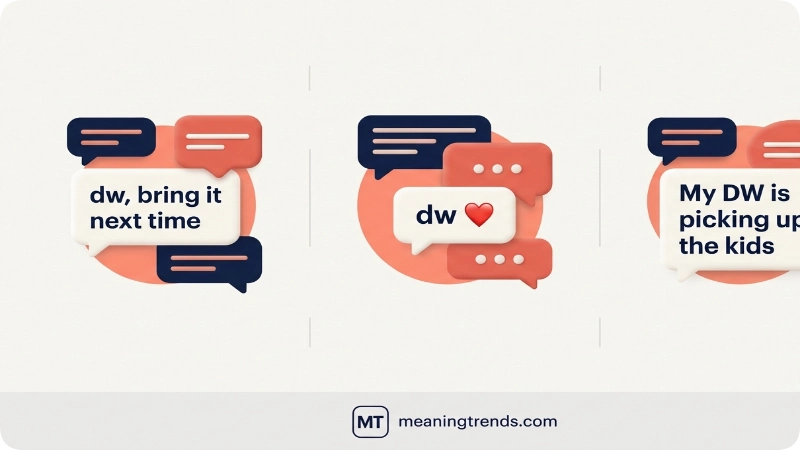
Understanding what DW stands for is only part of interpreting a message. You also need to consider what the sender is responding to and how the conversation is progressing.
When a friend sends DW
Among friends, DW can be a simple, supportive response.
Example:
You: “I forgot to bring your book today.”
Friend: “dw, bring it next time.”
The response suggests that your friend isn’t making an issue of the delay.
When someone you like sends DW
If a crush or romantic partner texts DW, it doesn’t automatically indicate attraction, annoyance, or emotional distance.
Example:
You: “Sorry I couldn’t reply earlier.”
Them: “dw ❤️”
The heart emoji may add warmth to the message, but it doesn’t establish the sender’s romantic intentions on its own.
Look at the broader interaction rather than treating two letters as a relationship signal.
When DW appears in a serious conversation
In a sensitive discussion, DW may be intended as reassurance but could also feel insufficient.
Example:
Person A: “I’m really concerned about what happened yesterday.”
Person B: “dw.”
The short reply doesn’t explain If the sender understands the concern or plans to address it.
A response such as “I understand why you’re worried, and I’ll explain what happened” would communicate more clearly.
When DW appears in a family or household discussion
Context can change the expansion entirely.
Example:
“My DW is picking up the kids.”
Here, “dear wife” fits the sentence, while “don’t worry” doesn’t.
The surrounding words help distinguish between these uses.
Examples of DW in Text Conversations
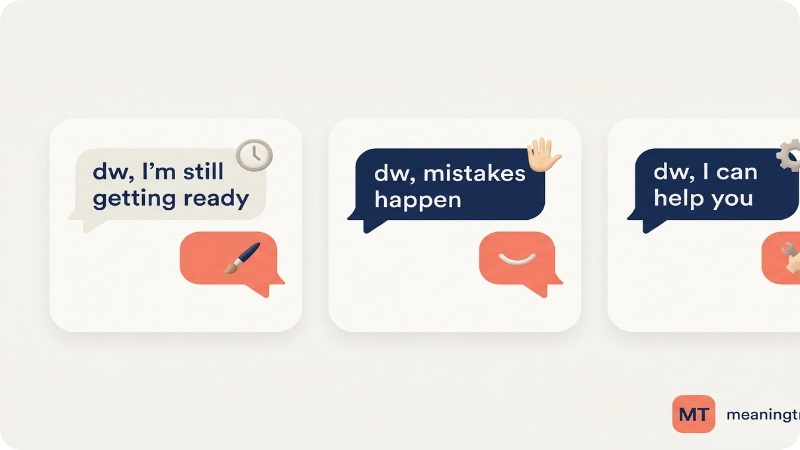
The following illustrative conversations show how DW can function in different situations.
| Situation | Text message | Likely interpretation |
| Running late | “dw, I’m still getting ready” | There’s no need to rush |
| Making a mistake | “dw, mistakes happen” | The sender is offering reassurance |
| Asking for help | “dw, I can help you” | The sender is willing to assist |
| Changing plans | “dw, we can go another day” | Rescheduling is acceptable |
| Apologizing | “dw about it!” | The sender is accepting the apology |
| Expressing concern | “dw, I’ll be careful” | The sender is trying to reduce concern |
Notice that DW doesn’t always mean the situation is objectively harmless. It communicates what the sender wants to express about the concern.
Someone can say “don’t worry” while a problem still needs attention.
Is DW Rude, Friendly, or Flirty?
DW isn’t inherently rude or flirty. Its tone depends on the words around it, the situation, and how the people involved normally communicate.
When DW sounds friendly
A message such as “dw, you’re good!” can sound warm and understanding.
Adding a helpful explanation or an encouraging phrase often makes the intended reassurance clearer.
When DW might sound dismissive
A standalone “dw” can sometimes feel abrupt, especially when someone has raised a serious concern.
For example:
Person A: “I’m worried because you haven’t told me what’s going on.”
Person B: “dw.”
The response might be intended to calm Person A, but it doesn’t directly address the question.
That doesn’t prove the sender is being dismissive. It simply leaves more room for interpretation.
When DW might feel flirty
DW can appear in playful or affectionate exchanges.
For example:
“dw, I’ll save you a seat 😉”
The wink may make the message feel playful, but the abbreviation itself doesn’t mean flirting.
The sender’s broader behavior matters more than any single abbreviation or emoji.
How Do You Reply to DW in Text?
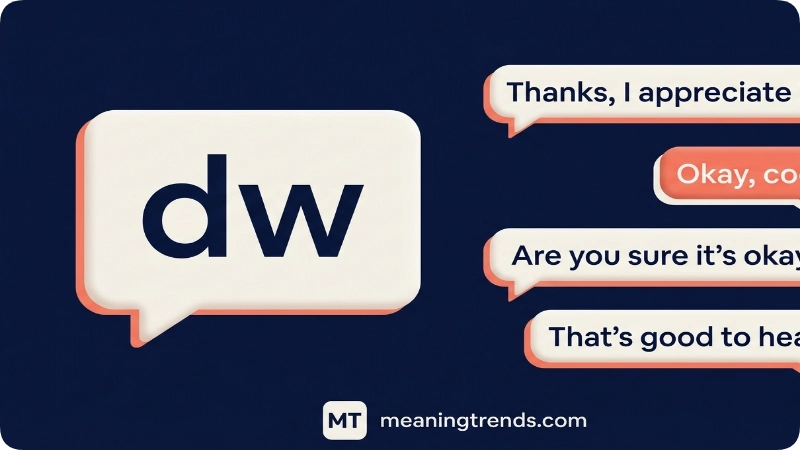
Your response should match the situation. In many cases, a simple acknowledgment is enough.
Here are some natural replies:
| If you want to… | You can reply… |
| Say thanks | “Thanks, I appreciate it!” |
| Keep it casual | “Okay, cool!” |
| Show relief | “That’s good to hear.” |
| Be playful | “Okay okay, I’ll stop stressing 😂” |
| Ask for clarification | “Are you sure it’s okay?” |
| Continue a serious discussion | “I understand, but I’d still like to talk about it.” |
You don’t always need to reply. If DW closes a minor exchange, leaving the conversation there may be perfectly natural.
But when the original concern is important, you can ask a follow up instead of assuming that “don’t worry” resolves everything.
When Should You Use or Avoid DW?
DW works best in casual communication where the meaning is clear and a relaxed tone is appropriate.
It’s suitable for friendly text messages, informal group chats, and quick exchanges about minor inconveniences.
For example:
“dw, I’ll send it later.”
This is concise and natural in a casual conversation.
However, DW may be less appropriate in professional or sensitive communication.
If a customer is concerned about an unresolved issue, replying only “dw” may not provide enough information.
A clearer response would be:
“Please don’t worry. I’ll review the issue and update you tomorrow.”
Similarly, if someone is discussing an important personal concern, using the full phrase alongside a thoughtful explanation can communicate greater care.
The goal isn’t to avoid abbreviations entirely. It’s to choose wording that fits the seriousness of the situation and the relationship.
What Are Other Ways to Say DW?
Several expressions can communicate a similar idea, although their exact tone and meaning vary.
- No worries: Casual reassurance or acceptance of an apology.
- No problem: Indicates that something isn’t an inconvenience.
- It’s okay: Reassures someone or accepts a minor mistake.
- You’re good: Informally tells someone that there’s no issue.
- All good: Suggests that the situation is fine.
- Don’t stress: Encourages someone not to become overly concerned.
- There’s no need to worry: A fuller, more formal alternative.
For example, “dw about being late” can be rewritten as “No worries about being late.”
In a professional message, “There’s no need to worry about the schedule change” may be easier to understand than “dw about the schedule.”
These alternatives aren’t always exact substitutes. Choose the one that accurately reflects what you mean.
How Is DW Different From NP, NVM, and IDC?
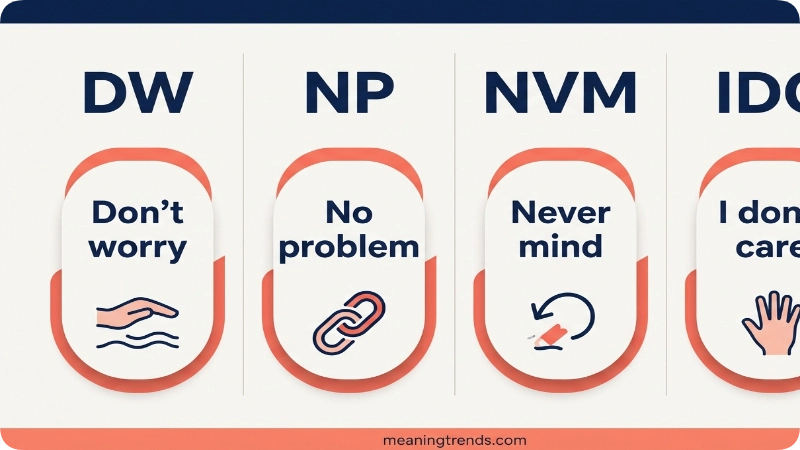
DW can be confused with other short texting expressions because they may appear in similar conversations.
| Expression | Meaning | Typical use | Key distinction |
| DW | Don’t worry | Reassuring someone | Addresses a concern |
| NP | No problem | Accepting thanks or an apology | Emphasizes that something isn’t inconvenient |
| NVM | Never mind | Withdrawing or dropping a point | Suggests the topic needn’t continue |
| IDC | I don’t care | Expressing indifference | May sound less reassuring |
Consider these examples:
“dw, I can fix it” reassures the other person.
“np, I can fix it” emphasizes that helping isn’t a problem.
“nvm, I fixed it” suggests that the earlier issue no longer needs attention.
“idc which one we choose” expresses a lack of preference.
Although these abbreviations may occasionally appear in similar situations, they communicate different attitudes.
Does DW Mean the Same Thing on Every Platform?
When DW is used to mean “don’t worry,” its basic meaning doesn’t depend on a particular messaging app.
You might encounter it in SMS messages, WhatsApp conversations, Instagram messages, Snapchat chats, Discord discussions, or TikTok comments.
The platform alone doesn’t establish what DW means.
For instance, “dw, I got this” naturally reads as “don’t worry, I got this” regardless of where the message appears.
In a household discussion, “DW” could still mean “dishwasher.” In a personal forum post, it could mean “dear wife.”
Rather than memorizing a separate definition for every platform, pay attention to the subject of the conversation and how the abbreviation fits into the sentence.
FAQs About DW Meaning in Text
What does DW mean from a girl?
In a casual text, DW generally means “don’t worry,” regardless of the sender’s gender. It doesn’t automatically communicate a particular romantic or emotional intention.
What does DW mean from a guy?
The abbreviation generally has the same meaning: “don’t worry.” The surrounding conversation is more useful for interpreting the sender’s tone than their gender.
What does “dw about it” mean?
It means “don’t worry about it.” Someone might say this to reassure you, accept an apology, or indicate that a minor issue doesn’t need further attention.
What does DW mean on Snapchat?
In a casual Snapchat conversation, DW can mean “don’t worry.” Read the rest of the message to confirm that interpretation.
What does DW mean on Instagram?
In Instagram messages or comments, DW can be shorthand for “don’t worry.” It isn’t a special Instagram feature or platform specific command.
Is DW a positive or negative response?
DW is often intended as reassuring, but its effect depends on the situation. It may feel supportive in a friendly conversation or too brief when someone expects a detailed response.
Is DW the same as “don’t worry about it”?
Not exactly. DW expands to “don’t worry,” while “don’t worry about it” adds a specific object of concern. In many everyday conversations, the two expressions serve a similar purpose.
Can DW mean “dear wife”?
Yes. In some personal writing and online discussions, DW is used to refer to a person’s wife. Sentence structure usually makes that meaning recognizable.
What Should You Remember About DW?
DW is a short way of saying “don’t worry” in casual texting. It can communicate reassurance, acceptance of an apology, or a relaxed attitude toward a minor problem. However, the abbreviation doesn’t tell you everything about the sender’s feelings. The surrounding words, conversation topic, and relationship provide important context.
When someone texts you DW, a simple “Thanks!” or “Okay, sounds good” is often enough. If the matter is serious or you’re unsure If the sender understands your concern, asking a clear follow up is better than guessing.
You can also use DW yourself when you want to reassure someone in an informal exchange. For professional or sensitive situations, fuller wording usually makes your message clearer. And remember that DW can have other meanings, such as “dear wife” or “dishwasher,” when the conversation isn’t about reassurance.

Alex writes about the words and shortcuts people use in texts, group chats, and social media. Each guide explains the meaning with everyday examples and tips on when to use it