QUICK ANSWER
OTP can mean One True Pairing, On The Phone, or One Time Password, depending on the conversation. In fandom and relationship discussions, it usually describes someone’s favorite couple. In casual messages, it can indicate that someone is on a phone call. In banking and account security, it refers to a temporary verification code.
For example: “They’re my OTP!” means the sender thinks those two people make a perfect couple.
Seeing “OTP” in a text can be confusing because the same three letters have different meanings in different situations. A friend might use it to explain why they’re unavailable, while someone discussing a favorite TV show might use it to describe a couple they love.
The important thing is not to assume that every message uses the same definition. The words around OTP, the subject of the conversation, and the way the abbreviation appears can help you understand what the sender means.
This distinction is especially useful when reading short messages, social media comments, and automated security notifications. A little context can make the intended meaning much clearer.
What Does OTP Mean in Text?
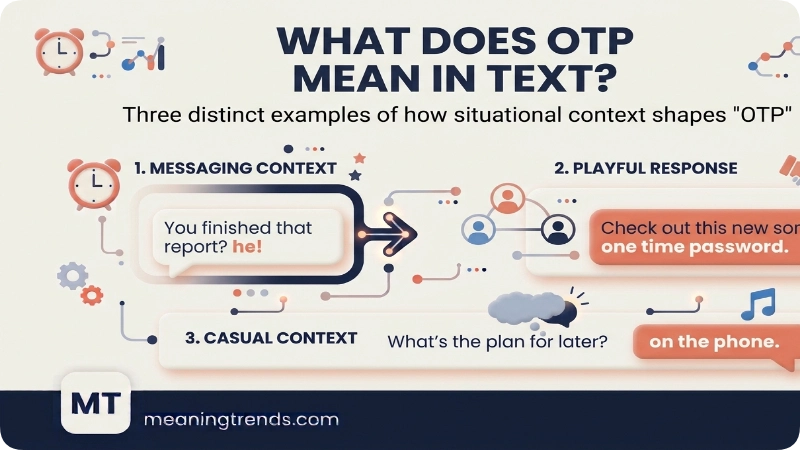
OTP is an initialism used in digital communication. Its meaning depends on the subject and purpose of the message.
Here are three established interpretations:
- One True Pairing: A person’s favorite romantic couple, particularly in fandom discussions.
- On The Phone: An informal way to say someone is currently talking on a phone call.
- One Time Password: A temporary code used to verify access to an account or authorize an action.
These meanings aren’t interchangeable. They belong to different conversational situations.
For example, someone writing “My favorite characters are my OTP” is probably talking about a fictional relationship. Someone writing “Sorry, I’m OTP” may be explaining that they’re busy on a call. A message saying “Enter your OTP” is likely referring to account verification.
The surrounding sentence is usually more useful than the abbreviation by itself.
1. OTP Meaning: One True Pairing
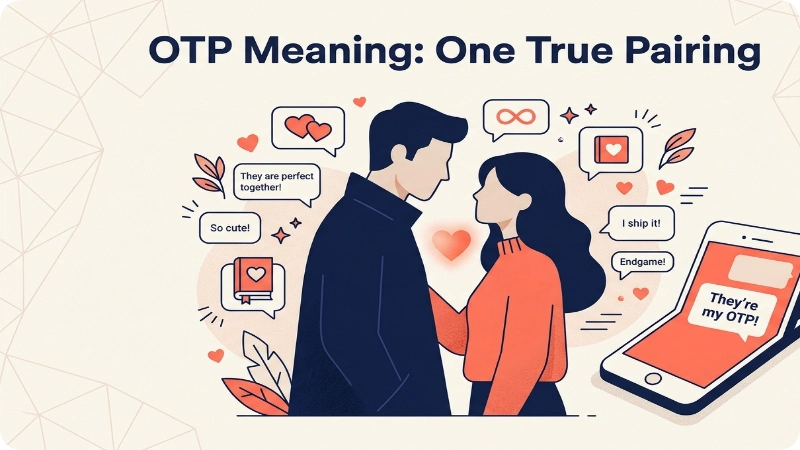
One True Pairing is a fandom expression for a romantic pairing someone particularly likes or supports.
The pairing might involve fictional characters from a television series, movie, book, anime, or video game. It can also describe a real life couple, such as two celebrities or people a friend thinks would make a good match.
For example:
“I’m rewatching the series because those two are my OTP.”
The sender is expressing enthusiasm for the relationship between the two characters.
According to Dictionary.com, the expression belongs to fandom and shipping culture. In this setting, shipping means supporting or wanting a particular relationship between two people or characters.
An OTP doesn’t necessarily have to be an official couple in the original story. Fans can support a pairing even when the characters never become romantically involved.
2. OTP Meaning: On The Phone
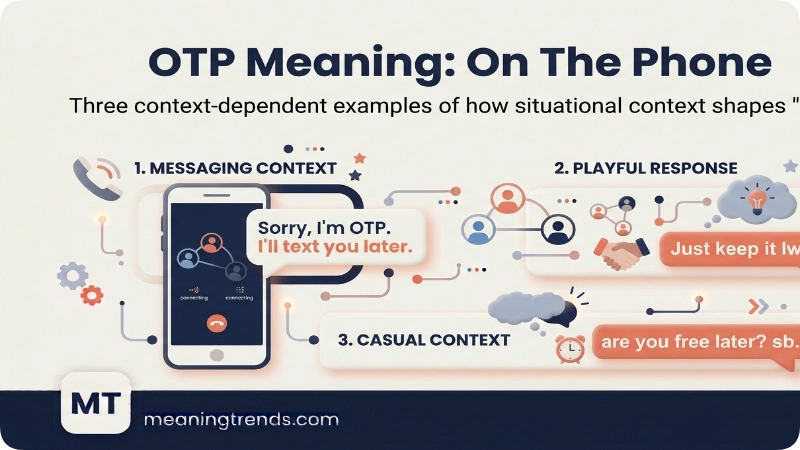
In casual messaging, OTP can also mean On The Phone.
Someone might use it to explain why they cannot answer immediately or participate in a conversation.
For example:
“Can’t talk right now, OTP. I’ll text you later.”
The sender is saying they’re currently occupied with a phone conversation.
This interpretation is different from the fandom meaning because it describes someone’s immediate availability rather than a relationship they support.
3. OTP Meaning: One Time Password
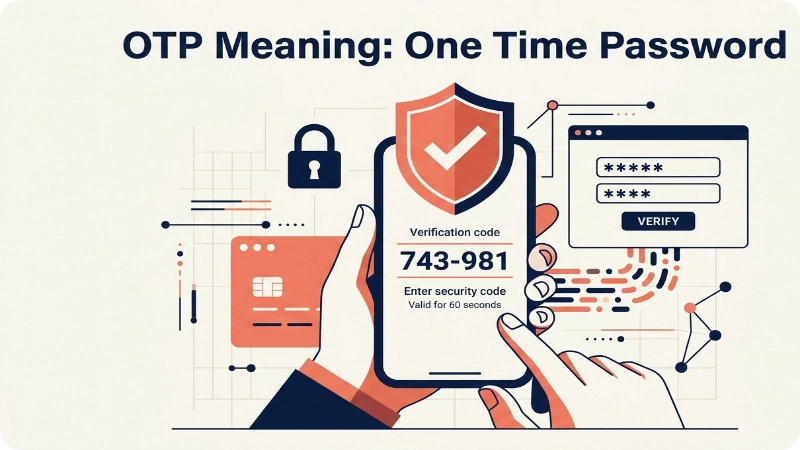
In banking, technology, and online security, OTP stands for One Time Password.
It refers to a temporary authentication code used to verify a login, transaction, or other account related action.
For example:
“Your OTP has been sent. Enter it to continue.”
Here, OTP isn’t internet relationship slang. It’s a security related term.
A one time password may arrive through an authorized authentication method, such as a text message or an authentication application, depending on the service.
If a message asks you to enter or provide a verification code, treat it as security related rather than assuming it’s casual texting slang.
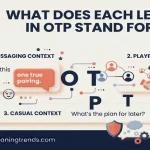
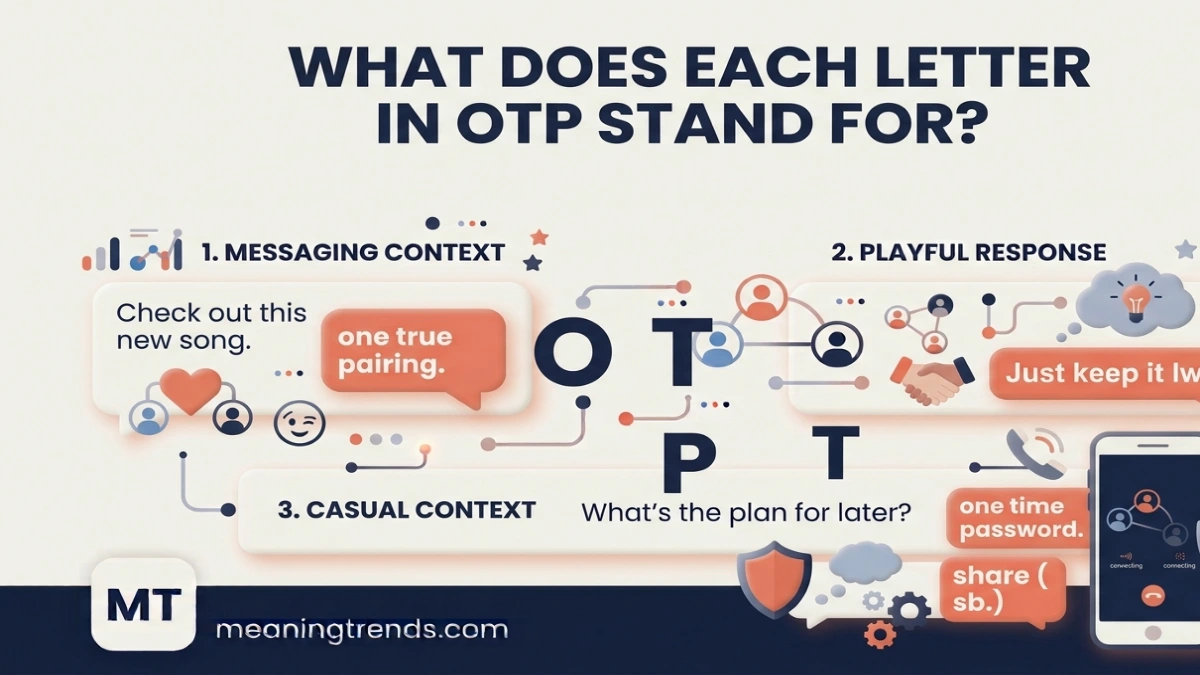
What Does Each Letter in OTP Stand For?
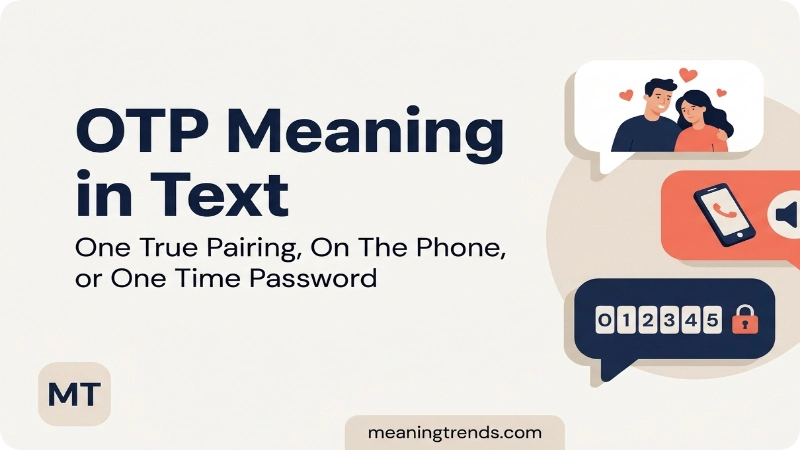
OTP is an initialism because its letters represent the first letters of a longer expression.
The expansion depends on the context:
| Initialism | Full form | Meaning |
| OTP | One True Pairing | A favorite romantic couple |
| OTP | On The Phone | Currently talking on a phone call |
| OTP | One Time Password | A temporary security code |
The letters don’t have one universal expansion. You shouldn’t automatically interpret OTP as One True Pairing just because someone uses it in a text message.
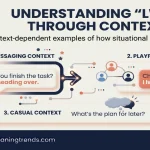
How Does Context Change the Meaning of OTP?
When you receive OTP in a message, look at the surrounding words before deciding what it means.
Here are some useful clues.
When Someone Is Talking About Relationships
If the conversation involves dating, fictional characters, celebrities, or couples, One True Pairing is a reasonable interpretation.
Examples of clues include:
- “They’re my OTP.”
- “Who’s your OTP?”
- “That couple will always be my OTP.”
- “I love this OTP so much.”
These expressions communicate support for a particular pairing.
However, calling two people an OTP doesn’t prove they’re dating or have romantic feelings for each other. It expresses the sender’s opinion or preference.
When Someone Is Explaining Why They’re Busy
If OTP appears alongside an explanation for a delayed response, it may mean On The Phone.
For example:
“I’m OTP with my sister. I’ll call you afterward.”
The sender is explaining that they’re occupied with a call.
Look for surrounding expressions such as “can’t talk,” “call you later,” or “text you soon.”
When Someone Is Discussing an Account or Login
If the message mentions a bank, account, login, payment, or verification, One Time Password is the likely meaning.
For example:
“Please enter the OTP to verify your account.”
This is a security instruction, not a casual expression.
Important: Never share a verification code simply because someone asks for it in a text. Follow the instructions of the legitimate service, and be cautious of unexpected requests for authentication codes.
Examples of OTP in Conversation
The following are illustrative conversations showing how the abbreviation can work in different situations.
Example 1: Talking About a Favorite Couple
Person A: Have you watched the new episode?
Person B: Yes! Those two are still my OTP.
Meaning: Person B loves the relationship between the two characters and considers them a favorite pairing.
Example 2: Discussing a Celebrity Couple
Person A: Do you think those celebrities look good together?
Person B: Absolutely. They’re my OTP!
Meaning: Person B thinks the two celebrities make a great couple.
Example 3: Explaining a Delayed Reply
Person A: Why aren’t you answering my calls?
Person B: Sorry, I’m OTP right now.
Meaning: Person B is currently on a phone call and can’t respond properly.
Example 4: Talking About a Phone Conversation
Person A: Can you talk for a minute?
Person B: I’m OTP with my mom. Give me a few minutes.
Meaning: The sender is occupied with another phone conversation.
Example 5: Receiving a Security Code
Person A: Did you get the message from your bank?
Person B: Yes, it contains an OTP for verification.
Meaning: OTP refers to a temporary security code.
Example 6: Asking About a Fictional Relationship
Person A: Which two characters do you ship the most?
Person B: They’re my OTP, no question!
Meaning: The sender strongly supports that fictional pairing.
Is OTP Rude, Flirty, or Offensive?
OTP isn’t inherently rude or offensive. Its tone depends on which meaning is intended and how it’s used.
When it means One True Pairing, it generally communicates enthusiasm or approval. Friends might use it playfully when discussing fictional couples or people they think look good together.
When it means On The Phone, it is usually a neutral explanation of someone’s availability. It doesn’t automatically suggest annoyance or disinterest.
When it means One Time Password, it has a practical, security related meaning rather than an emotional tone.
There is one important distinction when OTP refers to real people: calling two people an OTP doesn’t establish that they’re romantically involved. It may simply reflect someone’s personal opinion.
Likewise, a playful comment about two friends doesn’t prove that either person has romantic feelings.
If you’re unsure If a message is teasing, serious, or romantic, consider the complete conversation instead of relying on the abbreviation alone.
How Do You Reply to OTP in a Text?
Your response should match the meaning of OTP in the original message.
Here are some natural replies.
| Situation | Possible reply |
| Someone shares their favorite couple | “I agree! They’re adorable together.” |
| Someone asks about your favorite pairing | “I think those two are my OTP.” |
| Someone says they’re on the phone | “No problem. Text me when you’re free.” |
| Someone says they’re busy on a call | “Okay, talk to you later!” |
| Someone mentions a security code | “I received the verification code.” |
If you’re not sure which meaning the sender intends, ask a straightforward question:
“Do you mean you’re on the phone or something else?”
There’s no need to guess when a quick clarification can prevent confusion.
When Should You Use or Avoid OTP?
OTP is suitable for informal conversations when the other person is likely to understand the intended meaning.
You can use it when:
- Discussing your favorite fictional couples.
- Talking about relationships in fan communities.
- Explaining that you’re currently on a phone call.
- Discussing account verification in an appropriate technical context.
Avoid using the abbreviation when clarity matters more than brevity.
For example, in a professional email, writing “I’m on the phone” is clearer than writing “I’m OTP.” Similarly, “favorite couple” may be easier to understand than “OTP” for someone unfamiliar with fandom terminology.
In banking or account security instructions, use the complete phrase “one time password” when explaining what a verification code is.
The best choice depends on your audience. If the recipient might misunderstand the abbreviation, spelling out the meaning is a better option.
What Is the Difference Between OTP, Ship, and BROTP?
OTP, ship, and BROTP are related expressions in online fandom conversations, but they don’t mean exactly the same thing.
| Expression | Meaning | Typical use | Key distinction |
| OTP | One True Pairing | Favorite romantic pairing | Expresses a particularly strong preference |
| Ship | Support a relationship | Supporting two people as a couple | Can refer to any pairing someone supports |
| BROTP | A favorite platonic pairing | Celebrating a friendship or duo | Emphasizes friendship rather than romance |
For example, someone might ship two fictional characters because they think they would make a good couple. If that relationship becomes their favorite, they might call it their OTP.
BROTP is different because it celebrates a close friendship rather than a romantic relationship.
These expressions are most useful when the conversation is already taking place in a fandom or online community where people understand shipping terminology.
FAQs About OTP Meaning in Text
1. What does OTP mean from a girl or a guy?
OTP has the same basic meanings regardless of who sends it. It may mean One True Pairing, On The Phone, or One Time Password. The sender’s gender doesn’t establish which meaning is intended.
2. Does OTP mean One True Pairing?
Yes. In fandom and relationship discussions, OTP commonly stands for One True Pairing. It describes someone’s favorite romantic couple, If fictional or real.
3. Does OTP mean On The Phone?
Yes. OTP is also used informally to mean On The Phone. Someone might write “I’m OTP” to explain why they’re temporarily unavailable.
4. What does OTP mean on social media?
In fandom related social media discussions, OTP generally means One True Pairing. People use it when discussing favorite couples, fictional relationships, and celebrity pairings.
The meaning can differ in private messages or security related conversations.
5. Is OTP the same as a verification code?
Not exactly. OTP stands for One Time Password, which is the temporary authentication code itself. People often casually call the code an OTP.
6. Is OTP romantic?
It can be. When OTP means One True Pairing, it usually relates to romantic relationships. However, it doesn’t necessarily mean the sender is romantically interested in either person being discussed.
7. What should I do if I don’t understand OTP in a message?
Look at the surrounding conversation. If the meaning is still unclear, ask the sender, “What do you mean by OTP here?” A simple question is better than assuming the wrong definition.
Conclusion
OTP has several established meanings, and the right interpretation depends on the conversation. In fandom discussions, it can mean One True Pairing, referring to someone’s favorite couple. In casual messaging, it can mean On The Phone, while in account security, it stands for One Time Password.
The most useful habit is to check the words surrounding the abbreviation. References to couples and fictional characters suggest the fandom meaning, while phone calls and login instructions point toward the other interpretations.
If someone sends you OTP without enough context, don’t assume they’re talking about a relationship or a security code. Ask a quick question such as, “Do you mean One True Pairing or On The Phone?”
And if the message involves an authentication code, remember to protect it and follow the relevant service’s security instructions. Understanding the context makes OTP much easier to interpret without misunderstanding the sender.

Alex writes about the words and shortcuts people use in texts, group chats, and social media. Each guide explains the meaning with everyday examples and tips on when to use it