QUICK ANSWER
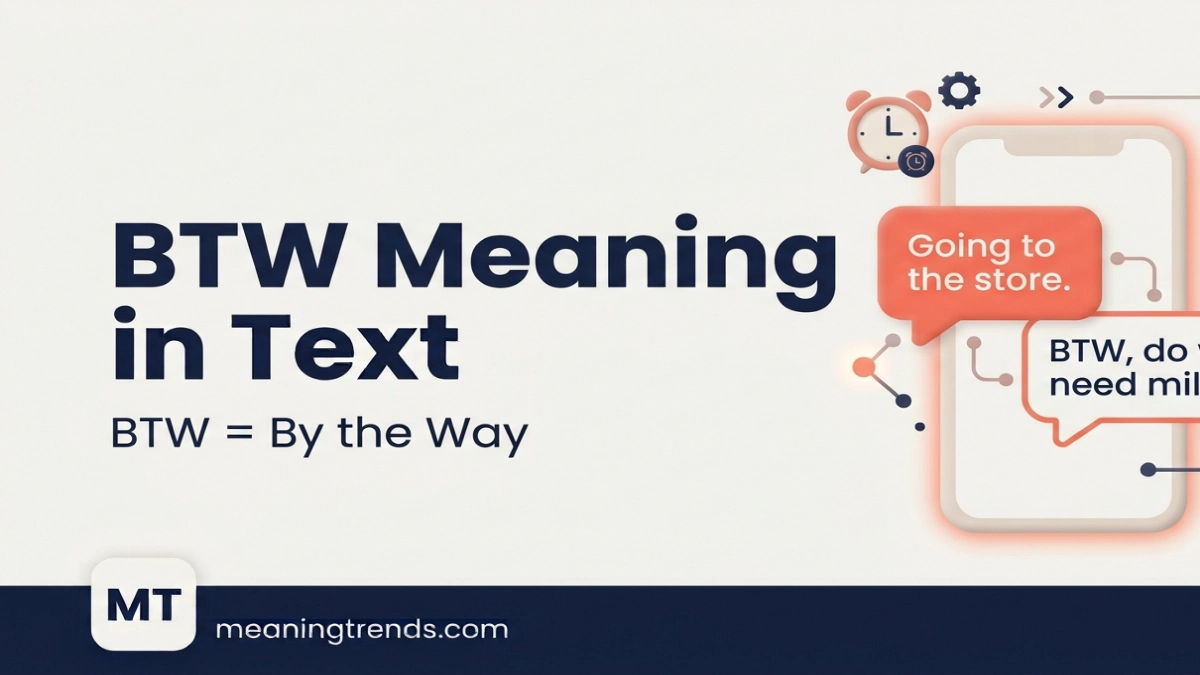
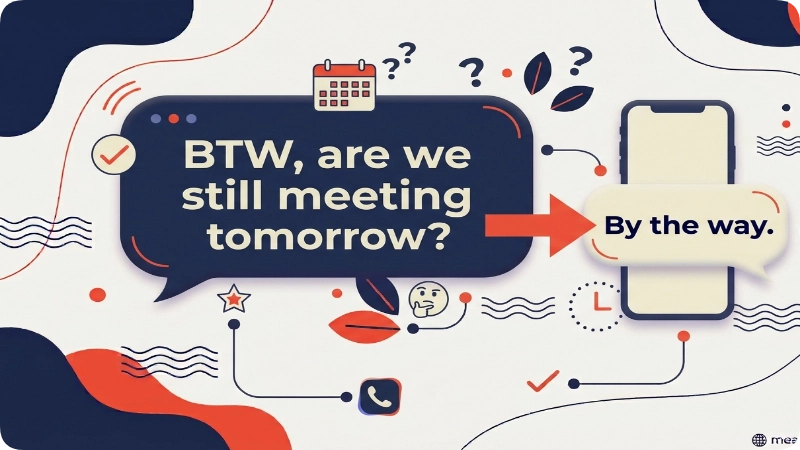
BTW means “by the way” in text messages, online chats, and emails. It’s an informal abbreviation used to introduce an extra thought, mention something related, or bring up a new question during a conversation. For example, “BTW, are we still meeting tomorrow?” means “By the way, are we still meeting tomorrow?”
When someone adds BTW to a message, they’re usually introducing an additional point rather than making it the main subject of the conversation.
Imagine you’re chatting with a friend about weekend plans. You’ve already discussed where to go, but you suddenly remember something important. Instead of starting a completely new conversation, you might write, “BTW, don’t forget to bring your jacket.”
That’s where this abbreviation fits naturally.
Understanding the surrounding message matters, though. BTW doesn’t automatically indicate excitement, annoyance, sarcasm, or romantic interest. It simply signals that the sender wants to add something to the conversation. The words that follow, your relationship with the sender, and the earlier discussion help explain the intended tone.
What Does BTW Mean in Text?
BTW is a written abbreviation for “by the way.” People use it in text messages, social media conversations, emails, and other informal digital communication.
The phrase “by the way” introduces an additional comment, question, reminder, or piece of information that isn’t necessarily the main focus of the conversation.
For example:
- “BTW, I found your missing notebook.”
- “Are you coming tonight? BTW, Sarah will be there.”
- “BTW, thanks for helping me yesterday.”
- “I finished the assignment. BTW, did you check yours?”
In each example, BTW helps introduce another thought without requiring a completely separate conversation.
It can connect to the previous topic or introduce something unrelated. The important point is that the sender is adding information.
Is BTW an abbreviation or an acronym?
BTW is generally described as an abbreviation or an initialism.
An initialism is formed from the first letters of a group of words and is typically pronounced letter by letter.
BTW represents:
- B = By
- T = The
- W = Way
People generally understand it as the shortened written form of the complete phrase, rather than a separate word with a different meaning.
What Does Each Letter in BTW Stand For?
Each letter in BTW represents one word in the phrase “by the way.”
| Letter | Word |
| B | By |
| T | The |
| W | Way |
Together, the letters form BTW.
Unlike shortened spellings such as “u” for “you,” BTW represents an entire phrase rather than shortening just one word.
You don’t need to interpret each letter separately when reading a message. It’s best understood as one complete expression.
For example:
Without abbreviation:
“By the way, did you receive my email?”
With abbreviation:
“BTW, did you receive my email?”
Both sentences communicate essentially the same thing. The second version is simply shorter and more casual.
Why Do People Use BTW in Text Messages?
People use BTW because it makes everyday conversations easier and more flexible.
Instead of interrupting a conversation with a completely new opening, someone can use BTW to introduce another thought.
Here are some common conversational purposes.
1. To introduce an additional thought
Someone might remember something while discussing another subject.
Example:
“Your presentation looks great. BTW, I added the new slides.”
The sender introduces extra information without changing the entire conversation.
2. To ask an unrelated question
BTW can help introduce a question that isn’t directly connected to the previous discussion.
Example:
“Did you finish your homework? BTW, do you know when the library closes?”
The second question shifts the subject naturally.
3. To share a reminder
Someone may use BTW when they remember something the other person needs to know.
Example:
“BTW, your appointment is at 10 tomorrow.”
Here, the abbreviation introduces a reminder.
4. To add information without restarting the conversation
A person may have something else to say but doesn’t want to send a completely separate opening message.
Example:
“That movie was really good. BTW, I think there’s a sequel coming out.”
BTW makes the additional comment feel connected to the ongoing chat.
5. To make communication feel conversational
In casual messages, BTW can make a transition between subjects feel natural.
It works particularly well when people are exchanging several short messages throughout the day.
However, using BTW doesn’t necessarily mean the sender is trying to change the subject. Sometimes they’re simply adding one more detail.
How Does Context Change the Meaning of BTW?
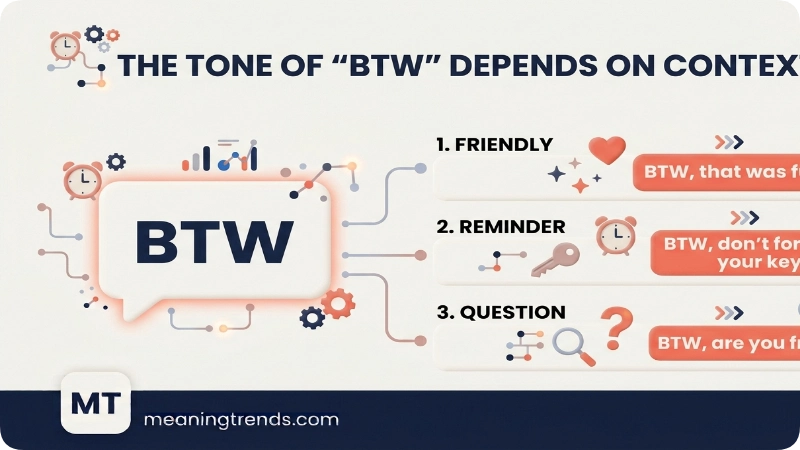
The basic meaning of BTW remains “by the way,” but the purpose and tone can change depending on what comes after it.
A message containing BTW might introduce a friendly question, an important reminder, a casual observation, or an unexpected topic.
Consider these situations.
When a friend uses BTW
Example:
“BTW, are you free this weekend?”
Your friend is introducing an additional question. They may have remembered something they wanted to ask or decided to discuss weekend plans.
It doesn’t automatically suggest that the question has a hidden meaning.
When a romantic partner uses BTW
Example:
“BTW, I really enjoyed spending time with you yesterday.”
This message adds a positive personal comment.
Depending on your relationship and the earlier conversation, it may sound affectionate. However, BTW itself isn’t a romantic abbreviation.
The actual words following it communicate the personal sentiment.
When a coworker uses BTW
Example:
“BTW, the meeting has been moved to 3 PM.”
The sender is adding a work related update.
Although BTW is informal, it can appear in relaxed workplace emails and team chats.
For formal business communication, writing “Additionally” or “One more thing” may be more appropriate.
When someone uses BTW during an argument
Example:
“BTW, you still haven’t answered my question.”
This message might sound frustrated because of the wording.
The tone comes from the criticism and the surrounding conversation, not from BTW alone.
A neutral message can become tense when the additional information is worded negatively.
The important distinction: BTW tells you how the sender introduces information. It doesn’t reliably tell you why they’re saying it or how they feel.
Examples of BTW in Conversation
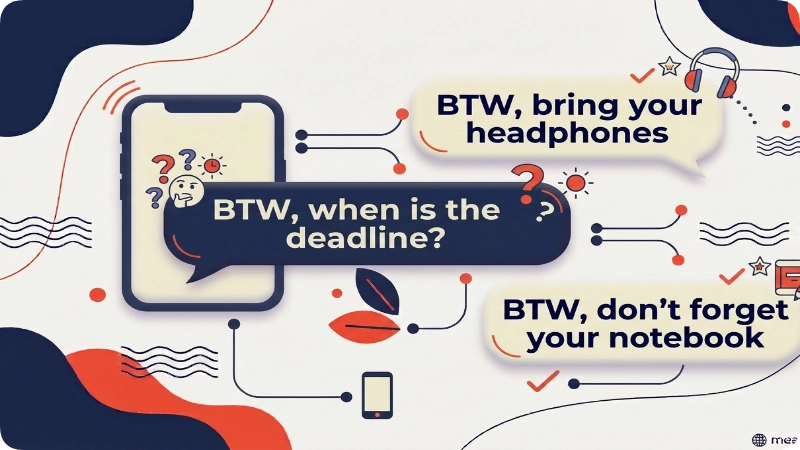
Seeing BTW in realistic conversations makes its meaning easier to understand.
The following are illustrative examples of how people might use it in everyday texting.
Example 1: Making plans
Person A: Are we meeting at the coffee shop tomorrow?
Person B: Yes, around 4 PM. BTW, bring your headphones.
Meaning: Person B confirms the meeting and adds another reminder.
Example 2: Talking to a friend
Person A: I finally watched that new movie!
Person B: Was it good? BTW, I watched the trailer yesterday.
Meaning: Person B asks a question and adds another related comment.
Example 3: Asking for information
Person A: I sent you the document.
Person B: Got it! BTW, when is the deadline?
Meaning: Person B confirms receiving the document and asks an additional question.
Example 4: Showing appreciation
Person A: Thanks for helping me with the project.
Person B: No problem! BTW, you did a great job too.
Meaning: Person B adds a friendly compliment.
Example 5: Changing the subject
Person A: The weather has been terrible today.
Person B: I know! BTW, have you booked your tickets yet?
Meaning: Person B moves the conversation toward another topic.
Example 6: Sharing an important reminder
Person A: I’ll see you at school tomorrow.
Person B: Sounds good. BTW, don’t forget your notebook.
Meaning: Person B adds a practical reminder before ending the conversation.
These examples demonstrate that BTW can introduce different types of information. The phrase that follows it determines the actual subject and conversational purpose.
Is BTW Rude, Flirty, or Offensive?
No. BTW isn’t inherently rude, flirty, or offensive. It’s a neutral, informal abbreviation for “by the way.”
However, the complete message can affect how it sounds.
Is BTW rude?
Usually, no.
For example:
“BTW, could you send me the notes?”
This is a straightforward request.
But consider:
“BTW, you never listen to me.”
This might sound confrontational because of the criticism.
The wording matters more than the abbreviation.
Is BTW flirty?
Not by itself.
Someone might write:
“BTW, you looked really nice today.”
That could sound complimentary or flirtatious depending on the relationship and conversation.
However, BTW simply introduces the additional comment. It doesn’t establish romantic interest.
Is BTW offensive?
The abbreviation itself isn’t offensive in ordinary English texting.
Nevertheless, it can introduce criticism, sensitive information, or an uncomfortable question.
For instance:
“BTW, why didn’t you invite me?”
The question might sound confrontational depending on the circumstances.
If you’re unsure about someone’s intended tone, consider the complete message instead of interpreting the abbreviation in isolation.
How Do You Reply to BTW in a Text?
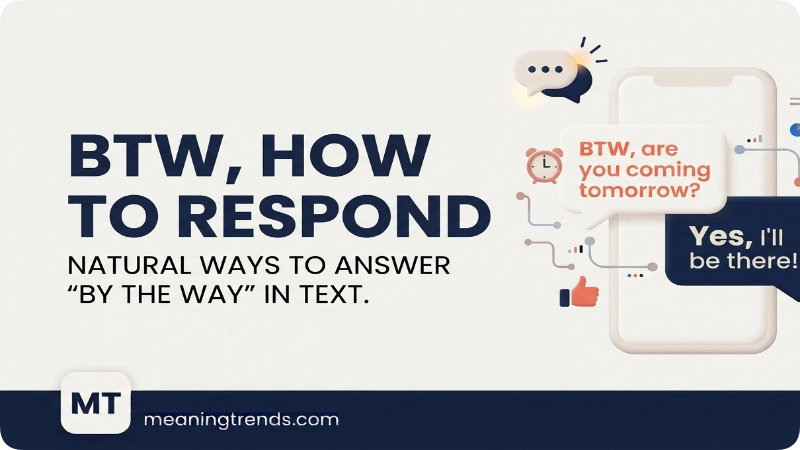
You don’t need a special response whenever someone uses BTW.
The easiest approach is to respond to whatever information, question, or reminder follows the abbreviation.
Here are some natural responses.
| Situation | Example reply |
| Someone asks a question | “Yes, I think so!” |
| Someone gives a reminder | “Thanks for reminding me!” |
| Someone shares information | “Oh, that’s good to know.” |
| Someone changes the subject | “Sure, let’s talk about that.” |
| Someone gives a compliment | “Thank you! That’s sweet.” |
| Someone asks something unclear | “What do you mean exactly?” |
Friendly replies
If a friend adds a casual comment, you can respond naturally.
- “Oh, really?”
- “Good to know!”
- “Haha, I almost forgot.”
- “Thanks for telling me!”
Direct replies
If someone asks a straightforward question, answer it directly.
Example:
Person A: BTW, are you coming tomorrow?
Person B: Yes, I’ll be there around noon.
Playful replies
If the conversation is already lighthearted, a playful response may fit.
Example:
Person A: BTW, you owe me coffee!
Person B: Haha, fair enough. Your coffee is on me!
Clarifying replies
If you’re unsure what someone is referring to, ask.
For example:
“BTW, what are you talking about?”
Or, more politely:
“Just to clarify, which thing do you mean?”
You don’t have to guess the sender’s intention when a simple question can clear things up.
When Should You Use or Avoid BTW?
BTW is appropriate in many everyday conversations, but it isn’t equally suitable for every situation.
Knowing when to use the abbreviation helps your messages remain clear and appropriate.
When BTW is appropriate
Use BTW when communicating informally with:
- Friends and family members.
- People you regularly text.
- Online gaming teammates.
- Group chat participants.
- Coworkers in relaxed team conversations.
- People communicating through casual social media messages.
For example:
“BTW, I’ll be a little late today.”
This is a natural way to add a quick update.
When to avoid BTW
Avoid BTW when writing formal documents or communicating in situations where complete wording is expected.
For example, in a professional email to someone you don’t know well, this:
“BTW, I attached the report.”
Could become:
“Additionally, I’ve attached the report for your review.”
Other situations where the complete phrase may be better include:
- Academic assignments.
- Formal business correspondence.
- Official applications.
- Legal or administrative documents.
- Important instructions where clarity is essential.
The abbreviation isn’t incorrect English. It’s simply informal, so your choice should reflect the audience and communication setting.
What Are Other Ways to Say BTW?
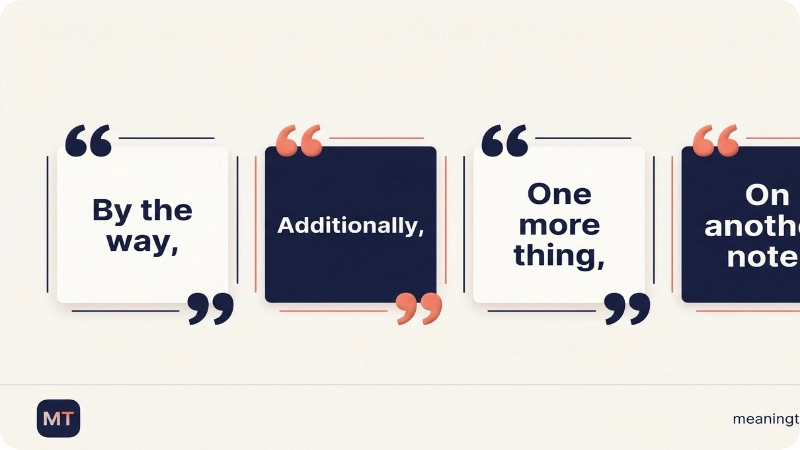
If you want to communicate the same idea without using BTW, several expressions work naturally.
The best alternative depends on the situation and how formal you want to sound.
| Alternative | Meaning or purpose | Typical use |
| By the way | Original complete phrase | Everyday conversations |
| Additionally | Introduces extra information | Professional writing |
| Also | Adds another point | Casual and formal writing |
| One more thing | Introduces another subject or detail | Everyday conversations |
| Incidentally | Introduces an additional observation | More formal conversation |
| Speaking of which | Connects to something just mentioned | Casual conversations |
| On another note | Introduces a different subject | Emails and conversations |
| Just so you know | Introduces information or a reminder | Informal communication |
Which alternative should you choose?
- Use “By the way” when you want to write the full version of BTW.
- Use “Also” when adding another related point.
- Use “Additionally” when writing a professional email.
- Use “One more thing” when introducing an extra comment.
- Use “On another note” when moving to a different subject.
These expressions have similar conversational purposes, but they aren’t always interchangeable.
For example, “Additionally” sounds more formal than BTW, while “Speaking of which” usually connects an additional comment to something already mentioned.
Common Mistakes and Confusion About BTW
Although BTW has a straightforward meaning, a few aspects of its use can cause confusion.
1. Thinking BTW indicates a specific emotion
BTW doesn’t automatically mean someone is angry, excited, annoyed, or flirting.
The rest of the message provides more useful clues about the intended tone.
2. Assuming BTW always changes the subject
Sometimes BTW introduces an unrelated topic, but it can also add information about the current subject.
For example:
“BTW, I found another restaurant near the hotel.”
This continues the discussion about restaurants rather than introducing an entirely new topic.
3. Thinking BTW is appropriate in every situation
BTW is an informal abbreviation. Although it can appear in relaxed professional communication, complete wording is generally a better choice in formal documents.
4. Confusing the abbreviation with the sender’s intention
Knowing that BTW means “by the way” doesn’t tell you exactly why someone included it.
For example:
“BTW, can we talk later?”
The sender may want to discuss something important, but the abbreviation alone doesn’t establish what that conversation will involve.
When the intended meaning isn’t clear, asking politely is more reliable than making assumptions.
FAQs About BTW Meaning in Text
1. What does BTW stand for in texting?
BTW stands for “by the way.” It’s an informal abbreviation used to introduce an additional comment, question, reminder, or piece of information.
2. What does BTW mean from a girl?
BTW means “by the way” regardless of the sender’s gender.
If a girl sends you BTW, she’s using the same abbreviation. The rest of her message determines what she’s communicating.
3. What does BTW mean from a guy?
It also means “by the way.” A guy might use it to add information, ask another question, or introduce a different topic.
The abbreviation doesn’t reveal romantic interest or any particular emotion.
4. Does BTW mean the same thing in chat and email?
Yes. In ordinary English digital communication, BTW means “by the way” in both text messages and emails.
The main difference is that the level of informality may depend on the email’s audience and purpose.
5. Is BTW formal or informal?
BTW is informal.
It’s suitable for everyday texting, social media conversations, and relaxed emails. In formal writing, use the complete phrase or an alternative such as “additionally.”
6. Can I use BTW at the beginning of a sentence?
Yes. BTW can appear at the beginning of a sentence or as an introductory expression within a message.
Example:
“BTW, I have something to tell you.”
It can also appear later:
“I forgot to mention, BTW, that the meeting was postponed.”
7. Should BTW be uppercase or lowercase?
Both BTW and btw are commonly understandable written forms.
Uppercase and lowercase letters don’t create different meanings. Choose whichever style fits your usual writing.
8. What does BTW mean at the end of a message?
It still means “by the way.”
When it appears toward the end of a message, it may introduce an afterthought or an additional comment. Read the surrounding words to understand its purpose.
9. Is BTW the same as FYI?
No. They have different meanings.
- BTW means “by the way” and introduces an additional thought or topic.
- FYI means “for your information” and introduces information someone should know.
They can sometimes appear in similar situations, but they aren’t interchangeable in every sentence.
10. What is the difference between BTW and TBH?
BTW means “by the way,” while TBH means “to be honest.”
BTW introduces an additional thought or question. TBH introduces an honest opinion or statement.
Conclusion
BTW is a simple abbreviation that makes everyday digital conversations shorter and more natural. It stands for “by the way” and is used when someone wants to add another thought, share a reminder, ask an extra question, or introduce a different subject. Its basic meaning stays the same If it appears in a text message, group chat, or informal email.
The most important thing to remember is that the abbreviation doesn’t tell you everything about the sender’s feelings or intentions. Pay attention to the words that follow it, the earlier conversation, and your relationship with the person. These details provide a much better understanding of the message.
If you want to use BTW yourself, it’s perfectly suitable for casual conversations. When writing something formal, use the complete phrase instead. And if someone’s message seems unclear, simply ask what they mean rather than assuming there’s a hidden meaning.

Alex writes about the words and shortcuts people use in texts, group chats, and social media. Each guide explains the meaning with everyday examples and tips on when to use it