Slang usage verified: October 2026
QUICK ANSWER
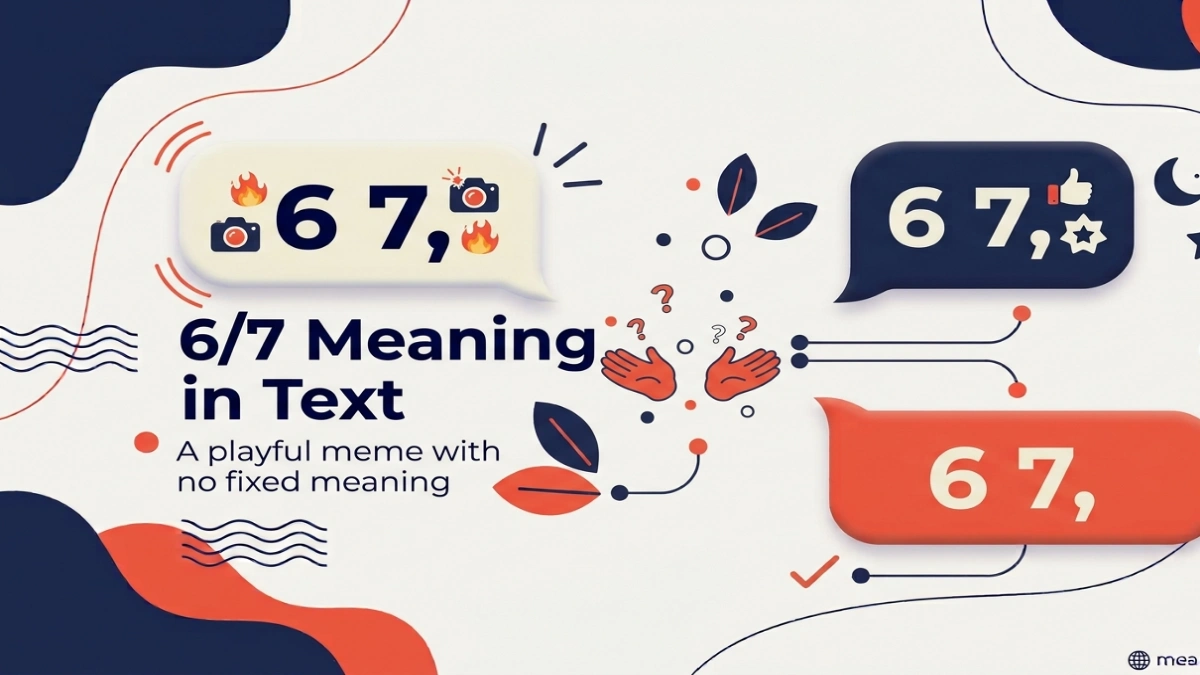
“6/7” in current slang usually refers to “six seven,” a deliberately vague internet meme with no single fixed definition. People may say or type it as a playful reaction, an absurd answer, or an in group reference, sometimes with an alternating palms up hand gesture. “So so” or “maybe this, maybe that” can fit some uses, but treating either as the universal translation misses the point.
If someone replies, “How was your day?” with “6/7,” they may simply be joking rather than giving you a numerical rating.
You might see the expression written as 6 7, 6 7, 67, or six seven. In the slang sense, it is generally pronounced “six seven,” not “sixty seven.” Dictionary.com and Cambridge Dictionary both document the expression as a contemporary internet/youth usage, while Dictionary.com notes that its meaning is deliberately slippery.
You can understand the confusion easily. Someone can write two ordinary numbers—“6” and “7”—and suddenly they may be functioning as a meme rather than as numbers. The surrounding conversation, the speaker’s tone, and If the phrase appears alongside the familiar hand gesture can make a difference.
The important distinction is between what “6/7” means as a slang expression and what a particular person intended by using it. The slang has a documented meme meaning, but it does not give every individual message one guaranteed interpretation.
What Does 6/7 Mean?
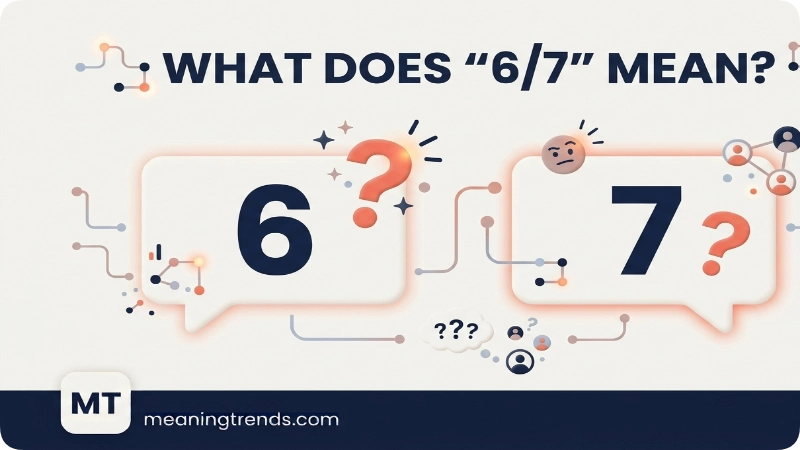
In slang, 6/7 is an intentionally ambiguous expression used mainly as an internet meme or playful interjection. It can serve as a joke, a random response, a reaction to seeing the numbers 6 and 7 together, or a signal that someone recognizes the meme.
Dictionary.com describes “67” as an informal slang expression associated with swagger or insider status in internet and youth culture. Its slang entry also records uses in which people answer unrelated questions with “67” or say it when they encounter the two numbers together.
Cambridge Dictionary takes an even more direct approach, defining “six seven” as an internet meme with “no real meaning.” It also notes the characteristic hand movement in which the hands are stretched out and moved up and down in turn.
That apparent contradiction—“it has a meaning” but “it has no meaning”—is actually useful. The expression has a social function without necessarily having a precise dictionary style definition.
It can communicate something like:
- “I’m making the meme reference.”
- “I’m joking.”
- “This is absurd.”
- “I’m giving a deliberately unhelpful answer.”
- “I recognize the same internet joke you do.”
- Sometimes, roughly, “so so” or “either way.”
The exact interpretation depends on the situation.
Is 6/7 the same as 67?
For the slang meme, yes. 67, 6 7, 6 7, and six seven can refer to the same expression. The spelling varies, but the slang pronunciation is generally “six seven.” Dictionary.com specifically distinguishes this slang pronunciation from the ordinary number “sixty seven.”
However, context still matters. A sentence such as “She is 67 years old” is simply using the ordinary number. The slang reading does not automatically apply whenever the digits 6 and 7 appear.
Why Do People Use 6/7?
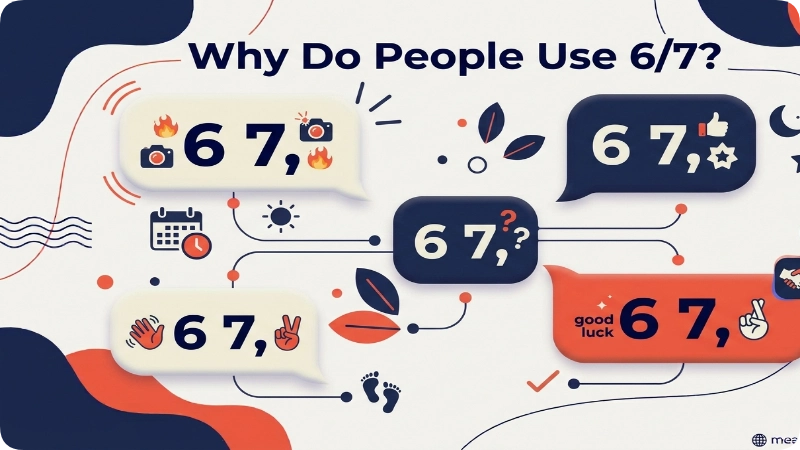
The appeal of 6/7 is partly that it doesn’t need a precise translation.
Internet memes often work through recognition and repetition rather than through conventional vocabulary. Someone who knows the reference may immediately understand why another person says “six seven,” while someone outside the meme may hear two random numbers.
Dictionary.com describes 67 as meaningful partly because of the connection it creates among people who recognize the reference. The site also characterizes its intentionally nonsensical quality as part of the broader “brainrot” style of internet slang.
That means a person may use 6/7 because:
- the numbers appeared naturally in the conversation;
- they want to make the meme reference;
- another person has just said “six” or “seven”;
- they want a deliberately silly answer;
- they’re participating in a group joke;
- or the phrase itself is the joke.
This is why asking for a literal definition can feel frustrating. There often isn’t a hidden sentence that translates perfectly into standard English.
How Does Context Change the Meaning?
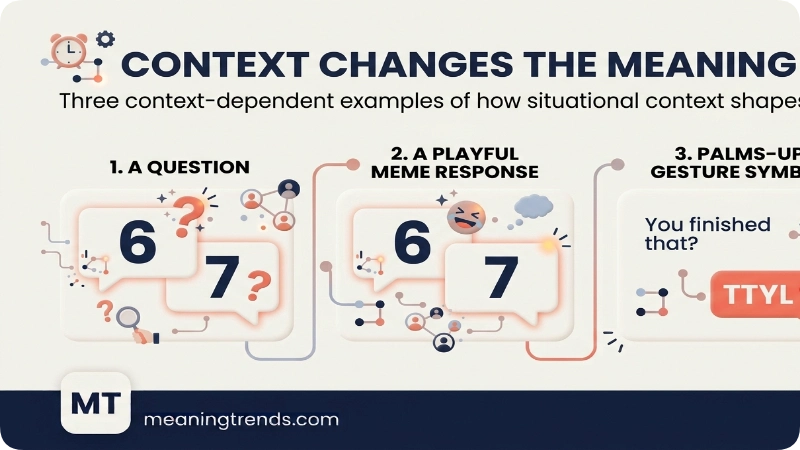
Context is especially important with 6/7 because the expression has no stable one to one translation.
When 6/7 appears as an answer
Suppose someone asks:
“How was the movie?”
and the reply is:
“6/7.”
That could be playful nonsense, or it could loosely suggest “so so” if the speaker is using the expression in that way. You shouldn’t automatically interpret it as a genuine rating of 6 or 7 out of 10.
When 6/7 follows the numbers
If someone is reading a score, calculation, page number, or other sequence and suddenly says “six seven,” the numbers themselves may have triggered the meme.
Dictionary.com specifically documents people using 67 after encountering the two numbers together in places such as math problems, phone numbers, or other everyday contexts.
When the hand gesture appears
The expression is often associated with a gesture involving both palms facing upward and moving alternately up and down.
That gesture can reinforce the loose “so so” or “this or that” interpretation, but it does not establish one universal meaning. Cambridge Dictionary and Dictionary.com both describe the gesture as part of the meme’s usage.
When a friend simply types “67”
In a group chat, a bare “67” may be nothing more than a meme reference. If there is no surrounding clue, it is safer not to assign an elaborate hidden meaning to it.
The same principle applies to capitalization, punctuation, or an accompanying emoji. Those details can contribute to tone, but they do not prove what the sender intended.
Examples of 6/7 in Conversation
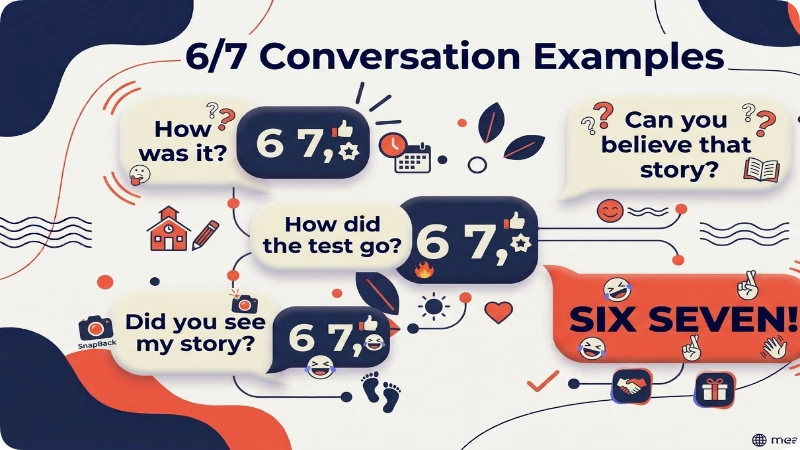
These are illustrative examples, not quotations from particular speakers.
Example 1: Deliberately vague answer
Person A: “Was the new game good?”
Person B: “6/7 😂”
Interpretation: Person B may be jokingly giving a vague or nonsensical response rather than providing a serious rating.
Example 2: Seeing the numbers
Person A: “The answer to the problem is 67.”
Person B: “SIX SEVEN!”
Interpretation: The number sequence has triggered the meme reference.
Example 3: Group joke
Person A: “What are you doing after school?”
Person B: “67.”
Person A: “You cannot be serious.”
Person B: “67 😭”
Interpretation: The second person is using the expression as an intentionally unhelpful joke.
Example 4: A possible “so so” reading
Person A: “How are you feeling today?”
Person B: “Six seven.”
Interpretation: In this context, the speaker may be using the expression loosely to convey “so so” or “somewhere in between.” That interpretation is possible, but the phrase does not guarantee it.
Example 5: Recognizing the meme
Person A: “Page six—”
Person B: “SEVEN!”
Person A: “You had to do it.”
Interpretation: The humor comes from recognizing the meme and anticipating the phrase.
Is 6/7 Rude, Flirty, or Offensive?
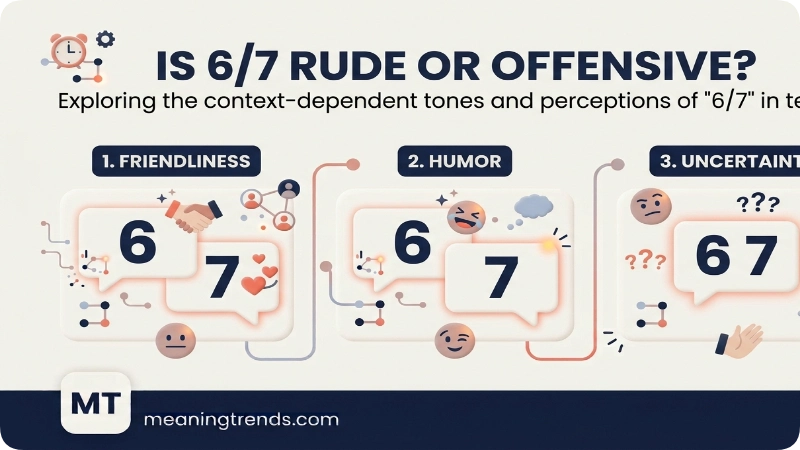
6/7 is not inherently rude, flirty, or offensive. In the documented slang usage, it is primarily a playful internet expression and meme reference. Dictionary.com describes it as an informal expression associated with internet and youth culture, while Cambridge Dictionary characterizes it as an internet meme.
Its tone can still change with context.
For example, saying “67” among friends may be harmless joking. Saying it repeatedly while someone is trying to answer a serious question could instead come across as disruptive or deliberately unhelpful.
That distinction matters because the expression itself does not determine the speaker’s attitude. Their relationship, the conversation, and what happened immediately before the message provide stronger clues.
If someone sends you “6/7” and you genuinely cannot tell what they mean, a simple response such as “Do you mean the meme, or are you actually answering me?” can resolve the ambiguity without assuming their intention.
When Should You Use or Avoid 6/7?
Use 6/7 when the setting is clearly informal and the people involved understand the meme. It fits casual chats, jokes, comments, and other situations where deliberately nonsensical internet language is expected.
Avoid relying on it when precision matters.
For example, it would be a poor substitute for a clear answer in:
- schoolwork;
- professional communication;
- formal writing;
- instructions;
- customer service;
- medical or legal discussions;
- serious conversations where the recipient needs to understand your exact meaning.
Even in casual conversation, “6/7” can be confusing to someone who doesn’t know the meme. If clarity matters, ordinary wording is better.
What Are Other Ways to Say 6/7?
There is no single standard English replacement because 6/7 does not have one fixed meaning.
Depending on what you actually intend, clearer alternatives include:
- “So so.” — when you mean something is average or neither good nor bad.
- “Maybe.” — when you’re genuinely uncertain.
- “Either way.” — when two possibilities seem comparable.
- “I don’t know.” — when you don’t have an answer.
- “I’m just joking.” — when the phrase is only being used as a meme.
- “That’s the meme.” — when you’re signaling that the expression is an internet reference.
These aren’t literal translations of 6/7. They’re clearer alternatives for specific interpretations that a speaker might otherwise leave ambiguous.
What Else Can 6/7 Mean?
Outside the slang context, 6/7 can simply be a mathematical or numerical expression.
For example, it can refer to:
- the numbers six and seven;
- a score of 6–7;
- a fraction such as 6/7;
- a date format in contexts where that notation is used;
- a measurement, address, page number, or other ordinary numerical reference.
Those meanings should not be confused with the internet slang.
The distinction is especially important in writing because 6/7 visually resembles a fraction, while “six seven” signals the meme when it is being used as spoken slang.
Dictionary.com separately lists ordinary “67” as the number sixty seven and the slang “67” as an informal interjection.
Common Mistakes and Confusion About 6/7
Mistake: Treating it as a fixed numerical rating
Not every “6/7” means “six or seven out of ten.” The meme is deliberately flexible, and Dictionary.com documents uses where it appears as an answer to unrelated questions.
Mistake: Assuming “so so” is always the definition
“So so” is one interpretation associated with the gesture and some uses of the meme. It is not a universal translation. Cambridge Dictionary emphasizes the expression’s lack of real meaning, while Dictionary.com describes its usage as ambiguous.
Mistake: Assuming every appearance of 67 is slang
A normal number is still a normal number. The surrounding language has to support the slang interpretation.
Mistake: Assuming the sender has a hidden message
Sometimes “67” really is just a meme reference. Trying to decode it as a secret statement about someone’s feelings, personality, or intentions goes beyond what the expression itself establishes.
Where Did 6/7 Come From?
The modern slang use is associated with the song “Doot Doot (6 7)” by rapper Skrilla. Dictionary.com identifies the song as the likely origin of the contemporary usage and documents how the expression was subsequently reinforced through viral basketball related videos and other social media content.
The song connection came before the expression became detached from its original musical context. Viral basketball edits helped spread the “6 7” reference, with LaMelo Ball becoming particularly associated with the meme because he is listed at 6 feet 7 inches tall. Dictionary.com also identifies a viral young basketball fan known as the “67 Kid” as another factor in the expression’s spread.
The important qualification is that the slang meaning should not be confused with the original meaning of the numbers in the song. The contemporary meme developed its own usage after the phrase circulated widely online.
The precise intended meaning of “6 7” within Skrilla’s original lyric has also been treated as ambiguous. That uncertainty is separate from the much clearer fact that the lyric became the source material for the later meme.
Does 6/7 Mean the Same Thing Everywhere?
Not necessarily.
The expression has a broadly recognizable meme identity, but individual uses can differ. Dictionary.com describes some users treating it as “so so” or “maybe this, maybe that,” while also documenting uses where it functions as a response to almost any question. Cambridge Dictionary similarly emphasizes that it has no real meaning.
The context can therefore shift the practical interpretation without creating a completely separate slang term.
A person who types “67” after seeing the number on a scoreboard may simply be making the meme reference. Someone who answers “How are you?” with “six seven” may be using the expression more like a deliberately vague response. Someone who shouts it with the hand gesture may be participating in the recognizable meme ritual.
The shared feature is the recognition of the expression, not a universally agreed translation.
FAQs
Is 6/7 pronounced “six seven”?
Yes. In the slang usage, it is generally pronounced “six seven,” not “sixty seven.” Dictionary.com specifically notes this distinction.
What does 6/7 mean on TikTok?
It generally functions as the same viral “six seven” meme used elsewhere online: a deliberately vague or nonsensical reaction, joke, or in group reference. The exact interpretation depends on the context.
Does 6/7 mean “so so”?
It can. The “so so” interpretation is especially associated with the alternating palms up gesture, but it is not a fixed definition. Some uses are simply nonsensical or function as an in group meme reference.
Is 6/7 the same as 67?
In the slang context, yes. “67,” “6 7,” “6 7,” and “six seven” are different written forms of the same meme expression. In ordinary numerical contexts, however, 67 can simply mean the number sixty seven.
Why do people make the 6/7 hand gesture?
The familiar gesture involves the hands being held up and moved alternately, and it is strongly associated with the “six seven” meme. It can reinforce the loose “so so” or “this or that” reading, but the gesture doesn’t give the expression one universally agreed definition.
Is 6/7 a Gen Z or Gen Alpha term?
Current reference sources generally associate the slang particularly with Gen Alpha and younger teens, although the meme has spread into broader internet and sports culture. Dictionary.com describes its use as extending beyond its original youth context.
What should I say if someone texts me “6/7”?
If you’re comfortable with the meme, you can play along. If you don’t know what they mean, ask something simple such as “Are you using the six seven meme?” That is clearer than guessing at a hidden meaning.
Conclusion
The most useful way to understand 6/7 slang is not as a number with one secret definition, but as a flexible internet meme. “Six seven” can be a joke, an intentionally meaningless answer, an in group signal, or depending on the speaker and gesture a loose “so so” or “this or that” response. The lack of a fixed translation is part of why the expression works as a meme.
When you see 6/7 in a message, look at the words around it, what happened immediately before it, and If the person is clearly participating in the meme. Don’t assume that the numbers themselves reveal the sender’s exact intention. If the context still doesn’t make sense, a quick clarification is more reliable than trying to decode the phrase.
For clear communication, replace the meme with the meaning you actually intend: “maybe,” “so so,” “I don’t know,” or “I’m joking.” The slang remains intentionally ambiguous, and that ambiguity is central to how it is currently used.

Alex writes about the words and shortcuts people use in texts, group chats, and social media. Each guide explains the meaning with everyday examples and tips on when to use it