QUICK ANSWER
SB can mean “somebody” in ordinary text messages or “snap back” on Snapchat. The meaning depends on the conversation. In general texting, it can refer to an unspecified person. On Snapchat, it usually asks someone to send a Snap in return. In some online communities, SB can also mean “soft block.”
Receiving an isolated “SB?” isn’t enough to establish the sender’s intention. Look at the surrounding words and where the message appeared.
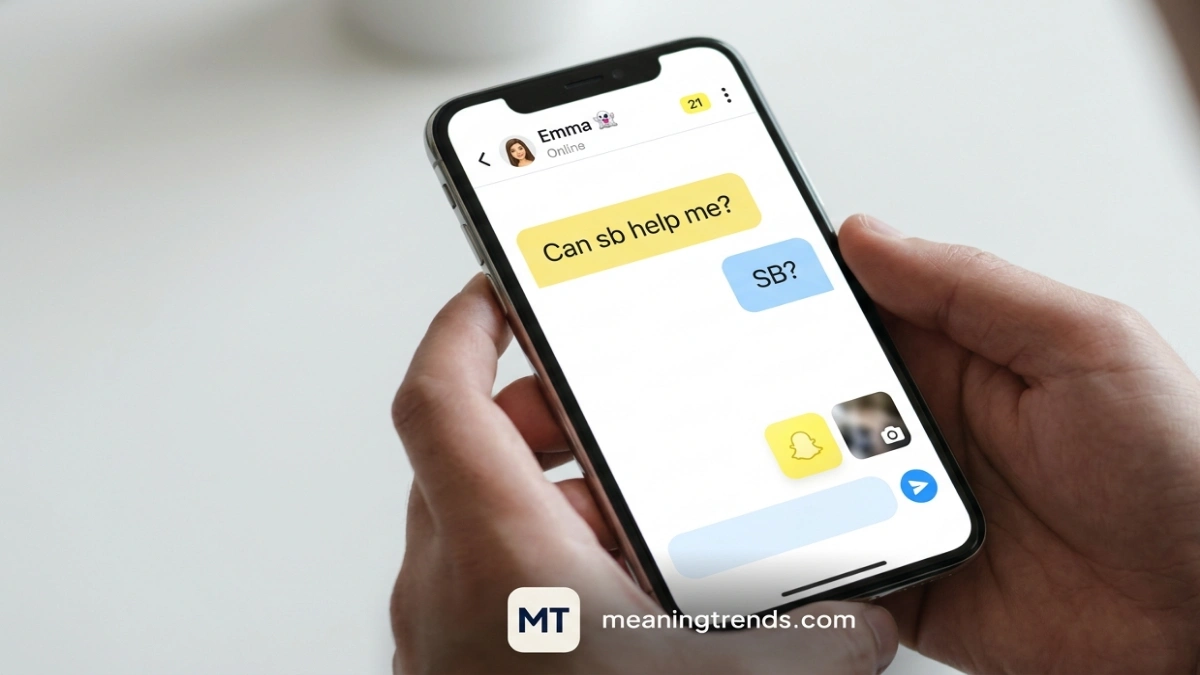
If someone texts, “Can sb help me?”, they mean “Can somebody help me?” If they send “SB?” after a Snapchat picture, they probably want you to send a Snap back.
Two letters can communicate different things depending on how they’re used. That’s particularly important with texting abbreviations because people often shorten words without considering If someone outside their usual circle will understand them.
You might encounter SB in a private message, a group conversation, a social media comment, or a Snapchat exchange. Although the spelling stays the same, the conversational purpose can change.
The easiest way to understand it is to examine the complete sentence rather than assume every person uses the abbreviation in the same way.
What Does SB Mean in Text?
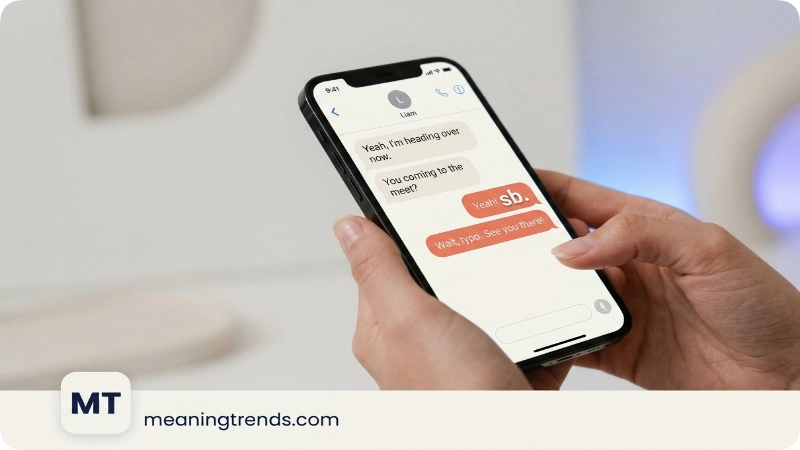
SB is an informal abbreviation whose interpretation depends on the setting. Two particularly useful readings are:
- Somebody: Refers to an unspecified person in an ordinary message.
- Snap back: Requests a reply Snap on Snapchat.
These meanings serve different purposes. Somebody functions as a shortened word within a sentence, while snap back is a request for an action.
For example:
- “I wish sb would call me.” — Somebody should call me.
- “Send me a snap, SB!” — The sender wants a Snap in return.
- “Can sb explain this?” — The sender is asking If any person can provide an explanation.
According to Seventeen (April 2023), SB can replace somebody in ordinary texting but has a different meaning on Snapchat. Cyber Definitions also documents somebody, snap back, and soft block as interpretations of the abbreviation.
SB is therefore not one universally fixed acronym. Its meaning comes from how the letters function in the conversation.
What Does Each Letter Stand For?
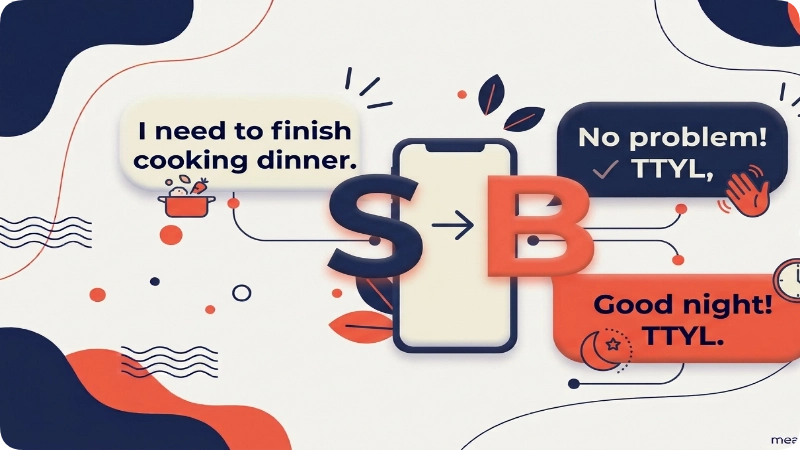
SB is an abbreviation, but its classification changes slightly depending on the intended meaning.
Here is the distinction:
| Meaning | Letter explanation | Classification |
| Somebody | A shortened spelling of somebody | Word abbreviation |
| Snap back | S = Snap, B = Back | Initialism |
| Soft block | S = Soft, B = Block | Initialism |
When SB means somebody, the letters are a shortened representation of the word rather than the initials of two separate words.
When it means snap back or soft block, each letter represents a word. These forms are initialisms because people generally pronounce the letters individually as “ess bee.”
There is no reason to assume every appearance of SB has a longer phrase behind it. Sometimes it is simply a shortened spelling of an ordinary English word.
Why Do People Use SB?

People use abbreviations like SB to communicate quickly, especially in casual conversations where the meaning is already understood.
The purpose depends on the situation.
When SB means somebody:
It saves typing time when the sender wants to refer to an unspecified person.
For example:
“Does sb have the notes from class?”
The sender wants to know If anyone has the notes.
When SB means snap back:
It encourages someone to respond with a Snapchat picture or video.
For example:
“SB for streaks!”
The sender is asking the recipient to send a Snap, potentially to maintain their Snapstreak.
When SB means soft block:
It describes a social media action involving quietly removing someone’s connection or follower status, commonly by blocking and then unblocking them.
The sender might use this shorthand when discussing account management or social media interactions.
These uses have different conversational purposes, so understanding the topic is more useful than memorizing a single expansion.
What Else Can SB Mean?

Besides somebody and snap back, SB has other documented or context specific interpretations.
1. Soft Block
Soft block is an informal social media expression.
It describes blocking someone and then unblocking them to remove the connection without necessarily keeping them permanently blocked.
For example:
Person A: “I don’t want that account following me anymore.”
Person B: “Just SB them.”
Here, SB means soft block.
This interpretation is particularly relevant in conversations about followers, unwanted interactions, and social media account management.
Cyber Definitions documents this use alongside the meanings somebody and snap back.
2. Sidebar
SB can also represent sidebar in certain informal conversations.
A sidebar is an additional conversation or a separate point that is related to the main discussion but not central to it.
For example:
Person A: “Let’s discuss the project first.”
Person B: “I have an SB question afterward.”
The intended meaning here is a separate question or discussion.
However, this is a context dependent shortening rather than a meaning you should automatically assume whenever someone writes SB.
3. Other Specialized Meanings
SB can also appear as an abbreviation in different subjects, organizations, and professional settings.
For instance, it may represent a business or organization name, a technical label, or a specialized expression.
These meanings aren’t necessarily texting slang. They depend on the subject being discussed.
It is better to interpret SB within its actual conversation than to assign it an unrelated expansion.
How Does Context Change the Meaning of SB?
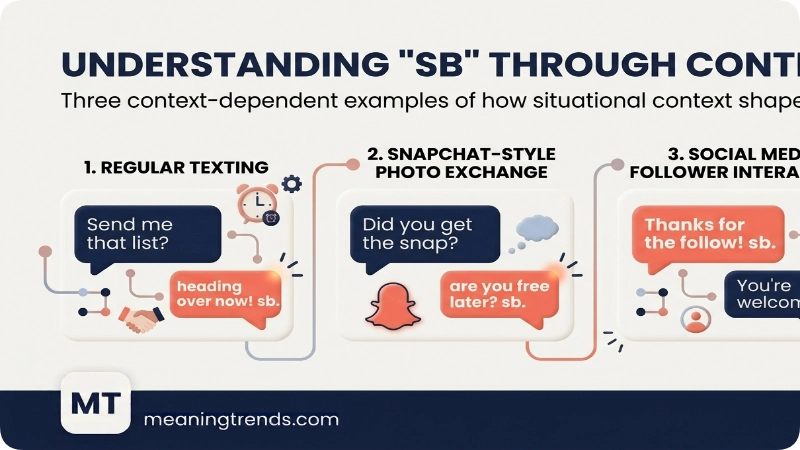
Context is the most important factor when interpreting SB.
The same two letters can communicate a request, identify an unnamed person, or describe an online action.
Consider these clues.
Look at the Words Around SB
The sentence structure often provides the strongest clue.
For example:
- “Can sb come over?” — Somebody.
- “Did sb tell you?” — Somebody.
- “SB me when you’re free.” — Potentially snap back if the conversation concerns Snapchat.
- “You should SB that account.” — Potentially soft block if discussing followers.
Notice how the words around the abbreviation help identify its grammatical purpose.
Consider the Platform
The platform can provide useful information, although it doesn’t guarantee the meaning.
On Snapchat, SB is commonly understood as snap back.
In ordinary SMS, WhatsApp, or iMessage conversations, somebody may be the intended meaning when the abbreviation appears inside a sentence.
On social media platforms where people discuss followers and blocking, soft block becomes a plausible interpretation.
The topic and wording still matter more than the platform alone.
Consider the Previous Conversation
A message rarely exists independently of everything that came before it.
Suppose someone sends:
“SB?”
If the previous exchange involved Snapchat pictures, the sender probably wants a Snap in return.
If the conversation involved finding someone to help with a task, the abbreviation might refer to somebody.
If you were discussing removing followers, soft block becomes a more reasonable interpretation.
Reading the previous message can often resolve the confusion without requiring another question.
Consider Your Relationship With the Sender
Your relationship can help explain the conversational purpose, but it cannot establish the meaning by itself.
A friend might use SB as casual shorthand because both people understand the expression.
A coworker might use it in an informal group chat, although the intended meaning could be different.
Someone you barely know might use an abbreviation that isn’t familiar to you.
When the context isn’t sufficient, asking for clarification is more reliable than assuming what the sender intended.
Examples of SB in Conversation
The following examples are illustrative. They show how the abbreviation can work in different situations.
Example 1: Asking for Somebody
Person A: “Is sb coming to the meeting?”
Person B: “Yes, I think Mark is.”
Meaning: SB means somebody. The sender wants to know If any person will attend the meeting.
Example 2: Asking for Help
Person A: “Can sb help me with this assignment?”
Person B: “I can help you.”
Meaning: The sender is asking If anyone is available to help.
Example 3: Requesting a Snapchat Reply
Person A: “Here’s my picture. SB!”
Person B: “Okay, sending one now.”
Meaning: SB means snap back. The sender wants a picture or video in return.
Example 4: Maintaining a Snapstreak
Person A: “Don’t forget our streak. SB!”
Person B: “Got it!”
Meaning: The sender wants the other person to send a Snap, potentially to keep their Snapstreak active.
Example 5: Discussing an Unwanted Follower
Person A: “That account keeps commenting on everything I post.”
Person B: “You could SB them.”
Meaning: SB means soft block. The suggestion is to remove the follower through the block and unblock method.
Example 6: Referring to a Separate Discussion
Person A: “We’ll finish the main presentation first.”
Person B: “Sure, I have an SB topic to bring up afterward.”
Meaning: SB may mean sidebar in this particular context. The speaker wants to introduce a separate discussion.
The surrounding conversation is important because this interpretation is less universally established than the texting and Snapchat meanings.
Is SB Rude, Flirty, or Offensive?
SB is not inherently rude, flirty, or offensive. Its tone depends on the intended meaning and the way someone uses it.
Is SB Rude?
Generally, no.
Using SB instead of somebody is simply an informal writing choice.
Similarly, asking someone to snap back isn’t automatically rude. However, repeatedly demanding a response could feel pushy.
For example:
“SB when you get a chance.”
This sounds like a casual request.
“SB right now. Why are you ignoring me?”
This sounds more demanding because of the surrounding words, not because SB itself is offensive.
Is SB Flirty?
It can appear in flirtatious conversations, but it doesn’t automatically indicate romantic interest.
For example:
“Hey, cute picture. SB? 😊”
The message could be friendly or flirtatious depending on the existing relationship and conversation.
A request for a Snapchat response only establishes that the sender wants a response. It doesn’t establish attraction, romantic intentions, or deeper feelings.
Is SB Offensive?
The abbreviation itself is generally neutral in the meanings discussed here.
However, the conversation surrounding it can change how the message feels.
A soft blocking discussion may involve an uncomfortable social situation, but the abbreviation isn’t inherently insulting.
If someone uses SB in a sensitive or unfamiliar conversation, consider the complete message before judging its tone.
How Do You Reply to SB?
Your response should depend on what the sender means and If you want to participate.
Here are some natural options.
If SB Means Somebody
You can answer the actual question.
- “I can help.”
- “Maybe ask the group.”
- “I think Sarah knows.”
- “Not sure who is available.”
If SB Means Snap Back
If you want to respond on Snapchat, you can send a picture or video.
Other possible replies include:
- “Sure, give me a minute.”
- “Sending one now!”
- “What should I snap?”
- “I’ll reply later.”
If you prefer texting instead of sending a picture, you can simply say so.
If You Don’t Understand SB
There is nothing wrong with asking what the sender means.
Try:
- “What do you mean by SB?”
- “Do you mean somebody or snap back?”
- “Can you explain that abbreviation?”
If You Don’t Want to Respond
You don’t have to send a Snap simply because someone requests one.
You can politely decline:
- “I’m not sending pictures right now.”
- “Maybe another time.”
- “I’d rather just chat.”
A request for a response doesn’t create an obligation to share a picture or personal information.
When Should You Use or Avoid SB?
SB works best when you’re communicating with people who understand the shorthand.
Appropriate situations include:
- Casual text messages.
- Conversations with friends.
- Informal group chats.
- Snapchat exchanges.
- Social media discussions.
- Conversations about followers and blocking.
Situations where spelling it out is better include:
- Professional emails.
- Academic assignments.
- Formal business communication.
- Instructions that need to be understood by different audiences.
- Conversations where the abbreviation could have multiple interpretations.
For example, instead of writing:
“Can sb send the report?”
Write:
“Can somebody send the report?”
The complete word makes the request clearer and more professional.
Likewise, if you’re asking someone to reply to a Snapchat picture, writing “Send me a Snap back” removes potential confusion.
The goal isn’t to avoid abbreviations altogether. It’s to use them where they make communication easier rather than less clear.
Common Mistakes and Confusion About SB
A few interpretation mistakes are worth avoiding.
1. Assuming SB always means somebody.
Somebody is a documented texting use, but Snapchat conversations commonly use SB for snap back.
2. Assuming every SB message is a Snapchat request.
The abbreviation can appear in ordinary messages without any connection to Snapchat.
3. Treating SB as an established romantic signal.
A request to snap back doesn’t prove that someone is flirting.
4. Confusing soft block with snap back.
Both expressions can be shortened to SB, but they describe different things. One concerns a social media connection; the other requests a Snapchat response.
5. Assuming capitalization changes the meaning.
SB, Sb, and sb can represent the same abbreviation. Capitalization alone doesn’t reliably establish the sender’s intention.
The most reliable approach is to consider the sentence, topic, and previous messages together.
FAQs About SB Meaning in Text
1. What does SB mean from a girl?
SB has the same basic possible meanings regardless of the sender’s gender. It may mean somebody, snap back, or soft block depending on the conversation.
The sender’s gender doesn’t establish which meaning is intended.
2. What does SB mean from a guy?
A guy using SB may be referring to somebody or asking you to send a Snap back.
Look at the message and the platform before deciding what he means. The abbreviation alone doesn’t reveal romantic interest.
3. Does SB mean somebody in texting?
Yes. SB can be used as informal shorthand for somebody.
For example, “Can sb help?” means “Can somebody help?”
4. Does SB mean snap back on Snapchat?
Yes. On Snapchat, SB commonly means snap back. It asks the recipient to send a Snap in return.
5. What does SB mean in a group chat?
It depends on the discussion.
If someone writes “Can sb answer this?”, they probably mean somebody. If the conversation concerns Snapchat exchanges, SB may mean snap back.
6. Is SB the same as snap back?
Not in every situation. SB is the abbreviated form sometimes used for snap back, but it can also represent other expressions.
The full phrase is clearer when the context isn’t obvious.
7. What does SB mean on social media?
It can mean different things depending on the platform and discussion. Snap back is associated with Snapchat, somebody can appear in general messages, and soft block is used in discussions about removing followers.
8. Should I ask someone what SB means?
Yes, especially when the message is too short to interpret confidently.
A simple “What do you mean by SB?” is a natural way to avoid misunderstanding.
What Should You Remember About SB?
SB doesn’t have one meaning in every text conversation. It can stand for somebody in ordinary messages, snap back in Snapchat conversations, or soft block in discussions about social media connections. Other context specific uses are possible, too.
The most important thing is to pay attention to the sentence and the conversation surrounding the abbreviation. A message such as “Can sb help?” has a different purpose from “SB?” sent after a Snapchat picture. The letters alone cannot tell you exactly what someone intends.
If you receive SB and aren’t sure how to interpret it, check the previous messages first. If the meaning remains unclear, ask the sender directly. Writing out the complete expression is also a good choice when clarity matters.
Ultimately, understanding texting shorthand isn’t about memorizing every possible abbreviation. It’s about recognizing how people use language in different situations and avoiding assumptions when the context doesn’t provide a clear answer.