QUICK ANSWER
MHM in text usually means “yes,” “uh huh,” or “I agree.” It’s a casual written version of the spoken sound “mm hmm,” used to confirm something, acknowledge a message, or show that you’re listening. Its exact tone depends on the conversation, so it doesn’t always indicate enthusiasm.
Imagine asking someone, “Are you coming tonight?” and receiving the reply “mhm.” They’re most likely saying yes without typing a complete sentence.
A short reply can sometimes leave you wondering If someone agrees, feels uninterested, or simply has nothing more to add. That’s especially true when you’re communicating through text, where you can’t hear someone’s voice or see their facial expression.
The expression “mhm” is a good example. It’s short, conversational, and often easy to understand when spoken aloud. However, its tone can feel different when it appears as a standalone message.
Understanding the words around it, the question being answered, and your relationship with the sender can help you interpret it more accurately.
What Does MHM Mean in Text?
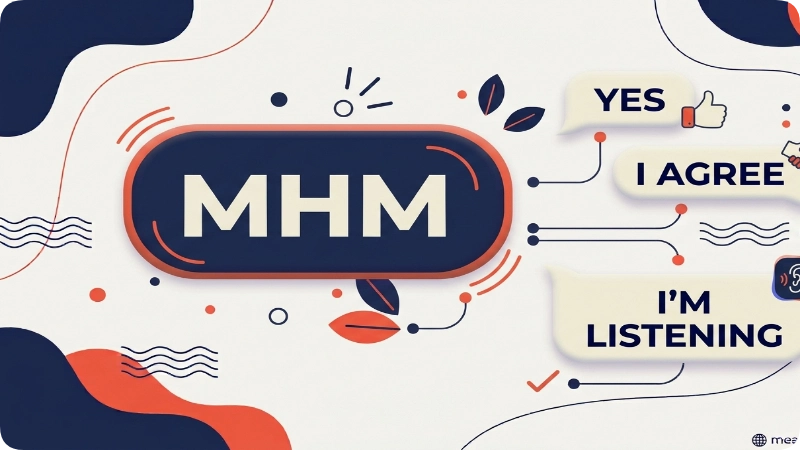
The MHM meaning in text is generally a positive acknowledgment. It represents the sound “mm hmm,” which people commonly use in conversation to communicate agreement, confirmation, or understanding.
According to the Oxford Advanced Learner’s Dictionary, “mhm” is an exclamation used to say yes or show someone that you’re listening.
In everyday texting, it can communicate several closely related messages:
- Yes: Giving an affirmative answer to a question.
- I agree: Showing that you share someone’s opinion.
- Okay: Acknowledging information or instructions.
- I understand: Confirming that you’ve followed what someone said.
- I’m listening: Encouraging someone to continue speaking or explaining.
For example:
Person A: “Did you finish your assignment?”
Person B: “Mhm.”
Here, the reply most naturally means “Yes.”
In another conversation:
Person A: “I think we should leave early to avoid traffic.”
Person B: “Mhm, that’s a good idea.”
Here, it communicates agreement rather than simply answering a yes or no question.
Important: MHM isn’t usually an acronym with a separate word behind every letter. It’s a written representation of a conversational sound, similar to “mm hmm.”
How Does Context Change the Meaning of MHM?
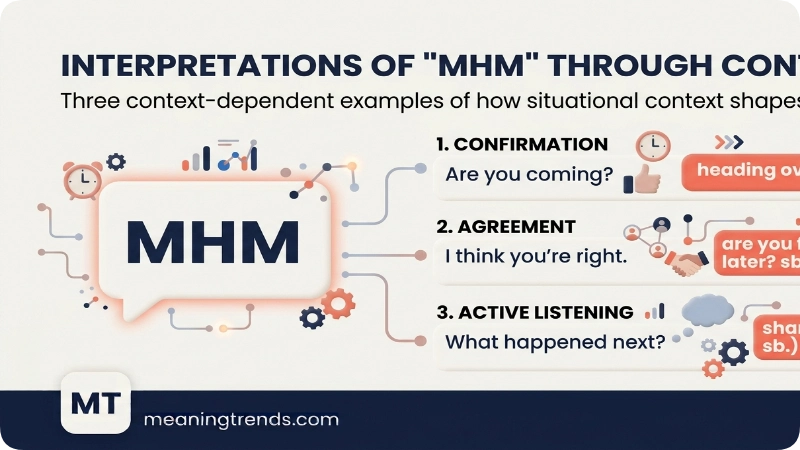
Although MHM generally communicates agreement or acknowledgment, the surrounding conversation helps determine what someone intends.
A single “mhm” can have different shades of meaning depending on the situation.
1. When Someone Asks a Yes or No Question
When MHM follows a direct question, it usually works as a simple affirmative answer.
Example:
Person A: “Are you free tomorrow?”
Person B: “Mhm.”
Meaning: Yes, I’m free tomorrow.
There’s usually no reason to interpret this response as negative or dismissive without additional clues.
2. When Someone Is Sharing a Story
Sometimes people use MHM to show that they’re following another person’s story.
Example:
Person A: “I went to the store, but they had already closed.”
Person B: “Mhm, what happened next?”
Meaning: I’m listening. Please continue.
In this situation, the expression works as a conversational acknowledgment rather than a direct yes.
3. When Someone Is Giving Instructions
MHM can also indicate that someone has received and understood information.
Example:
Person A: “Please remember to call me when you get home.”
Person B: “Mhm, I will.”
Meaning: Okay, I understand, and I’ll do that.
4. When Someone Is Discussing an Opinion
If someone shares an opinion, MHM can indicate that the other person agrees.
Example:
Person A: “That restaurant has really good food.”
Person B: “Mhm, I love their pasta.”
Meaning: I agree with you.
5. When Someone Is Having a Difficult Conversation
A short acknowledgment can also feel less engaged during an emotional or serious discussion.
Example:
Person A: “I felt really hurt by what happened yesterday.”
Person B: “Mhm.”
Meaning: The sender is acknowledging the message, but their exact feelings and level of engagement aren’t clear.
They might be listening, thinking about their response, or unsure what to say.
A single reply isn’t enough to establish that they’re upset or uninterested.
Examples of MHM in Text Conversations
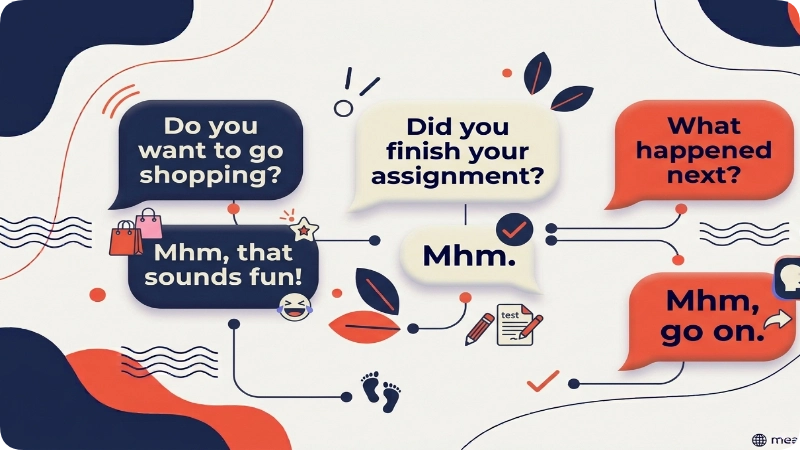
Here are some illustrative conversations showing how people might naturally use MHM in different situations.
Example 1: Making Plans
Person A: “Do you want to go shopping this weekend?”
Person B: “Mhm, that sounds fun!”
Meaning: The person agrees and is interested in the plan.
Example 2: Confirming Something
Person A: “You received my message, right?”
Person B: “Mhm.”
Meaning: Yes, I received it.
Example 3: Showing Understanding
Person A: “The meeting starts at 10, not 11.”
Person B: “Mhm, got it.”
Meaning: I understand the updated time.
Example 4: Agreeing With a Friend
Person A: “I think that movie was better than the first one.”
Person B: “Mhm, definitely!”
Meaning: The person shares the same opinion.
Example 5: Listening to Someone
Person A: “So I called her, and then she told me everything.”
Person B: “Mhm, go on.”
Meaning: I’m following your story. Keep talking.
Example 6: A Short or Uncertain Response
Person A: “I guess we have to cancel our plans.”
Person B: “Mhm…”
Meaning: The response could suggest hesitation, disappointment, or simple acknowledgment. More context is needed to know which interpretation fits.
These examples show why the conversation matters more than the expression alone.
Is MHM Rude, Flirty, or Dismissive?
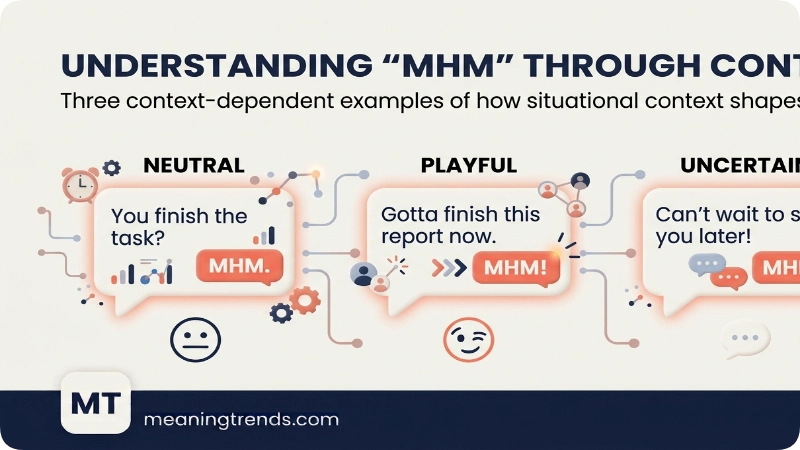
MHM isn’t inherently rude, romantic, or dismissive. It’s generally a neutral conversational expression, but its tone can change with the situation.
Can MHM Sound Rude?
Sometimes.
If someone sends a long, personal message and receives only “mhm” in response, they might feel that the other person isn’t giving the conversation much attention.
However, a short reply doesn’t automatically mean disrespect.
Some people naturally communicate using brief messages, even when they’re interested in the conversation.
Can MHM Be Flirty?
It can appear in playful or flirtatious conversations, but the expression itself isn’t a reliable sign of romantic interest.
For example:
Person A: “You looked really nice today.”
Person B: “Mhm, did you notice? 😉”
The playful follow up and wink contribute to the flirtatious tone. MHM alone doesn’t establish that intention.
Can MHM Mean Someone Is Annoyed?
It may sound distant or reluctant in certain conversations, particularly when the surrounding messages involve disagreement.
For example:
Person A: “I thought we agreed not to cancel again.”
Person B: “Mhm.”
The response might feel tense, but it could also be a simple acknowledgment.
To understand the sender’s attitude, consider their usual communication style and what they say next.
How Do You Reply to MHM in a Text?
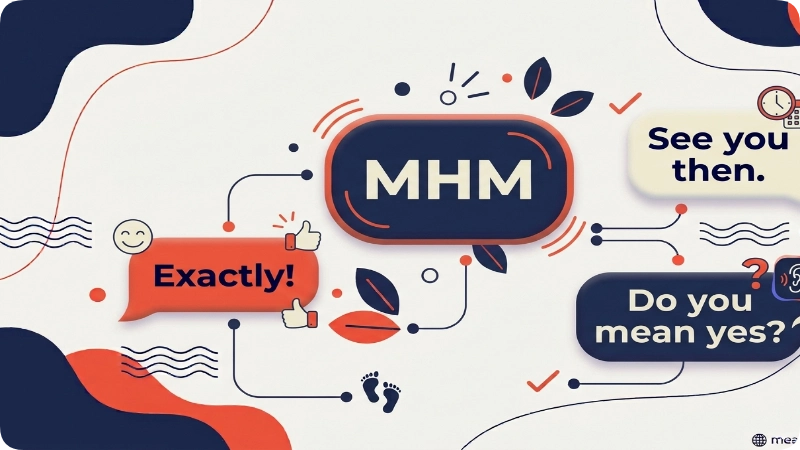
Your response depends on what the other person is communicating and If you want to continue the conversation.
Here are some natural options.
| Situation | Possible Reply |
| They agree with you | “Exactly!” |
| They’re confirming plans | “Great, see you then.” |
| They’re listening to your story | “Anyway, here’s what happened next.” |
| You’re unsure what they mean | “Do you mean yes?” |
| You want a friendly response | “Haha, glad you agree!” |
| You’re discussing something serious | “I wanted to hear what you think about it.” |
You don’t always need to reply to MHM. If it answers your question or confirms something, the conversation may naturally move forward.
If the response feels unclear, asking a simple follow up is better than assuming the sender is upset.
When Should You Use or Avoid MHM?
MHM works best in informal conversations where both people understand casual texting expressions.
Good situations to use MHM:
- Texting friends and family.
- Agreeing with someone’s casual opinion.
- Confirming simple plans.
- Acknowledging information.
- Showing that you’re following a conversation.
Situations where a fuller response is better:
- Professional emails and workplace communication.
- Important conversations that require clear confirmation.
- Serious discussions involving personal feelings.
- Situations where someone needs a detailed answer.
For example, if a colleague asks If you’ve completed an important task, replying “MHM” may be less clear than writing:
“Yes, I’ve completed it.”
Similarly, if someone shares something personal, a thoughtful response may communicate more attention than a one word acknowledgment.
The goal isn’t to avoid MHM altogether. It’s to choose a response that gives the other person enough information.
What Are Other Ways to Say MHM?
If you want to communicate the same general idea more clearly, several alternatives are available.
| Expression | Meaning | Typical Use |
| Yeah | Yes or agreement | Casual conversations |
| Yep | Yes or confirmation | Quick answers |
| Uh huh | Yes or acknowledgment | Spoken style conversations |
| I agree | Sharing an opinion | Clear agreement |
| Okay | Acknowledgment or acceptance | General conversations |
| Got it | I understand | Instructions or information |
| Absolutely | Strong agreement | Enthusiastic responses |
| I understand | Confirmation of understanding | Serious or professional conversations |
These expressions aren’t perfect substitutes in every situation.
For instance, “got it” communicates understanding, while “absolutely” usually expresses stronger agreement. MHM can cover both acknowledgment and agreement depending on the context.
FAQs About MHM Meaning in Text
1. What does MHM stand for in texting?
MHM doesn’t normally stand for a series of separate words. It’s a written version of “mm hmm,” a conversational sound used to express agreement, confirmation, or acknowledgment.
2. Does MHM mean yes or no?
MHM generally means yes, not no. It is an affirmative response commonly used to answer questions or show agreement.
3. What does MHM mean from a girl?
When a girl texts MHM, it generally has the same meaning as when anyone else uses it: yes, agreement, or acknowledgment. The message alone doesn’t reveal romantic interest, annoyance, or other personal feelings.
4. What does MHM mean from a guy?
When a guy sends MHM, he’s usually acknowledging something, agreeing, or answering yes. The surrounding conversation helps determine the exact meaning.
5. Is MHM the same as MM HMM?
They’re closely related written forms of the same conversational sound. Both can express agreement, confirmation, or active listening.
6. Does MHM mean okay?
It can. When someone uses MHM after receiving information or instructions, it may communicate “okay” or “I understand.” However, the exact meaning depends on what came before it.
7. Is MHM a good or bad response?
Neither automatically. MHM is generally neutral and affirmative. It can feel friendly, distant, or less engaged depending on the conversation, but it doesn’t have an inherently negative meaning.
8. Is MHM appropriate in professional messages?
It’s understandable in casual workplace chats, but a complete response is usually clearer for important professional communication. Expressions such as “Yes, understood” or “Confirmed” can be more appropriate.
Conclusion
MHM is a simple conversational expression that generally communicates yes, agreement, understanding, or acknowledgment. It’s the written form of “mm hmm,” rather than a traditional acronym with a fixed full form. People use it because it provides a quick, natural way to respond without typing a complete sentence.
The most important thing to remember is that the expression doesn’t tell you everything about the sender’s feelings. A short “mhm” might be a friendly confirmation, an acknowledgment that someone is listening, or a brief response during a busy moment. Its tone becomes clearer when you consider the question, surrounding messages, and relationship between the people communicating.
If you’re unsure what someone means, look at the conversation before making assumptions. You can always ask, “Do you mean yes?” or “Is everything okay?” A little clarification is often more useful than trying to interpret a short message on its own.
Slang usage verified: October 2026. Core definitions checked against the Oxford Advanced Learner’s Dictionary, Dictionary.com, and linguistic reference material on conversational interjections.

Alex writes about the words and shortcuts people use in texts, group chats, and social media. Each guide explains the meaning with everyday examples and tips on when to use it