QUICK ANSWER
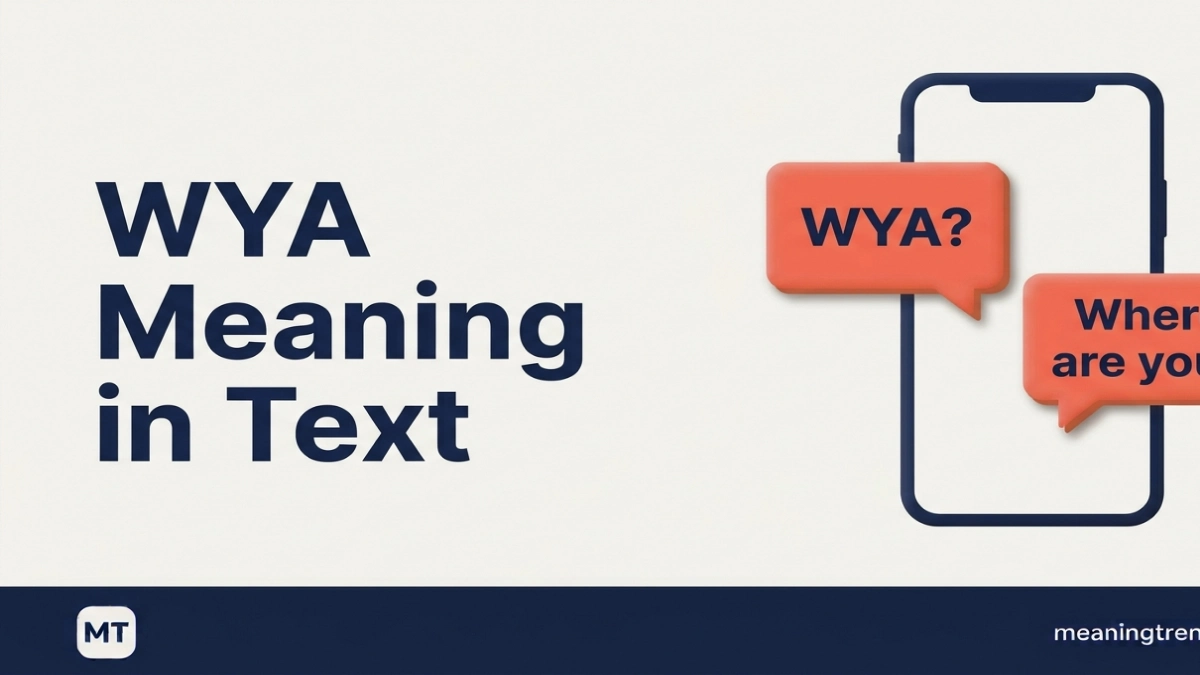
WYA means “Where you at?” in text messages and online chats. It’s an informal way to ask where someone is, If they’re at home, nearby, or on their way somewhere. Depending on the conversation, it can be a simple question, an invitation to meet, or a request for an update. The abbreviation alone doesn’t reveal the sender’s exact intention.
Example:
Person A: “Wya?”
Person B: “At home, just chilling.”
Meaning: Person A is asking where Person B is.
If you’ve received “wya” in a message, the surrounding conversation can help you decide If the sender simply wants to know your location or is trying to make plans.
What Does WYA Mean in Text?
WYA is an informal texting abbreviation for “Where you at?” The phrase asks about someone’s current location and is commonly understood as a casual alternative to “Where are you?”
The wording is conversational rather than formal. In everyday texting, people often shorten questions to save time or make their messages feel relaxed.
For example:
- “Hey, wya?” means “Hey, where are you?”
- “Wya rn?” means “Where are you right now?”
- “Wya tonight?” asks where you are or, depending on the conversation, where you’ll be that evening.
- “Wya? We’re here already” asks for your location and may imply that the sender is waiting for you.
The precise interpretation depends on the words around WYA. A message asking “wya rn?” usually focuses on the present moment, while “wya tonight?” may be about future plans.
WYA is not usually a complete formal sentence. It’s a shortened expression that works because people familiar with texting can understand the intended question without every word being written out.
It’s also useful to distinguish the expression’s literal meaning from its conversational purpose. Someone can ask where you are because they’re meeting you, checking If you’re available, or simply continuing a conversation. The abbreviation itself doesn’t establish which explanation is correct.
What Does Each Letter in WYA Stand For?
WYA is an initialism formed from the first letters of the words in “Where You At?”
| Letter | Word | Meaning |
| W | Where | Asks about a place or location |
| Y | You | Refers to the person receiving the message |
| A | At | Points to the place someone is located |
The full expression is “Where you at?” In standard American English, the equivalent question is “Where are you?”
For example:
- WYA? — Where are you?
- WYA rn? — Where are you right now?
- WYA after work? — Where will you be after work, or where can we meet after work?
The last example illustrates an important distinction: adding words can change the time frame or practical purpose of the question.
WYA is not a different word for every situation. Its basic location related meaning stays the same, while the conversation determines If the sender wants a quick update, is arranging a meeting, or is asking about your plans.
Why Do People Use WYA?
People use WYA because it makes a short question easy to send in a casual conversation. Instead of typing a complete sentence, they can use three letters and rely on the recipient to understand the intended meaning.
There are several practical reasons someone might send it.
- To find someone: A friend wants to know where you are at a meeting place, event, or public location.
- To coordinate plans: Someone wants to find out If you’re nearby or ready to meet.
- To check availability: The sender wants to know If you’re around before suggesting an activity.
- To continue a conversation: Someone opens a chat with a quick question rather than a longer greeting.
These are possible conversational purposes, not separate definitions of WYA.
For example, if a friend texts “WYA? We’re at the restaurant,” the reference to the restaurant suggests that they’re trying to locate you or coordinate your arrival. If someone texts “WYA this weekend?” they may be asking about your plans rather than your immediate location.
The key is to read the abbreviation alongside the rest of the message.
How Does Context Change the Meaning of WYA?
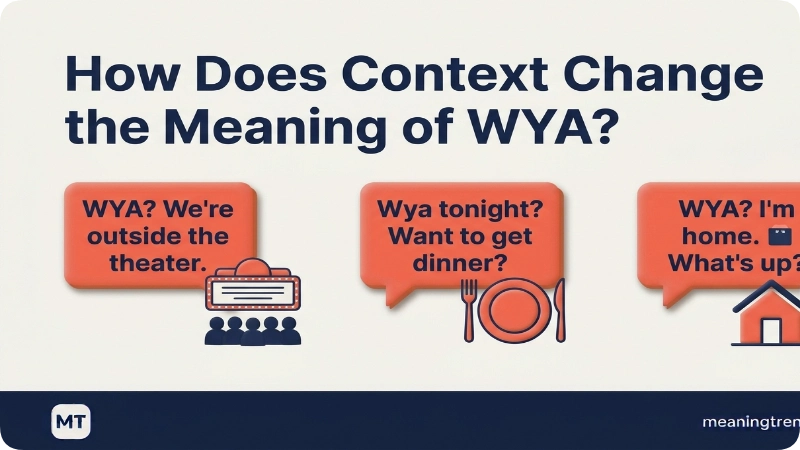
WYA asks about location, but the reason for asking can vary. Look at the surrounding words, any existing plans, and your relationship with the sender before deciding what the message implies.
When a friend sends WYA
A friend might use WYA to find you, check If you’re joining a group, or start a casual conversation.
Example:
Person A: “WYA? We’re outside the theater.”
Person B: “Walking over now.”
The mention of the theater suggests that the sender wants to coordinate a meeting. There’s no need to assume the message is impatient or annoyed.
When a romantic interest sends WYA
In a romantic conversation, WYA may be a way to find out If you’re available to meet or spend time together. However, the abbreviation alone doesn’t prove that the sender is flirting.
Example:
Person A: “Wya tonight?”
Person B: “Just staying home. Why?”
Person A: “Want to get dinner?”
The follow up invitation makes the sender’s purpose clearer. Without it, the original message could simply have been a location or availability question.
When a family member sends WYA
A family member may be checking your whereabouts because you’re expected somewhere or because you’re coordinating plans.
Example:
Person A: “WYA? Dinner’s ready.”
Person B: “Leaving work now. Be home in 20 minutes.”
Here, the mention of dinner makes the practical purpose clear. The message doesn’t need to carry any special emotional meaning.
When a coworker or acquaintance sends WYA
The same abbreviation can sound overly casual in a professional conversation, depending on the relationship and workplace culture.
Example:
Coworker: “WYA? The meeting started.”
A clearer response might be: “I’m on my way to the conference room.”
If the message is about work, respond to the practical question. You don’t need to interpret the abbreviation as a criticism unless the surrounding conversation provides a reason to do so.
When someone sends WYA without any other words
A message containing only “wya?” offers little information about the sender’s purpose.
They might want to meet, ask a quick question, or simply find out where you are. If you don’t know why they’re asking, a brief clarification is often more useful than guessing.
For example: “I’m home. What’s up?”
This answers the question while giving the sender an opportunity to explain what they need.
Examples of WYA in Conversation
The following are illustrative conversations showing how WYA can appear in different everyday situations.
Example 1: Meeting friends
Person A: “WYA? We got a table.”
Person B: “Just parked. Be there in five.”
Interpretation: Person A wants to know where Person B is in relation to the planned meetup.
Example 2: Making spontaneous plans
Person A: “Wya rn?”
Person B: “At home. Why?”
Person A: “Wanna grab coffee?”
Interpretation: The location question leads to an invitation. The second message clarifies the sender’s purpose.
Example 3: Checking on someone’s arrival
Person A: “WYA? The movie starts in 10.”
Person B: “On the bus, almost there.”
Interpretation: The sender is checking the recipient’s whereabouts because the event is about to begin.
Example 4: Starting a casual conversation
Person A: “Heyy wya”
Person B: “Just finished class. What’s up?”
Interpretation: The message could be a casual opener or a way to check availability. The reply leaves room for the sender to explain.
Example 5: Asking about future plans
Person A: “WYA Saturday night?”
Person B: “Nothing planned yet.”
Person A: “Want to come to the game?”
Interpretation: Because Saturday night is mentioned, the question concerns future availability or plans rather than the recipient’s current location.
Example 6: An unclear message
Person A: “WYA?”
Person B: “At home. Did you need something?”
Interpretation: The reply provides a general location and politely asks for the reason behind the message.
These examples show why context matters. The abbreviation asks a location related question, but what happens next helps explain the sender’s practical goal.
Is WYA Rude, Flirty, or Offensive?
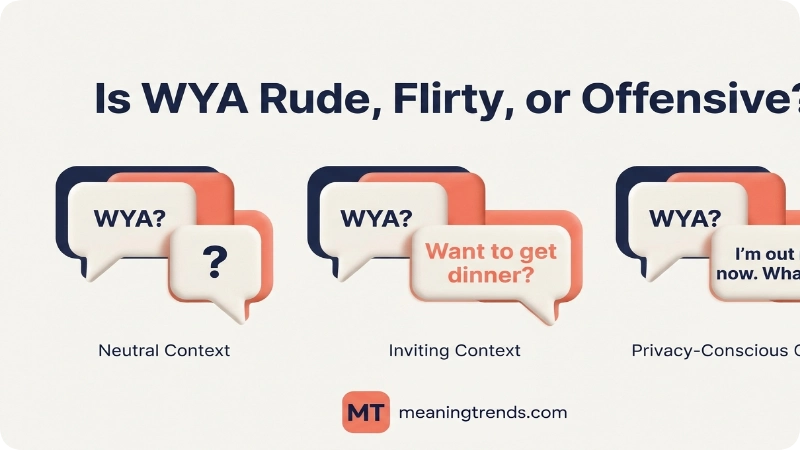
WYA is generally a casual, neutral expression. It isn’t inherently rude, romantic, or offensive. Its tone depends on the wording, situation, relationship, and expectations between the people messaging.
Can WYA sound rude?
It can feel abrupt when sent without a greeting, especially if the recipient isn’t expecting the message. But a short message isn’t automatically rude.
Compare these examples:
- “Hey, wya? 😊” may feel friendly.
- “WYA? We’re waiting for you.” communicates a practical need and may sound urgent.
- “WYA???” after repeated unanswered messages may convey impatience, depending on the circumstances.
Punctuation can influence how a message feels, but it doesn’t prove the sender’s emotional state. The history of the conversation is more informative than punctuation alone.
Can WYA be flirty?
Yes, it can be used in a flirtatious conversation, particularly when the sender is trying to arrange time together. However, the phrase itself isn’t a declaration of attraction.
For example:
Person A: “Wya tonight?”
Person B: “Home, why?”
Person A: “I was hoping to see you.”
The follow up message provides the stronger evidence of romantic interest. Without that context, WYA could simply be an ordinary question.
Is WYA offensive?
The abbreviation isn’t inherently offensive. It’s informal shorthand, so the main concern is If it suits the setting or If the question feels intrusive.
You also don’t have to share your exact location simply because someone asks. If you’re uncomfortable, you can give a broad answer, ask why they want to know, or politely decline to share your whereabouts.
For example: “I’m out right now, but what’s up?”
That keeps the conversation open without disclosing more than you want to.
How Do You Reply to WYA?
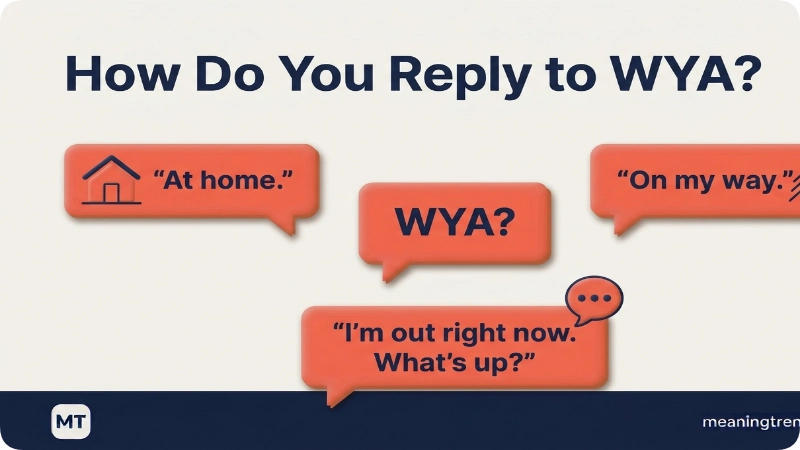
The easiest way to respond to WYA is to answer according to what you’re comfortable sharing and what you think the sender needs to know. You don’t need a clever response; a short, direct message is usually enough.
1. Give a simple location update
Example: “I’m at home.”
Use this when the sender simply wants to know where you are.
2. Explain that you’re on your way
Example: “About 10 minutes away.”
This works when you’re heading to a place where the sender is waiting.
3. Find out what they have in mind
Example: “I’m free right now. What’s up?”
This is useful when you suspect they want to make plans but haven’t explained yet.
4. Keep it playful
Example: “Guess where 😉”
Use this only if a playful tone fits your existing relationship and conversation.
5. Protect your privacy
Example: “I’m out at the moment. Did you need something?”
This lets you respond without sharing your exact location.
If you’re unsure why someone sent WYA, a useful all purpose response is “I’m at home. What’s up?” It answers the question at a broad level and invites the sender to explain their purpose.
When Should You Use or Avoid WYA?
WYA works best when the conversation is informal and both people understand texting shorthand.
Good situations for WYA include:
- Texting friends or family.
- Coordinating a casual meetup.
- Checking If someone has arrived.
- Messaging someone you’re already chatting with informally.
- Sending a quick question in a group chat.
Consider using the full question instead when:
- Writing a formal email.
- Contacting a client or someone you don’t know well.
- Communicating in a setting where clarity matters more than brevity.
- Asking for someone’s location in a situation that requires precise information.
For example, instead of texting “WYA?” to a professional contact, you could write, “Where are you currently?” If you’re checking on an appointment, “Have you arrived?” may be more precise.
The aim isn’t to avoid all slang. It’s to choose wording that suits the relationship and makes your meaning easy to understand.
What Are Other Ways to Say WYA?
Several expressions can replace WYA, but they don’t all ask exactly the same question.
| Expression | Meaning | Typical use | Key distinction |
| Where are you? | Asks about someone’s location | General conversation | Standard English equivalent |
| Where are you right now? | Asks for a current location | Time sensitive coordination | Emphasizes the present |
| Are you nearby? | Asks If someone is close | Meeting up | Focuses on distance |
| Have you arrived? | Checks If someone has reached a destination | Appointments or events | Focuses on arrival |
| Are you free? | Asks about availability | Making plans | Doesn’t necessarily ask about location |
| WYD | “What you doing?” | Casual texting | Asks about activity rather than place |
The closest standard English alternative is “Where are you?” If you want to know If someone can meet, “Are you free?” may be a better choice. If you’re waiting for someone, “Have you arrived?” can make your question more specific.
WYA vs. WYD: What’s the Difference?
WYA and WYD are easy to confuse because both appear in casual text conversations, and both can help people start making plans.
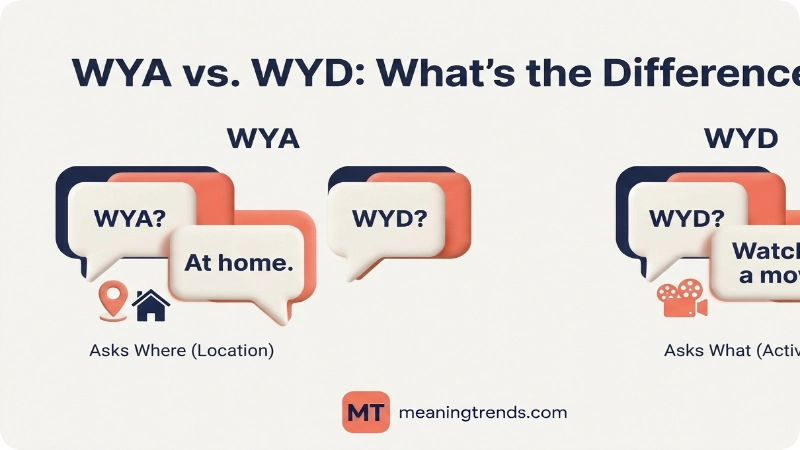
- WYA asks where someone is.
- WYD asks what someone is doing.
For example:
Person A: “WYA?”
Person B: “At home.”
Person A: “WYD?”
Person B: “Watching a movie.”
The first answer gives a location; the second describes an activity. People may send both questions together when they want to know where you are and what you’re doing.
The distinction is useful because someone asking WYD isn’t necessarily asking for your whereabouts, and someone asking WYA isn’t necessarily asking what you’re doing.
FAQs About WYA Meaning in Text
What does WYA mean from a girl or a guy?
WYA means “Where you at?” regardless of the sender’s gender. The person may be asking about your location, checking your availability, or trying to arrange a meetup. The message alone doesn’t establish romantic interest.
What does WYA mean in a text from a crush?
A crush may use WYA to see If you’re available or If you can meet. However, it can also be a straightforward location question. Look at any follow up messages and the context of your conversations before interpreting it as flirting.
What does WYA mean with RN?
RN means “right now.” Together, “WYA rn?” means “Where are you right now?” The added abbreviation emphasizes the present moment.
Does WYA mean the same thing on Snapchat and Instagram?
WYA retains its basic meaning, “Where you at?”, in ordinary text messages and social media chats. The surrounding conversation determines If someone is asking about location, checking availability, or trying to make plans.
Is WYA the same as WYD?
No. WYA asks where someone is, while WYD asks what someone is doing. The questions can be used together, but they request different information.
What does it mean if someone texts WYA late at night?
It still asks where you are. Depending on the conversation, the sender may be checking If you’re available, suggesting a meetup, or simply asking a question. The time of day alone doesn’t prove that the message is flirtatious or has any particular hidden meaning.
Should I tell someone exactly where I am when they ask WYA?
Only if you’re comfortable sharing that information. You can answer generally, ask why they want to know, or decline to provide details. You aren’t obligated to disclose your precise location just because someone sends a text.
What Should You Remember About WYA?
WYA is a casual texting abbreviation for “Where you at?” It’s a short way to ask where someone is, and it often appears when people are coordinating plans, checking arrivals, or finding out If someone is available. The standard English equivalent is “Where are you?”
The most important thing to remember is that the question itself doesn’t reveal the sender’s motive. A friend, coworker, family member, or romantic interest may use the same three letters for different reasons. Read the message alongside the conversation rather than assuming the sender is flirting, annoyed, or expecting you to meet.
If someone texts you WYA and you’re unsure what they want, you can simply answer “I’m at home. What’s up?” Share only the information you’re comfortable giving, and ask a follow up question if you need more context. A short message doesn’t have to become a guessing game when a clear, natural reply can resolve the uncertainty.

Alex writes about the words and shortcuts people use in texts, group chats, and social media. Each guide explains the meaning with everyday examples and tips on when to use it