QUICK ANSWER
WSG usually means “what’s good?” in text messages and online chats. It’s an informal greeting similar to “what’s up?” or “how’s it going?” People use it to say hello, check in, or start a conversation. For example, “wsg?” generally invites a casual response like “Not much, you?”
Seeing a message that contains only three letters can leave you wondering If the sender is greeting you, asking about your plans, or trying to show interest. The surrounding conversation helps you tell the difference. A friend sending “wsg” may simply want to catch up, while someone messaging you before a weekend outing may be checking what you’re doing.
The key is to understand both the expression and its purpose. Although WSG has a recognizable meaning in texting slang, it doesn’t automatically reveal the sender’s mood, intentions, or feelings toward you. A short message can be friendly without being flirty, and it can start a conversation without asking for a detailed update.
What Does WSG Mean in Text?
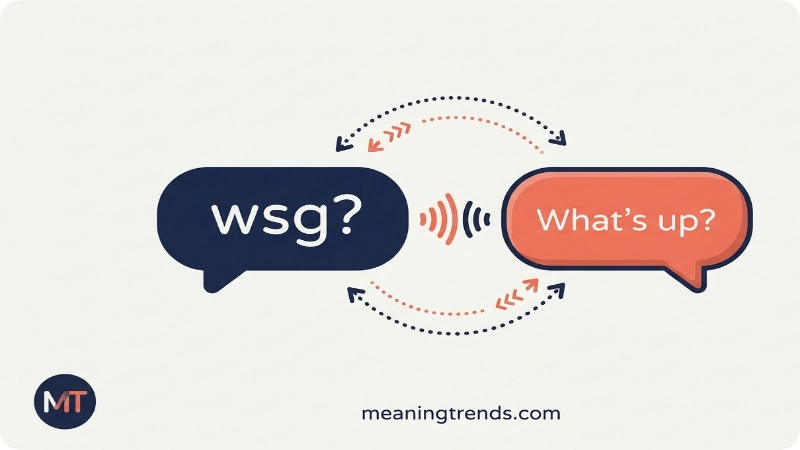
WSG is an informal abbreviation for “what’s good?” Dictionary.com identifies this as the expression’s texting and social media meaning.
In everyday conversation, “what’s good?” functions as a greeting or check in rather than a literal question about what is good. Depending on the situation, it can communicate several closely related ideas:
- “What’s up?” — A casual way to say hello.
- “How are you?” — An invitation to share how things are going.
- “What’s going on?” — A question about current events or what is happening.
- “What are you up to?” — A possible interpretation when the conversation concerns someone’s activities or plans.
These expressions aren’t exact replacements in every situation, but they capture the general conversational purpose of WSG.
For example, if someone texts “wsg bro,” they’re probably greeting you. If they write “wsg tonight?”, the added reference to tonight suggests they may be asking about your plans.
The abbreviation is informal, so it fits naturally into texts, direct messages, group chats, and other relaxed conversations. It is less suitable for formal emails, professional introductions, or messages where clear, polished wording matters.
What Does Each Letter in WSG Stand For?
WSG is commonly used as an initialism for “what’s good?” It takes the initial letters of the three words:
- W — What’s
- S — Good? Wait, the second letter of “what’s good” is not S.
This is where the abbreviation needs a little clarification: WSG is an established shorthand for “what’s good,” but its letters do not correspond neatly to the first letters of those words under ordinary spelling rules. It is best learned as a conventional texting abbreviation rather than treated as a perfectly letter by letter construction.
You may see it written as wsg, Wsg, or WSG. In casual messages, these variations generally communicate the same greeting. Capitalization alone doesn’t establish a different tone or meaning.
The most useful thing to remember is the phrase people use it to represent, not an attempt to assign a separate word to every letter.
More precisely, the letters reflect the written form “what’s good”: W represents “what,” S reflects the contraction “’s,” and G represents “good.” This explains the spelling without inventing a separate expansion for each letter.
Why Do People Use WSG?
People use WSG because it offers a quick, relaxed way to open a conversation. Instead of typing a complete question, someone can send three letters and let the other person decide how much they want to share.
Common reasons include:
- Starting a conversation: A simple “wsg?” can replace “Hey, how are you?”
- Checking in: Someone may want to know how you’ve been without making the conversation feel serious.
- Finding out about plans: In a message about an upcoming event, WSG can introduce a question about what’s happening.
- Reconnecting casually: An old friend might use it to restart a conversation without a formal greeting.
- Keeping a chat relaxed: The abbreviation gives a message an informal, conversational feel.
For instance:
Person A: wsg Person B: Not much, just relaxing. You?
Person A has opened the conversation, and Person B has responded while giving them an opportunity to continue.
However, the abbreviation doesn’t necessarily mean the sender has something important to say. Sometimes a greeting is simply a greeting.
How Does Context Change the Meaning of WSG?
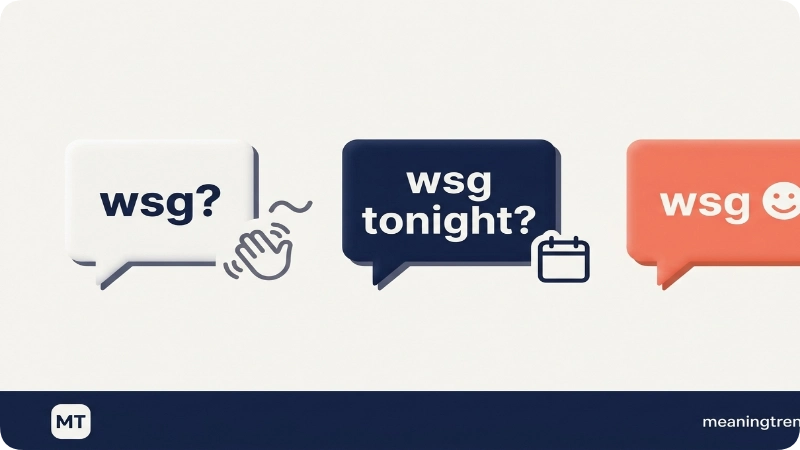
The basic meaning generally stays the same, but the purpose behind the message can change with the situation. Consider who sent it, what you were discussing previously, and If the message includes additional words.
When a Friend Sends WSG
A friend might send “wsg?” while you’re both online or after a few days without talking. This is usually a casual invitation to chat.
Example:
Person A: wsg bro Person B: Chilling at home. What’s up?
The exchange suggests a relaxed greeting. There’s no reason to assume the sender is worried, upset, or asking for anything specific.
When Someone You Like Sends WSG
If someone you’re interested in sends “wsg?”, they may be trying to start a conversation. The message could be a way to show interest, but the abbreviation alone doesn’t establish romantic or sexual intent.
Look at the broader interaction. Does the person ask follow up questions, make plans, or continue the conversation? Those behaviors provide more context than the three letters themselves.
Example:
Person A: wsg 😊 Person B: Hey! Not much, how about you?
The smile emoji may make the message feel warmer, but it doesn’t prove that the sender is flirting.
When Someone Sends WSG Before Making Plans
A message such as “wsg tonight?” is more specific than a standalone greeting. The reference to tonight suggests the sender wants to discuss plans or find out what’s happening.
Example:
Person A: wsg tonight? Person B: Nothing planned yet. Why?
Here, asking why is a natural way to find out If the sender has a suggestion or invitation in mind.
When WSG Appears in a Group Chat
In a group chat, WSG may address several people at once. The sender could be checking what’s happening, starting a general conversation, or asking If anyone is available.
Example:
Person A: wsg everyone, anyone playing later? Person B: I’m free after 8.
The rest of the sentence makes the purpose clear: the sender wants to coordinate an activity.
Examples of WSG in Conversation
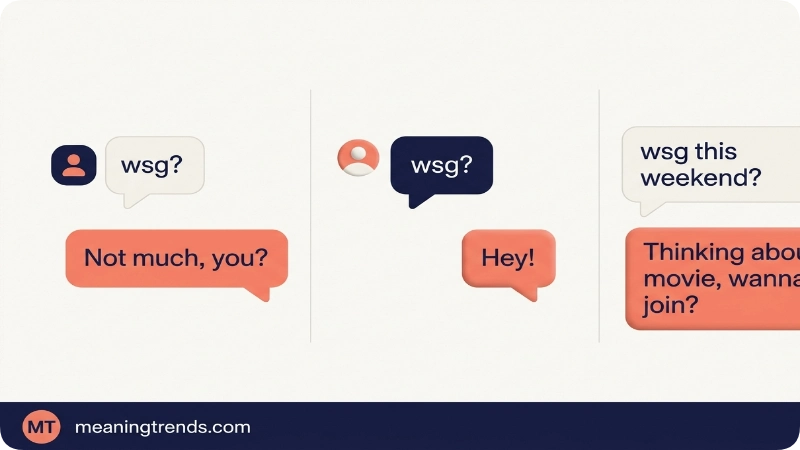
These illustrative examples show how WSG works in different texting situations.
1. A basic greeting
Person A
wsg?
Person B
Hey, not much. You?
Meaning: A casual conversation opener.
2. Asking about plans
Person A
wsg this weekend?
Person B
I’m free Saturday. Why?
Meaning: The sender may be checking availability or starting a discussion about plans.
3. Reconnecting with someone
Person A
wsg, been a while
Person B
For real! I’ve been good. How’ve you been?
Meaning: The sender is reopening a conversation after some time apart.
4. A potentially flirty conversation
Person A
wsg 😊
Person B
Hey you! What’s up?
Meaning: The exchange is friendly; If it is flirtatious depends on the wider relationship and conversation.
These examples are illustrative, not fixed rules. The same message can serve different purposes depending on the relationship and what happened before it.
Is WSG Rude, Flirty, or Offensive?
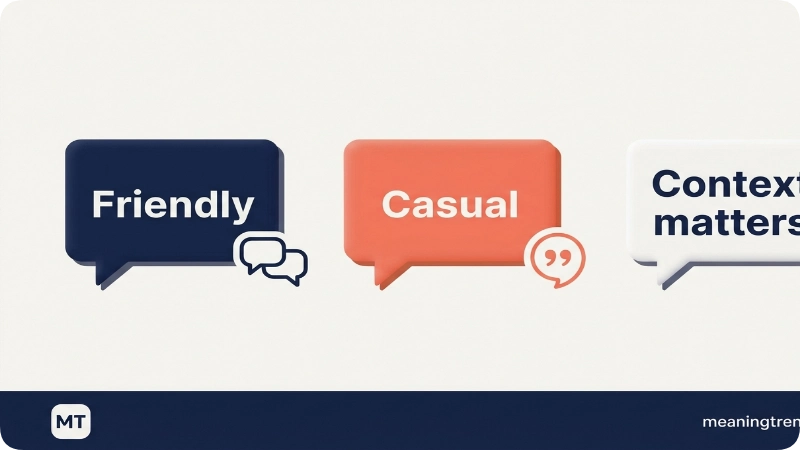
WSG is generally a casual, neutral greeting. It isn’t inherently rude, offensive, or romantic, although the surrounding conversation can change how it comes across.
- Friendly: A friend sends “wsg?” to see how you’re doing.
- Potentially flirty: Someone you have been flirting with uses it to start another conversation.
- Very casual: A new acquaintance sends “wsg” instead of a more conventional greeting.
- Possibly abrupt: If you’re unfamiliar with texting slang, a message containing only three letters may seem unusually short.
A short message doesn’t necessarily indicate disrespect. Some people communicate with brief greetings, while others prefer complete sentences.
Likewise, don’t assume that someone is romantically interested in you just because they initiate a conversation. Their follow up messages and overall behavior are more informative than WSG by itself.
If the message makes you uncomfortable or you don’t want to continue chatting, you don’t have to respond. You can also ask what the person means if the surrounding conversation is unclear.
How Do You Reply to WSG?
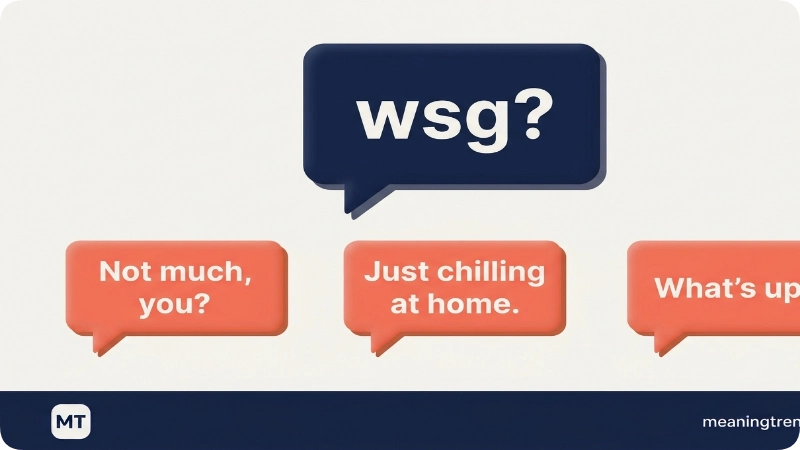
The easiest response is to treat WSG like “What’s up?” You can answer briefly, share what you’re doing, or ask the other person the same question.
Here are several natural replies you can adapt to your situation.
| Your situation | Possible reply |
| You want to be friendly | “Hey! Not much, you?” |
| You’re busy | “Just finishing some work. What’s up?” |
| You’re relaxing | “Just chilling at home.” |
| You want to make plans | “Nothing much. You trying to do something?” |
| You want to sound playful | “What’s good with you? 😂” |
| You’re unsure what they mean | “Hey, what’s up? Did you need something?” |
| You don’t want to chat | You can leave it unanswered or politely say you’re busy. |
You don’t need to copy the sender’s slang to fit in. A straightforward response such as “Hey, how’s it going?” works just as well.
Should You Reply With WSG Too?
You can, especially if you want to return the greeting without adding much to the conversation.
For example:
Person A: wsg
Person B: wsg lol
This mirrors the original message, but it may not move the conversation forward. If you’d like to keep chatting, add a question or a little information about yourself.
For instance, “Hey, just got home. What are you up to?” gives the other person something specific to respond to.
When Should You Use or Avoid WSG?
WSG works best when the conversation is already informal or when a relaxed greeting fits the relationship.
Good situations for WSG include:
- Texting friends or people you know casually.
- Starting a conversation in a group chat.
- Messaging someone with whom you already use informal language.
- Asking about plans in a relaxed conversation.
Consider avoiding WSG when:
- Writing a formal email to a client or manager.
- Contacting a professional for the first time.
- Communicating in a situation where clarity and courtesy are especially important.
- Messaging someone who may not recognize the abbreviation.
For a professional setting, use “Hello,” “How are you?” or “I hope you’re doing well.” These alternatives communicate the same general friendliness without relying on slang.
There’s no need to avoid WSG altogether. The important thing is to choose language that suits the audience and situation.
What Are Other Ways to Say WSG?
If you understand the meaning but prefer a different expression, several alternatives can work.
| Expression | Meaning | Typical use | Key distinction |
| What’s up? | A casual greeting or check in | Friends and acquaintances | A direct, familiar alternative |
| How’s it going? | Asking how someone is doing | Casual and some professional settings | Slightly more complete wording |
| What’s going on? | Asking what’s happening | General conversations | Can focus more on events |
| Hey | A simple greeting | Almost any informal conversation | Doesn’t necessarily ask a question |
| How have you been? | Asking about someone’s well being over time | Reconnecting with someone | Suggests interest in the time since you last spoke |
| What are you up to? | Asking about someone’s current activity | Friends and casual chats | More directly asks what the person is doing |
These alternatives overlap with WSG, but they’re not interchangeable in every context. If you want to check in with someone without sounding overly casual, “How’s it going?” is a useful option.
FAQs
Does WSG mean “what’s good” or “what’s up”?
WSG stands for “what’s good.” In conversation, it often serves the same purpose as “what’s up?” The first is the expression represented by the abbreviation; the second is a natural way to explain its conversational meaning.
What does WSG mean from a guy or a girl?
The basic meaning doesn’t change based on the sender’s gender. It usually means “what’s good?” If the message is friendly, flirtatious, or simply practical depends on the conversation and relationship, not the sender’s gender alone.
What does WSG mean when someone sends it with a question mark?
“Wsg?” is usually a casual greeting or an invitation to start talking. The question mark makes it look like a direct question, but it doesn’t necessarily mean the sender expects a detailed answer.
Is WSG the same as WYD?
No. WSG means “what’s good?” and generally works as a greeting or check in. WYD stands for “what are you doing?” and more directly asks about someone’s current activity.
For example, “wsg?” opens a conversation, while “wyd tonight?” asks what someone plans to do that evening.
Can WSG have a different meaning?
Yes. WSG can represent other initials in specialized contexts, such as an organization’s name or a technical designation. However, in an ordinary casual text, “what’s good?” is the established slang interpretation. If the message appears in a technical or professional discussion, consider the surrounding context before interpreting it.
Is WSG appropriate for work?
It depends on the workplace and your relationship with the recipient. It may be fine in a casual team chat where informal slang is normal, but “Hello” or “How are you?” is generally clearer for formal communication.
Conclusion
WSG is a short, informal way to say “what’s good?” in texting and online conversations. It functions much like “what’s up?” and gives people an easy way to greet someone, check in, or start a conversation without writing a complete sentence.
The most important thing is to separate the abbreviation‘s meaning from the sender’s intention. A message containing WSG doesn’t automatically mean someone is flirting, asking you out, or expecting a particular response. The surrounding words, your previous conversations, and the nature of your relationship help you interpret it more accurately.
If someone sends you WSG, you can keep your reply simple: “Hey, not much. You?” If you’re unsure why they’re messaging, a natural follow up question can clear things up. You don’t need to use slang yourself, and you don’t have to reply if you don’t want to. Choose a response that feels comfortable and fits the conversation.

Alex writes about the words and shortcuts people use in texts, group chats, and social media. Each guide explains the meaning with everyday examples and tips on when to use it