QUICK ANSWER
ASL in text can mean “as hell,” “age, sex, location,” or American Sign Language, depending on the conversation. In casual slang, “tired asl” means “extremely tired.” A standalone “ASL?” may ask for someone’s age, sex, and location, while a conversation about signing or language usually points to American Sign Language.
Seeing “asl” at the end of a message versus on its own is an important clue, but the surrounding conversation matters most.
You might see a message like “That test was hard asl” and understand the words individually, yet still wonder what the last three letters mean. Or someone might message you “ASL?” without explaining what they want to know. The same abbreviation can communicate very different things in these situations.
The key is to read the entire sentence rather than assume that every use of ASL has the same definition. Its meaning can depend on how it fits grammatically, If the sender is asking a question, and If the conversation is about everyday feelings, meeting someone online, or learning a language. Once you recognize these clues, it’s much easier to interpret the message without guessing what the sender intended.
Slang Usage Verified: October 2026
What Does ASL Mean in Text?
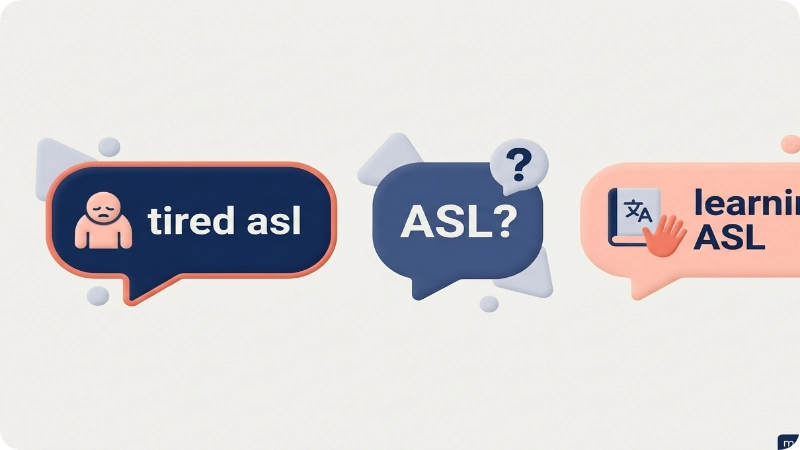
The meaning of ASL depends on how the abbreviation functions in a message. Dictionary.com recognizes both the online chat meaning “age, sex, location” and the informal slang use “as hell.” ASL is also an established abbreviation for American Sign Language.
Here are the three main interpretations to recognize:
| Expression | Meaning | Example |
| tired asl | Tired as hell; extremely tired | “I’m tired asl today.” |
| ASL? | Age, sex, location? | “Hey, ASL?” |
| learning ASL | Learning American Sign Language | “She’s learning ASL in college.” |
These meanings serve different purposes. The first adds emphasis to a description, the second asks for personal information, and the third identifies a language.
In casual slang, “as hell” is an informal intensifier. It strengthens the word or description before it, much like “very,” “really,” or “extremely.” The phrase can sound more emphatic than those alternatives, depending on the sentence.
The older “age, sex, location” meaning is associated with online chat, where people used the abbreviation to ask strangers for basic information. Pew Research Center documented this usage in its 2001 report Teenage Life Online, which described “ASL?” as a question asked of people entering chatrooms.
What Does Each Letter Stand For?
ASL is an initialism that can represent different phrases, depending on its context.
ASL meaning “as hell”
In this slang use, the letters abbreviate the phrase “as hell.” The expression acts as an intensifier rather than a question.
For example:
- “Funny asl” means very funny.
- “Cold asl” means extremely cold.
- “Busy asl” means really busy.
The abbreviation usually appears after the word being emphasized. You can often replace it with “as hell” to understand the sentence.
ASL meaning “age, sex, location”
In the older internet chat meaning, each letter represents a word:
- A — Age: How old are you?
- S — Sex: What sex are you?
- L — Location: Where are you located?
The question was a quick way to request basic information from another person online. Today, the wording may feel blunt or overly personal, especially when it comes from a stranger.
ASL meaning “American Sign Language”
In education, accessibility, and language discussions, ASL stands for American Sign Language.
The National Association of the Deaf describes American Sign Language as a visual language with its own grammar and syntax. It uses hand shapes, movements, facial expressions, and body movements to convey linguistic information.
This is a language name, not a texting expression. For example, “I’m taking an ASL class” refers to learning American Sign Language.
Why Do People Use ASL?
People use ASL for different reasons depending on which meaning they intend.
When someone writes “cute asl” or “excited asl,” the abbreviation adds emphasis without requiring a longer phrase. It suits quick, informal conversations in which the participants understand the slang.
When someone asks “ASL?” they may be trying to establish basic details about another person. This usage is associated with older internet chatrooms and can still appear in online conversations.
In a school or accessibility discussion, ASL provides a convenient abbreviation for American Sign Language.
The important distinction is the purpose of the message. An intensifier describes something, a question requests information, and a language abbreviation identifies a subject.
How Does Context Change the Meaning?
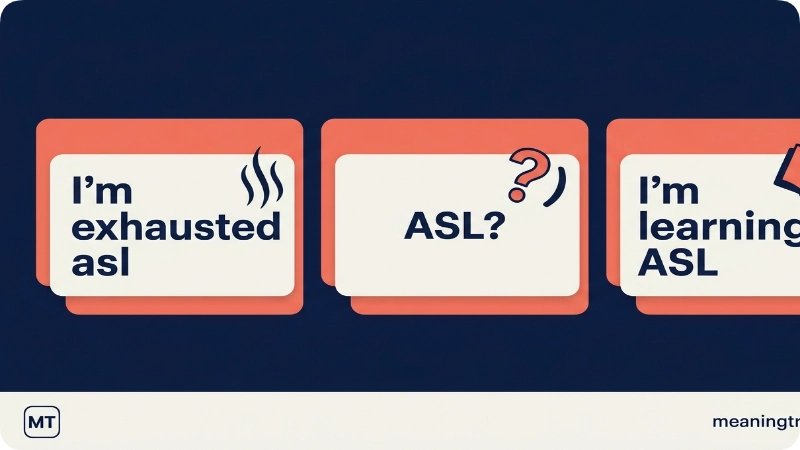
Context is the most useful way to work out what someone means by ASL. Look at the sentence structure, the topic, and the messages immediately before it.
When ASL follows an adjective
If ASL appears after a descriptive word, the intended meaning may be “as hell.”
Illustrative example:
Person A: “How was the concert?”
Person B: “It was loud asl.”
Interpretation: Person B means the concert was extremely loud.
The abbreviation strengthens the description. It doesn’t automatically tell you If the person enjoyed the concert or disliked it.
When ASL appears as a question
A standalone “ASL?” may refer to “age, sex, location,” especially when someone is introducing themselves to a stranger in a chat.
Illustrative example:
Person A: “Hey, nice to meet you.”
Person B: “Hey! ASL?”
Interpretation: Person B may be asking for the other person’s age, sex, and location.
The question alone doesn’t establish If the sender is being friendly, flirting, or simply trying to learn who they’re talking to.
When the conversation concerns signing
If the discussion involves language classes, interpreters, accessibility, or Deaf communities, ASL likely means American Sign Language.
Illustrative example:
Person A: “What language are you studying?”
Person B: “ASL.”
Interpretation: Person B is studying American Sign Language.
When the message is unclear
A message such as “asl” with no surrounding conversation may be difficult to interpret. Capitalization and punctuation can offer clues, but neither provides a guaranteed answer.
If the meaning matters, ask a short question such as, “Do you mean ‘as hell’ or ‘age, sex, location’?”
Examples of ASL in Conversation
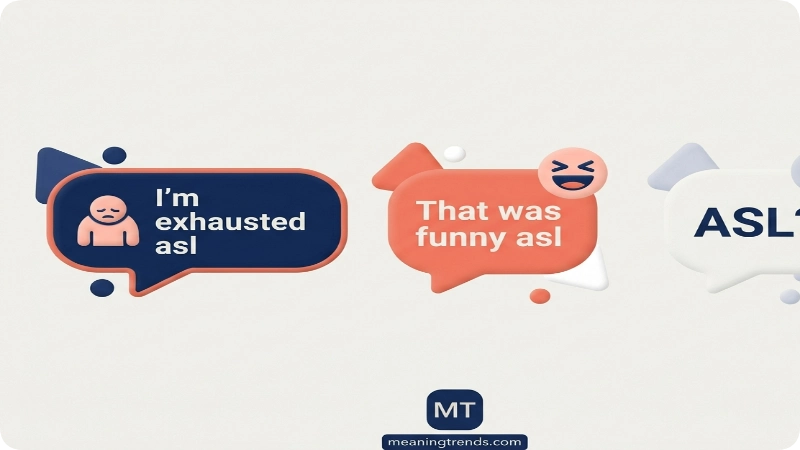
The following illustrative chats show how the same abbreviation can mean different things.
Example 1: Expressing a strong feeling
Person A: “How are you feeling?”
Person B: “I’m exhausted asl.”
Meaning: Person B is saying they’re extremely exhausted.
Example 2: Reacting to something funny
Person A: “Did you see that video?”
Person B: “That was funny asl 😂”
Meaning: Person B thought the video was very funny. The laughing emoji supports that reading, although the words themselves carry the emphasis.
Example 3: Asking for personal details
Person A: “Hi, what’s up?”
Person B: “Not much. ASL?”
Meaning: Person B may be asking for age, sex, and location.
Example 4: Discussing a class
Person A: “What are you taking this semester?”
Person B: “ASL and psychology.”
Meaning: ASL refers to American Sign Language, a subject the person is studying.
These examples are not rules that apply to every conversation. They demonstrate how grammar and subject matter help distinguish the meanings.
Is ASL Rude, Flirty, or Offensive?
ASL isn’t inherently rude or flirty, but its meaning and context affect how it comes across.
When used to mean “as hell,” it can sound casual, emphatic, or slightly profane because the full expression includes the word “hell.” If that tone is appropriate depends on the audience and setting.
When used to ask for age, sex, and location, the abbreviation can feel intrusive. Someone may interpret the question as an attempt to start a personal or romantic conversation, but the abbreviation alone doesn’t prove that intention.
The question can also raise privacy concerns when it comes from someone you don’t know. You don’t have to disclose personal information simply because someone asks for it. You can answer generally, decline, or change the subject.
When ASL refers to American Sign Language, it is a neutral language abbreviation. It should be interpreted in that context rather than treated as internet slang.
How Do You Reply to ASL?
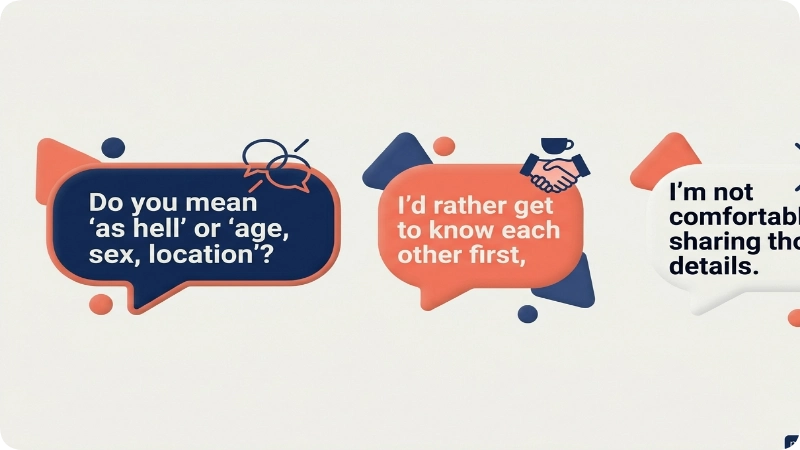
Your reply depends on what the other person means and If you want to continue the conversation.
If someone uses ASL to mean “as hell,” you can respond naturally to the statement.
- Friendly: “Honestly, same.”
- Casual: “For real!”
- Conversational: “What made it so difficult?”
For example, if someone texts “I’m tired asl,” you could reply, “You should get some rest if you can.”
If someone asks “ASL?” and you want to clarify the question, try:
- Clarifying: “Do you mean age, sex, and location?”
- Friendly but cautious: “I’d rather get to know each other first.”
- Boundary setting: “I’m not comfortable sharing those details.”
You can also choose not to respond to an unsolicited personal question.
If the abbreviation appears in a conversation about sign language, reply to the actual topic. For instance, you could ask, “How long have you been learning ASL?”
When Should You Use or Avoid ASL?
ASL works best when the people communicating understand the intended meaning.
Use the “as hell” form in casual texts, informal group chats, or social media comments where slang fits the conversation. For example, “That was stressful asl” is understandable in an informal exchange.
Avoid it in formal emails, professional reports, academic writing, and situations where readers may not recognize the abbreviation. Use clearer alternatives such as “extremely stressful” or “very difficult.”
The “age, sex, location” form is best understood as an informal request for personal details, not a universal greeting. If you’re meeting someone online, asking a more specific and respectful question may be clearer. Avoid requesting information you don’t need, and don’t feel obliged to provide your own.
When discussing American Sign Language, writing the full name on first mention can help readers unfamiliar with the abbreviation. After that, ASL is a clear and widely recognized shortened form in relevant contexts.
What Are Other Ways to Say ASL?
There isn’t one replacement for every meaning of ASL. Choose wording that preserves the intended message.
| Expression | Meaning | Typical use | Key distinction |
| Very | A high degree | Everyday conversation | Neutral and widely appropriate |
| Extremely | A particularly high degree | Formal and informal writing | More explicit and often stronger |
| Really | Emphasis or confirmation | Casual conversation | Flexible and conversational |
| How old are you, and where are you from? | Requests personal information | Introductions | More explicit than “ASL?” |
| American Sign Language | Name of a visual language | Education and accessibility | Spells out the language name |
For the slang meaning, “very” or “extremely” usually works well. For the older question, writing out what you want to know avoids ambiguity. For the language meaning, use “American Sign Language” when clarity is important.
FAQs
Does ASL mean “as hell” or “age, sex, location”?
It can mean either. “Tired asl” suggests “tired as hell,” while a standalone “ASL?” can mean “age, sex, location?” The surrounding sentence helps distinguish them.
What does ASL mean after a word?
When it follows a description such as “funny,” “cute,” or “tired,” ASL may mean “as hell.” It adds emphasis, similar to “very” or “extremely.”
Does ASL mean American Sign Language?
Yes. ASL is the standard abbreviation for American Sign Language, a visual language with its own grammar. This meaning is especially relevant in discussions of signing, education, and accessibility.
Is ASL an inappropriate word?
Not necessarily. The slang phrase “as hell” can sound mildly profane, while “age, sex, location” is a personal question. American Sign Language is a neutral language name. Context determines which meaning applies.
Should I answer if someone texts me “ASL?”
Only if you want to. You can ask what they mean, share limited information, or politely decline. You don’t need to disclose personal details to continue a conversation.
Conclusion
ASL has several established meanings in digital communication. It can intensify a description as “as hell,” ask for “age, sex, location,” or refer to American Sign Language. The most useful clue is how the abbreviation fits into the sentence and what the conversation is about.
If you see “tired asl,” read it as an informal expression of being very tired. If someone sends “ASL?” on its own, consider If they’re asking for personal information. And if the topic is signing or language learning, American Sign Language is the relevant interpretation.
When you’re unsure, don’t assume you know the sender’s motive based on three letters. Ask a quick clarifying question and respond in a way that feels comfortable to you. If someone requests personal details, remember that you can set boundaries without explaining yourself. Understanding the wording is useful, but the surrounding conversation is what helps you interpret it accurately.

Alex writes about the words and shortcuts people use in texts, group chats, and social media. Each guide explains the meaning with everyday examples and tips on when to use it