Slang usage verified: October 2026
QUICK ANSWER
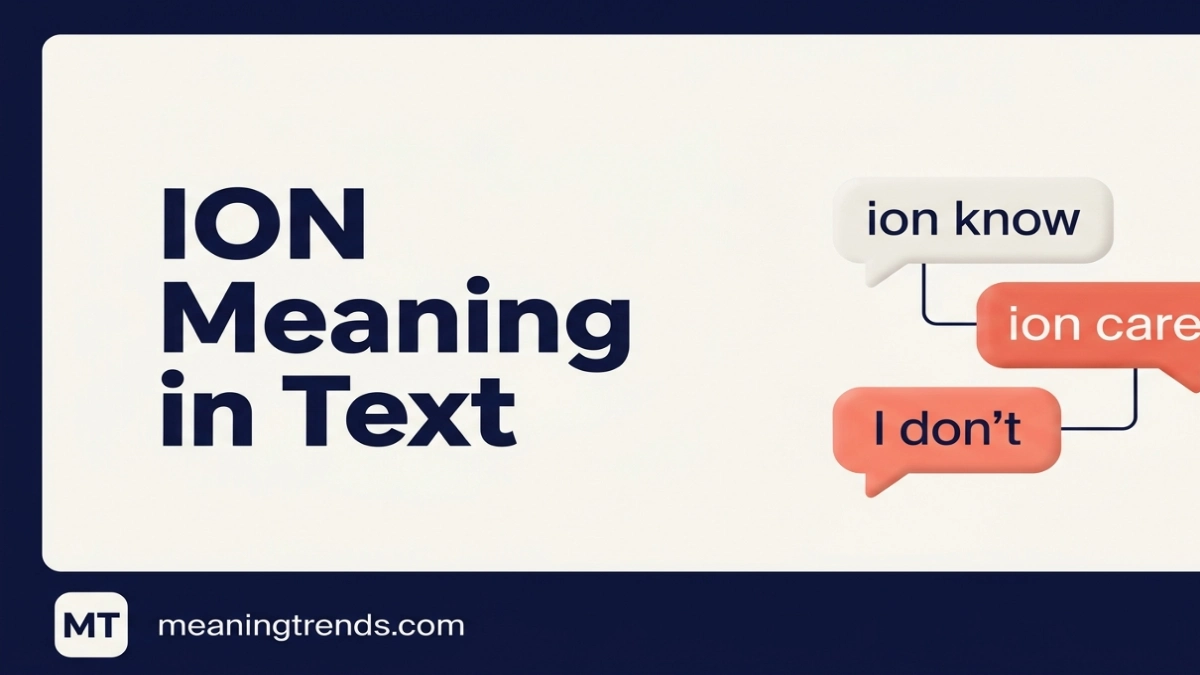
In texting and online conversations, “ion” usually means “I don’t.” It is an informal, phonetic spelling that reflects how the phrase can sound in casual speech. For example, “ion know” means “I don’t know.” Depending on the context, uppercase “ION” can also stand for “In Other News.”
Have you ever received a message like “ion know” or “ion even care” and wondered If it was a typo, an abbreviation, or a new slang expression? The spelling can be confusing because ion is also a scientific term for an electrically charged atom or molecule.
In casual digital conversations, however, the surrounding words usually provide the clearest clue. Someone writing “ion wanna go” is expressing that they do not want to go, while someone using “ION” to introduce an unrelated update may be changing the subject.
Understanding the expression also means looking beyond its literal definition. A message can communicate uncertainty, reluctance, disagreement, or indifference depending on the words that follow it. The spelling alone does not tell you If the sender is annoyed, joking, flirting, or simply speaking casually.
What Does ION Mean in Text?
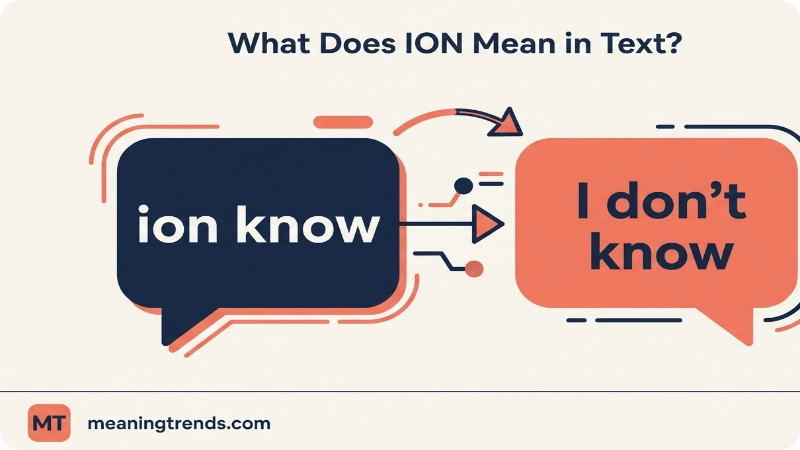
The slang expression ion is an informal way of writing “I don’t.” It appears in casual messages, online comments, captions, and other digital conversations.
Here are some straightforward examples:
| Text message | Standard English |
| Ion know. | I don’t know. |
| Ion care. | I don’t care. |
| Ion want that. | I don’t want that. |
| Ion think so. | I don’t think so. |
| Ion remember. | I don’t remember. |
| Ion wanna go. | I don’t want to go. |
The key is to read ion as part of the sentence rather than as a standalone word with one fixed conversational purpose.
For example, “ion know” communicates a lack of knowledge or certainty. “Ion want that” expresses a preference or refusal. Both use the same slang spelling, but the rest of the sentence determines what the speaker is communicating.
This expression is informal rather than standard written English. It may be natural in a relaxed conversation with someone familiar with the slang, but “I don’t” is clearer when writing for an unfamiliar audience.
What Does Each Letter in ION Stand For?
When ion means “I don’t,” its letters do not represent three separate words. It is better understood as a phonetic slang spelling than as a traditional acronym.
The spelling reflects a casual pronunciation of “I don’t,” in which the words can blend together in speech. It is associated with African American English, also known as African American Vernacular English (AAVE), and is also encountered in broader online slang.
Dictionary.com documents the slang use and describes it as a spelling based on the colloquial pronunciation of “I don’t,” particularly in Black English.
This distinction helps explain why ion and abbreviations such as LOL are not quite the same.
- ION meaning “I don’t”: A spelling that represents how a phrase sounds in informal speech.
- LOL: An initialism formed from the first letters of “laughing out loud.”
- IDK: An initialism formed from “I don’t know.”
In other words, ion is not simply an acronym that needs to be expanded letter by letter. Its meaning comes from the spoken phrase it represents.
Why Do People Use ION in Text Messages?
People use ion to write in a casual, conversational style that reflects informal speech. Like other nonstandard spellings, it can help a message sound less formal and more like everyday conversation.
Its purpose depends on the sentence, but several uses are easy to recognize.
- Expressing uncertainty: “Ion know what happened” means the sender does not know what happened.
- Showing a preference: “Ion wanna watch that movie” expresses that the sender does not want to watch it.
- Disagreeing: “Ion think that’s a good idea” communicates a different opinion.
- Expressing indifference: “Ion care about the score” suggests that the score does not matter to the sender.
These examples show that the expression does not have one particular emotional meaning. It provides the negative phrase “I don’t,” while the following words establish the message’s content.
It is also important not to assume that everyone who writes this way belongs to a particular age group or community. Although the spelling is associated with specific speech varieties, an individual message does not establish the writer’s identity or background.
What Else Can ION Mean?
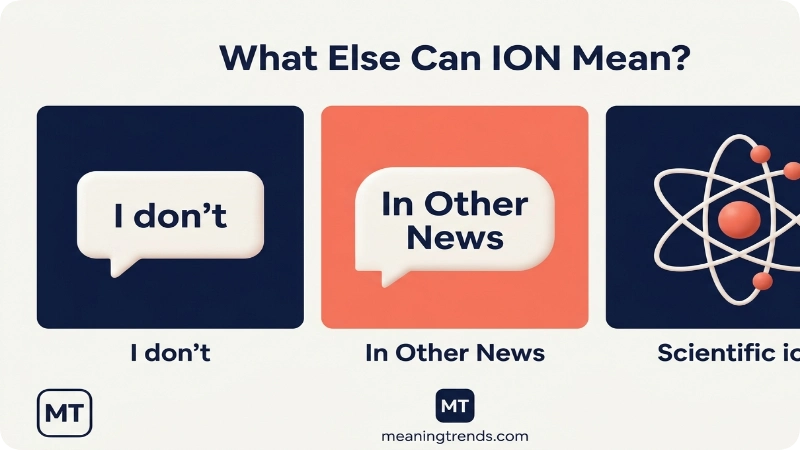
Although “I don’t” is a useful interpretation in informal texting, ion has other established meanings. The sentence, capitalization, and subject of the conversation help distinguish them.
1. “In Other News”
In some informal writing, ION stands for “In Other News.” This expression introduces a new subject, often after a previous topic or as a transition to an unrelated update.
For example:
Person A: “I finally finished my exams.”
Person B: “ION, my favorite show comes back tonight.”
Here, “ION” is being used to introduce a separate update rather than to say “I don’t.”
The meaning is especially plausible when the letters appear at the beginning of a sentence and are followed by a new announcement. Dictionary.com documents this use of ION as an informal abbreviation.
2. The scientific term “ion”
In chemistry and physics, an ion is an atom or molecule with a net electrical charge because it has gained or lost electrons.
For example, a discussion about sodium, chloride, or chemical reactions may use ion in its scientific sense.
This meaning is unrelated to the texting expression. If a message says, “The sodium ion has a positive charge,” there is no reason to interpret ion as “I don’t.”
How can you tell which meaning is intended?
Consider the following clues:
- If ion appears before a verb, as in “ion know,” the slang reading is plausible.
- If uppercase “ION” introduces a new topic, “In Other News” may fit.
- If the conversation discusses chemistry or physics, the scientific definition is more likely.
Capitalization is a clue, not proof. People do not always capitalize slang consistently, so the words and subject matter are more useful than letter case alone.
How Does Context Change the Meaning of ION?
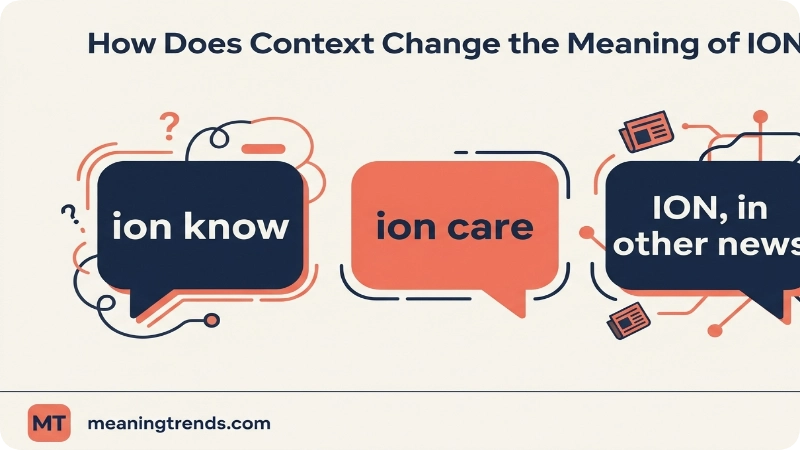
The most reliable way to interpret ion is to replace it mentally with “I don’t” and then read the entire message. After establishing the literal meaning, consider the surrounding conversation to understand the intended tone.
When a friend uses ION
A friend might write:
“ion know where everybody went lol”
The straightforward interpretation is “I don’t know where everybody went.” The casual wording and “lol” may make the message feel lighthearted, but they do not establish the sender’s precise emotional state.
You can generally respond to the information being shared rather than treating the slang itself as a hidden message.
When someone uses ION during a disagreement
Imagine receiving:
“ion think you understood what I meant.”
This means “I don’t think you understood what I meant.” It may express disagreement or frustration, depending on what happened earlier.
The wording alone does not prove that the sender is angry. A disagreement may be serious, playful, or entirely ordinary.
When someone uses ION in a personal conversation
Consider this message:
“ion wanna talk about it rn.”
The likely meaning is “I don’t want to talk about it right now.” The sender is expressing a preference not to discuss something at that moment.
A respectful response would acknowledge that preference instead of assuming a hidden motive. If the subject is personal, you can ask a gentle follow up or simply give the person space.
When the message contains only ION
A standalone message reading “ion” is harder to interpret because the phrase it represents is incomplete.
The sender might have sent an unfinished thought, made a typing mistake, or expected the surrounding conversation to supply the missing context. If another meaning seems plausible, ask what they meant rather than committing to a guess.
The practical rule is simple: distinguish what the words literally communicate from what you think the sender might feel.
Examples of ION in Conversation
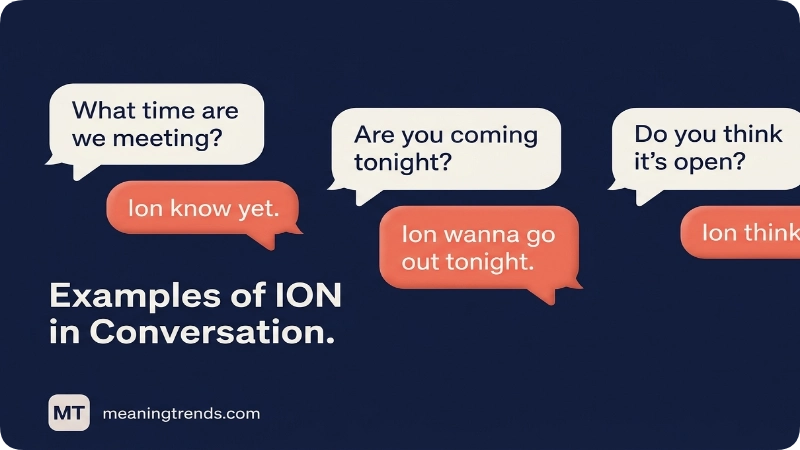
These illustrative exchanges show how the expression works in ordinary messages.
Example 1: “Ion know”
Person A: “What time are we meeting?”
Person B: “Ion know yet.”
Meaning: Person B does not know the meeting time yet. The message expresses uncertainty, not necessarily unwillingness to answer.
Example 2: “Ion care”
Person A: “Do you want the blue shirt or the black one?”
Person B: “Ion care, you can pick.”
Meaning: Person B is leaving the choice to the other person. In this situation, the phrase may communicate indifference rather than hostility.
Example 3: “Ion wanna go”
Person A: “Are you coming to the party tonight?”
Person B: “Ion wanna go out tonight.”
Meaning: Person B does not want to go out. The sentence communicates a preference, but it does not explain why.
Example 4: “Ion think so”
Person A: “Do you think the store is still open?”
Person B: “Ion think so.”
Meaning: Person B doubts that the store is open. The phrase communicates uncertainty or a tentative negative answer.
Example 5: “ION” meaning “In Other News”
Person A: “I finally cleaned my whole apartment.”
Person B: “ION, I got tickets for Saturday!”
Meaning: Person B introduces a separate update. In this context, “In Other News” fits better than “I don’t.”
Example 6: A message that sounds dismissive
Person A: “I spent an hour explaining why this mattered to me.”
Person B: “ion care.”
Meaning: The literal message is “I don’t care.” Given the preceding statement, it could reasonably sound dismissive or hurtful. The interpretation comes from the complete exchange, not from the spelling ion by itself.
Is ION Rude, Flirty, or Offensive?
ION is not inherently rude, flirty, or offensive when it means “I don’t.” It is an informal spelling, and its tone depends on the words, situation, and relationship between the people communicating.
Here is how different sentences may come across:
| Expression | Possible tone | Why |
| “ion know lol” | Casual or playful | The sender admits uncertainty in a relaxed way. |
| “ion care” | Neutral or dismissive | It can express indifference or disregard for someone’s concern. |
| “ion wanna go” | Reluctant or straightforward | The sender states a preference not to go. |
| “ion think so” | Uncertain or disagreeing | The sender gives a negative or tentative opinion. |
These are possible interpretations, not fixed emotional definitions.
Does ION mean someone is flirting?
No. The expression does not have a standard romantic meaning. A person using ion in a conversation about dating may simply be saying “I don’t.”
To understand If a message is flirtatious, consider the actual words, the preceding conversation, and any clear expressions of interest. Neither the spelling nor the sender’s gender establishes romantic intent.
Does ION mean someone is angry?
Not by itself. “Ion know” may be a neutral response, while “ion care about what you think” may sound dismissive because of the sentence as a whole.
If the tone matters and you are unsure, a simple clarification is more reliable than guessing: “Do you mean you don’t know, or is something bothering you?”
How Do You Reply to ION?
You do not need a special response to ion. Reply to the complete message as you normally would.
Here are some natural options.
- If someone says “ion know”: “No worries. Let me know when you find out.”
- If someone says “ion care”: “Okay, I’ll choose one, then.”
- If someone says “ion wanna go”: “That’s fine. We can make other plans.”
- If someone says “ion think so”: “Got it. What makes you think that?”
- If you cannot tell what they mean: “What do you mean by ion here?”
If the message concerns a sensitive subject, avoid assuming that a short reply reveals the person’s entire attitude. You can acknowledge what they said, ask a respectful question, or leave the conversation there if no response is needed.
When Should You Use or Avoid ION?
Use ion when the conversation is informal and the people involved are likely to understand the expression.
It may fit naturally in:
- Casual text messages with friends.
- Informal group chats.
- Social media comments and direct messages.
- Relaxed conversations where nonstandard spellings are already part of the writing style.
Avoid it when clarity and formality matter, particularly in:
- Professional emails and workplace correspondence.
- Academic assignments.
- Formal applications and business documents.
- Messages to unfamiliar people who may not recognize the slang.
For example, instead of writing “ion know if I can attend,” use “I don’t know if I can attend” in a professional message.
Neither version changes the underlying meaning, but the standard English version is easier for a wider audience to understand.
The same principle applies when writing for an international audience or communicating in a situation where ambiguity could cause a problem. Choosing the fuller expression is a matter of clarity, not a judgment about the slang or the people who use it.
How Is ION Different From IDK?
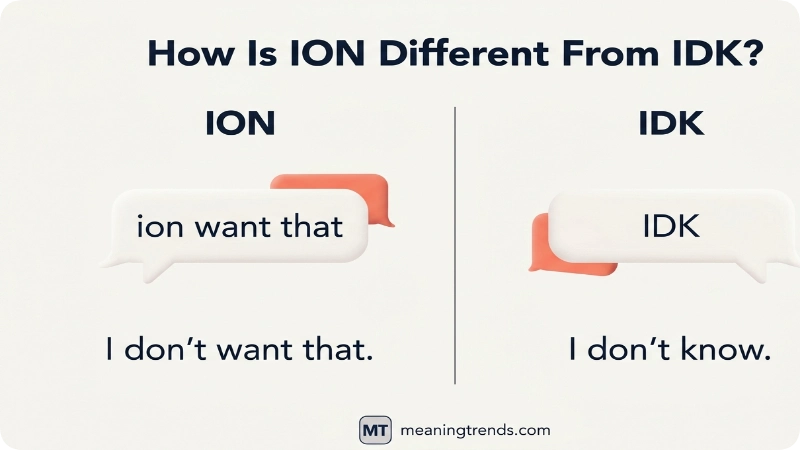
ION and IDK can appear in similar conversations, but they serve different grammatical purposes when used as slang.
| Expression | Meaning | Typical use | Key distinction |
| ION | I don’t | Before a verb or phrase | Flexible slang spelling |
| IDK | I don’t know | A complete short response or statement | Fixed initialism |
| IDC | I don’t care | Expressing indifference | Refers specifically to caring |
| IMO | In my opinion | Introducing a viewpoint | Signals an opinion, not a negative statement |
For example, “ion want that” means “I don’t want that,” while “IDK” means “I don’t know.”
You cannot normally replace ion with IDK without changing the sentence. “IDK want that” does not work as a standard equivalent of “I don’t want that.”
Similarly, IDC is more specific than ion: the latter can be followed by different verbs, while the former already expresses the idea of not caring.
FAQs
What does ion mean in a text from someone?
It usually means “I don’t.” For instance, “ion know” means “I don’t know.” Read the full sentence to understand what the person is denying or expressing.
Is ION short for “I don’t know”?
Not exactly. Ion represents “I don’t,” while ion know represents the complete phrase “I don’t know.”
Does ION mean “In Other News”?
Yes, in some informal writing. When it introduces a new topic or update, uppercase ION can mean “In Other News.” The sentence determines If that interpretation fits.
Is ion a real word?
Yes. Ion is an established scientific word for an electrically charged atom or molecule. The informal texting spelling has a separate meaning.
Is ION an acronym?
Not when it means “I don’t.” In that use, it is a phonetic slang spelling. It can function as an initialism for “In Other News” in a different context.
Can I use ion in a formal email?
It is better to write “I don’t” in formal communication. The full phrase is clearer and appropriate for professional and academic writing.
Does ion mean the same thing on every social media platform?
The slang interpretation can be used across different online settings, but no platform specific meaning should be assumed from the spelling alone. The surrounding words and topic remain the best clues.
Conclusion
When you encounter ion in a casual text, start by checking If it makes sense as “I don’t.” Phrases such as “ion know,” “ion care,” and “ion wanna go” usually become clear when rewritten in standard English. The expression is an informal spelling, not an acronym with three separate words behind its letters.
Keep the alternative meanings in mind, too. In some messages, ION means “In Other News,” while in science, an ion is an electrically charged atom or molecule. The words surrounding the expression help you distinguish these uses.
Most importantly, do not confuse a definition with a sender’s intention. A message can express uncertainty, disagreement, reluctance, or indifference without revealing exactly how the person feels. If the meaning or tone is unclear, ask a short, direct question instead of assuming.
For your own writing, use ion when the casual style suits the conversation. When clarity or professionalism matters, the standard phrase “I don’t” is the simplest choice.

Alex writes about the words and shortcuts people use in texts, group chats, and social media. Each guide explains the meaning with everyday examples and tips on when to use it