QUICK ANSWER
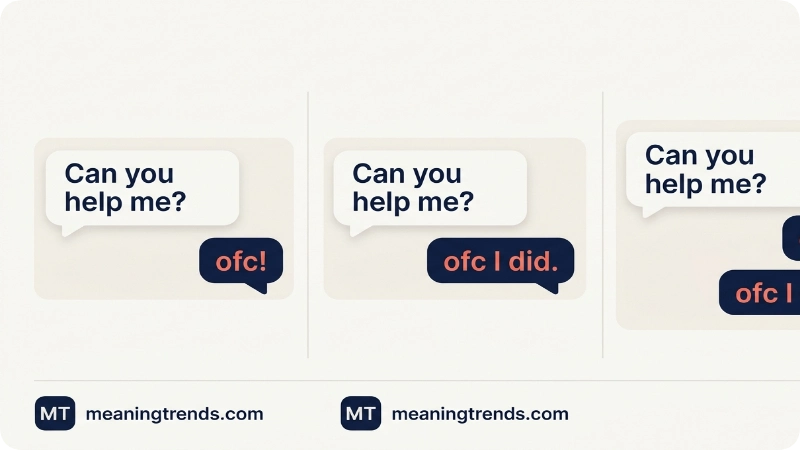
OFC usually means “of course” in text messages and online chats. It’s an informal abbreviation people use to say yes, agree with someone, confirm a plan, or reassure another person. For example, “Can you help me later?” “ofc!” means “Of course!” The exact tone depends on the conversation.
Imagine asking a friend, “You’ll save me a seat, right?” and getting a three letter reply: “ofc.” You probably understand that it’s a yes, but you might still wonder whether the person sounds friendly, impatient, or simply casual.
That uncertainty is understandable because texting removes many of the clues we rely on in face to face conversations, such as voice, facial expressions, and emphasis. A short abbreviation can communicate the answer without making the sender’s feelings equally clear.
The useful distinction is between what the letters mean and what the person intends to convey. The surrounding sentence, the question being answered, and your usual communication style with the sender can help you interpret the message without reading too much into it.
What Does OFC Mean?
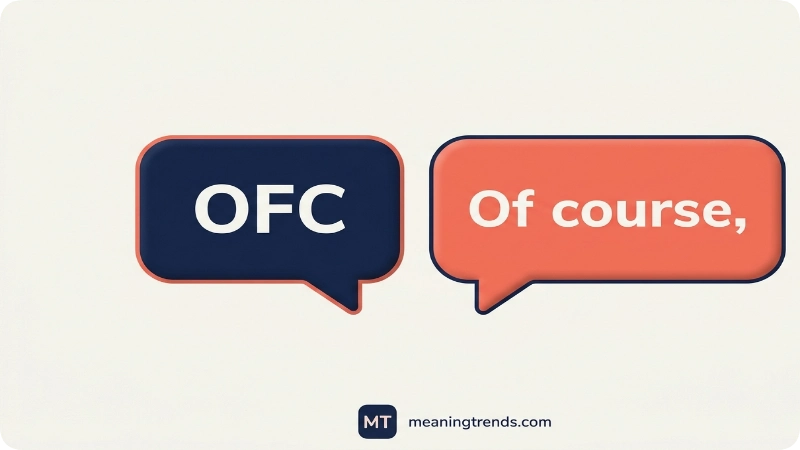
In everyday texting, OFC is an abbreviation of “of course.” It is an informal way to express agreement, confirmation, willingness, or certainty.
The phrase “of course” can serve several conversational purposes. Depending on the situation, it can mean “yes,” “certainly,” “naturally,” or “that’s understood.”
For example:
- “Can I call you after work?” “OFC.” The sender agrees to the call.
- “Are we still meeting tomorrow?” “ofc!” The sender confirms the plan.
- “You know I appreciate you, right?” “ofc.” The reply may acknowledge something the sender considers understood.
- “Can you send me the picture?” “ofc, one sec.” The sender agrees and indicates they will send it shortly.
These examples illustrate the same basic meaning in different situations. The abbreviation doesn’t automatically communicate a particular emotion; the rest of the exchange helps establish the tone.
Is OFC an abbreviation or an acronym?
OFC is commonly described as an abbreviation or initialism in informal digital communication. Its letters correspond to the words in “of course.”
In ordinary texting, people generally use it as a ready made shorthand rather than treating each letter as a separate word. You can read it as the full phrase when interpreting a message.
Lowercase “ofc” and uppercase “OFC” ordinarily communicate the same phrase. Capitalization may reflect typing habits or emphasis, but it doesn’t establish a different meaning.
What Does Each Letter in OFC Stand For?
In its usual texting sense, OFC comes from the initial letters of the phrase:
- O Of
- F (the second word begins with C? No.)
- O and F the two letters in “of”
- C the first letter of “course”
Together, the letters form OFC, a compact spelling of “of course.”
This is a shortened written form of an existing phrase, not a new phrase whose meaning needs to be guessed from the letters. In a typical text conversation, there is no need to assign a separate word to each letter beyond recognizing the original phrase.
Why Do People Use OFC in Text Messages?
People use OFC to make a reply shorter and keep a conversation informal. Instead of typing the complete phrase, they can answer with three letters and rely on the other person to understand the shorthand.
Its practical uses include:
- Agreeing: responding positively to a suggestion or request.
- Confirming: indicating that a plan or arrangement still stands.
- Giving permission: saying someone can do something.
- Reassuring: communicating that something is understood or not in doubt.
- Emphasizing certainty: expressing that an answer feels straightforward or expected.
Consider the difference between these replies:
“Of course, I can help you.”
“ofc”
Both can communicate agreement. The first spells out the phrase and feels more complete, while the second is brief and casual. Neither is automatically more sincere than the other.
OFC can also fit naturally into a longer message, such as “ofc I’ll be there” or “You can ask me, ofc.” In these examples, the abbreviation works as part of a sentence rather than as a standalone answer.
How Does Context Change the Meaning of OFC?
The basic meaning usually remains “of course,” but the conversational purpose and perceived tone can change. When you receive OFC, consider what the sender is responding to before deciding how the message feels.
When a friend uses OFC
Between friends, OFC may be a straightforward yes, an offer of help, or reassurance.
Illustrative example:
Person A: “Can I borrow your notes from class?”
Person B: “ofc, I’ll send them tonight.”
Interpretation: Person B agrees to share the notes and gives a time frame. The rest of the sentence makes the willingness clear.
A one word reply such as “ofc” can also be perfectly ordinary between people who regularly send short messages. Brevity alone doesn’t mean someone is upset or uninterested.
When a romantic interest uses OFC
If someone you’re dating or interested in sends OFC, it usually carries the same basic meaning as it does elsewhere. It might be a warm agreement, a simple confirmation, or a reassuring response.
Illustrative example:
Person A: “Do you still want to see me this weekend?”
Person B: “ofc ❤️”
Interpretation: The reply confirms interest in meeting. The heart emoji may add warmth or affection, but it doesn’t prove romantic intent by itself.
The nature of the relationship and the rest of the conversation matter more than the abbreviation alone. One “ofc” isn’t enough to determine someone’s deeper feelings.
When a coworker uses OFC
In a work chat, OFC may simply confirm a routine request or acknowledge an arrangement. The abbreviation can feel informal, particularly when colleagues are accustomed to casual messaging.
Illustrative example:
Person A: “Can you review the document before noon?”
Person B: “Ofc, I’ll take a look.”
Interpretation: The coworker agrees to review the document.
For an unfamiliar client, a senior stakeholder, or a formal business exchange, writing “Of course” in full may be clearer and more appropriate. The right choice depends on workplace expectations.
When OFC sounds sarcastic or dismissive
Sometimes a message using OFC can sound impatient, sarcastic, or dismissive. That impression usually comes from the sentence or the history of the conversation, not from an automatic alternative definition.
Illustrative example:
Person A: “You forgot to tell me about the change again.”
Person B: “ofc I did.”
Interpretation: Depending on the preceding conversation, Person B may be using the phrase sarcastically or expressing frustration. The wording alone doesn’t establish which emotion is intended.
Compare that with “ofc, no problem!” in response to a polite request. The same abbreviation appears in both exchanges, but the surrounding words change how the message may be read.
If you’re unsure, avoid treating a short reply as proof of someone’s mood. A neutral follow up can clear things up without escalating the conversation.
Examples of OFC in Conversation
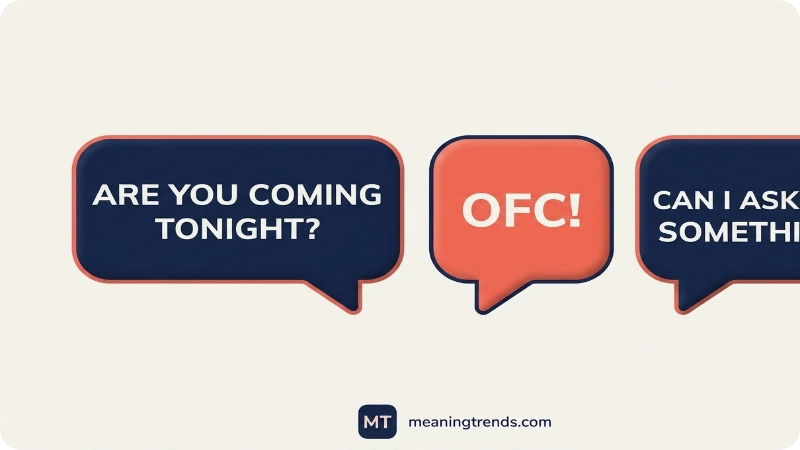
The following examples are illustrative, not quotations from real conversations. They show how the same abbreviation can fit different everyday situations.
| Text conversation | What OFC communicates |
| A: “Are you coming tonight?” B: “OFC!” | A confident confirmation |
| A: “Can you help me study?” B: “ofc” | Agreement to help |
| A: “Is it okay if I bring a friend?” B: “ofc, that’s fine.” | Permission |
| A: “You remember my birthday, right?” B: “ofc 😂” | Confirmation, possibly playful |
| A: “Can I tell you something personal?” B: “ofc, go ahead.” | Willingness to listen |
| A: “You’re still sending the file today?” B: “Ofc, I’ll send it soon.” | Confirmation of an expected action |
| A: “You ignored the instructions again.” B: “ofc I did.” | Possible sarcasm, depending on context |
What these examples show
OFC doesn’t need to be interpreted as a different abbreviation every time. In most of these examples, it still means “of course.”
What changes is the function of the response. Sometimes it answers a yes or no question, sometimes it grants permission, and sometimes it reassures the other person.
Tone is a separate question. Punctuation, extra words, emojis, and the previous exchange can offer clues, but none is a foolproof indicator of emotion.
For instance, “OFC!” may appear enthusiastic, while “ofc.” may feel more matter of fact in a particular conversation. However, some people use periods routinely, and others capitalize every message. Look at their usual style before drawing conclusions.
Is OFC Rude, Flirty, or Offensive?
OFC is not inherently rude, flirty, or offensive. Its standard meaning is neutral, and the surrounding conversation determines how the response may come across.
Is OFC rude?
Usually, the abbreviation itself is not rude. A person may use it to answer quickly, agree to a request, or reassure a friend.
It could feel dismissive if it appears in a tense exchange, especially when the surrounding words suggest impatience or mockery. Even then, context matters. A short response may reflect the sender’s usual texting style rather than irritation.
If the reply leaves you uncertain, you can ask, “Just checking are we still good?” This invites clarification without assuming bad intent.
Does OFC mean someone is flirting?
Not by itself. A romantic partner, friend, coworker, or acquaintance can use OFC in exactly the same basic way.
If someone replies “ofc ❤️” to an affectionate message, the combination may sound warm. But the abbreviation doesn’t independently establish attraction, romantic interest, or commitment.
Look at the broader pattern of communication and, when necessary, discuss the relationship directly rather than relying on a single abbreviation.
Does OFC contain offensive language?
In its ordinary texting use, OFC stands for “of course” and contains no profanity.
A separate, informal interpretation sometimes expands it as “of f***ing course,” adding an expletive for emphasis. Wiktionary records this as an uncommon internet slang use alongside the standard meaning.
That interpretation should not be assumed whenever someone types OFC. Unless the context supports the stronger reading, “of course” is the more straightforward interpretation for an ordinary text message.
How Do You Reply to OFC?
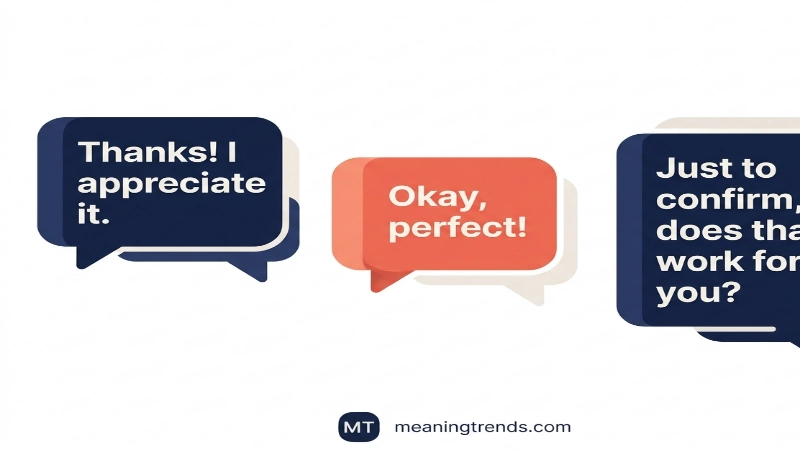
Because OFC generally communicates agreement or confirmation, you don’t need a special response. Reply to the message’s meaning rather than to the abbreviation itself.
Here are a few natural options for different situations:
- Friendly: “Thanks! I appreciate it.”
- Casual: “Okay, perfect!”
- Enthusiastic: “Yay, see you then!”
- Clarifying: “Great so we’re definitely meeting at 6?”
- Playful: “Knew I could count on you 😂”
- Professional: “Thank you for confirming.”
If someone replies “ofc” to “Can I ask you something?”, you can simply continue with your question. If they use it to confirm a plan, acknowledge the confirmation and move on.
If the reply seems cold or confusing, you don’t have to assume that something is wrong. You can ask, “Did you mean that you’re okay with it?” when the answer genuinely affects what you should do next.
The best reply depends on the original question, your relationship with the sender, and whether you need more information.
When Should You Use or Avoid OFC?
OFC works best when both people are comfortable with informal digital communication.
When OFC works well
Use it in situations such as:
- Casual text messages with friends and family.
- Group chats where shorthand is normal.
- Informal conversations on social media.
- Quick replies confirming plans or agreeing to requests.
- Gaming chats and other relaxed online conversations.
For example, if a friend asks, “Can you pick me up at 5?” replying “ofc!” is a natural way to agree, provided you genuinely can.
When it’s better to write “of course”
The full phrase is generally preferable in formal or unfamiliar settings, including:
- Professional emails to clients or managers.
- Academic assignments and formal writing.
- Official correspondence.
- Situations where the reader may not recognize texting abbreviations.
- Important instructions where clarity matters more than brevity.
Compare these two responses:
- Casual: “ofc, I’ll send it tonight.”
- More formal: “Of course. I’ll send it tonight.”
Both communicate the same basic message. The second is more suitable when you want a polished, professional tone.
You don’t need to avoid OFC entirely in professional messaging. Some workplaces encourage casual chat. The important consideration is whether the abbreviation fits the audience and the purpose of the message.
What Are Other Ways to Say OFC?
If you want to express the same idea without using an abbreviation, several alternatives work depending on the situation.
| Expression | Meaning | Typical use |
| Of course | The full original phrase | General conversation |
| Sure | Agreement or willingness | Casual requests |
| Absolutely | Strong agreement or confirmation | Positive, confident replies |
| Definitely | Clear confirmation or certainty | Plans and decisions |
| Certainly | Polite agreement | Professional or formal communication |
| No problem | Agreement, often with reassurance | Requests and favors |
| Yes, of course | Explicit agreement | When a fuller answer is useful |
| Naturally | Something is expected or unsurprising | Contexts where the idea feels self evident |
These alternatives overlap, but they’re not identical in every situation.
For example, “sure” can sound more neutral than “absolutely,” while “certainly” often feels more formal. “No problem” emphasizes that the request is acceptable rather than directly repeating the idea of “of course.”
Choose the wording that best reflects what you actually mean. If you want to be warm, “Of course, happy to help” is clear and friendly. If you’re confirming a deadline, “Yes, I’ll send it by noon” may be more useful because it states the commitment directly.
How Is OFC Different from Similar Text Abbreviations?
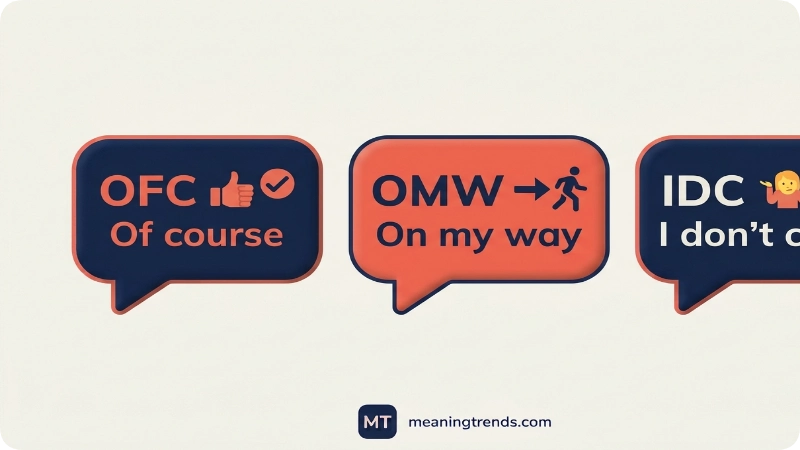
OFC is sometimes confused with other short expressions because they all appear in quick online conversations. However, each one serves a different purpose.
| Expression | Meaning | Typical use | Key distinction |
| OFC | Of course | Agreement or confirmation | Communicates an expected or willing yes |
| OMW | On my way | Travel or arrival updates | Says someone is heading somewhere |
| IDC | I don’t care | Indifference or lack of preference | Expresses a different attitude toward the topic |
| IMO | In my opinion | Sharing a viewpoint | Introduces or qualifies an opinion |
| NGL | Not gonna lie | Candid or emphatic statements | Signals a personal, candid comment |
| TBH | To be honest | Giving an honest opinion | Frames what follows as candid or sincere |
For example, if someone asks, “Can you join us later?”, replying “OFC” means you’re agreeing. Replying “OMW” means you’re already on your way, which communicates something different.
Likewise, “IDC” shouldn’t be treated as a synonym for OFC. One usually signals indifference, while the other ordinarily signals agreement or confirmation.
Understanding the distinction makes it easier to read short messages without confusing agreement, opinion, indifference, and action.
What Else Can OFC Mean?
Although “of course” is the usual interpretation in casual texting, the letters OFC can have other meanings in specialized settings.
One example is “original female character,” a term used in some fanfiction and fandom discussions to describe a female character created by a fan rather than taken directly from the source work. The exact meaning depends on the surrounding community and how the term is being used.
In other fields, OFC may be used as an abbreviation for a technical term, organization, or institution. These meanings are not interchangeable with the texting expression.
The important distinction is the subject of the conversation:
- In a casual message answering a question, “of course” is the natural starting interpretation.
- In a fanfiction discussion about character creation, “original female character” may fit better.
- In a technical document, the relevant field and surrounding terminology determine whether OFC has a specialized meaning.
Don’t assume that every possible expansion applies to every message. Start with the context and use the interpretation that makes sense in the sentence.
Common Mistakes and Confusion About OFC
A few misunderstandings can make a simple text reply harder to interpret than it needs to be.
- Assuming OFC always signals excitement. It can be enthusiastic, but it can also be a neutral confirmation.
- Treating a short reply as proof of annoyance. A brief “ofc” doesn’t establish that the sender is upset.
- Assuming the abbreviation contains profanity. Although an uncommon profane expansion exists, the standard texting interpretation is “of course.”
- Confusing the abbreviation with a specialized term. In a fandom or technical discussion, the subject may point to another meaning.
- Assuming capitalization changes the definition. “ofc” and “OFC” generally mean the same thing in ordinary texting.
The safest approach is to read the entire message, consider what came before it, and distinguish the literal meaning from any impression you get about the sender’s tone.
FAQs
What does OFC mean from a girl or a guy?
OFC generally means “of course,” regardless of the sender’s gender. The word itself doesn’t reveal whether someone is flirting, annoyed, or expressing a deeper feeling.
What does OFC mean on Snapchat, Instagram, or TikTok?
In ordinary messages and comments on these platforms, OFC usually means “of course.” The basic meaning doesn’t change simply because someone uses a particular platform.
Does OFC mean “of course” or “of f***ing course”?
Both interpretations are documented in informal online usage, but they aren’t equally typical. “Of course” is the standard interpretation in everyday texting. The profane version adds emphasis and should only be considered when the surrounding context supports it.
Is lowercase OFC different from uppercase OFC?
Usually not. Lowercase “ofc” and uppercase “OFC” ordinarily express the same phrase. Capitalization may reflect personal typing habits or emphasis rather than a change in meaning.
Can I use OFC in a professional message?
You can use it in a workplace chat if informal abbreviations are accepted there. In formal emails, reports, and official correspondence, writing “of course” in full is generally clearer.
What should I do if I don’t understand someone’s OFC reply?
Look at the question they were answering and read the complete message. If the intended answer remains unclear, ask a simple follow up, such as “Just to confirm, does that work for you?”
Conclusion
OFC is a convenient abbreviation for “of course” in everyday texting and online conversations. It can communicate agreement, confirmation, permission, or reassurance without requiring a longer response. In specialized discussions, the same letters can have other meanings, so the subject of the conversation still matters.
The most useful rule is to separate the words from the tone. A reply such as “ofc” tells you something about the answer, but it doesn’t automatically tell you whether the sender is excited, irritated, affectionate, or being sarcastic. The surrounding message and your established communication style provide better clues than the abbreviation alone.
When you use OFC yourself, keep your audience in mind. It works naturally in casual chats, while spelling out “of course” can make an important or professional message clearer. And if someone else’s reply leaves you uncertain, a brief, polite question is usually more reliable than guessing what they meant.
Clarification: In OFC, O and F come from “of,” and C comes from “course.”

Alex writes about the words and shortcuts people use in texts, group chats, and social media. Each guide explains the meaning with everyday examples and tips on when to use it