QUICK ANSWER
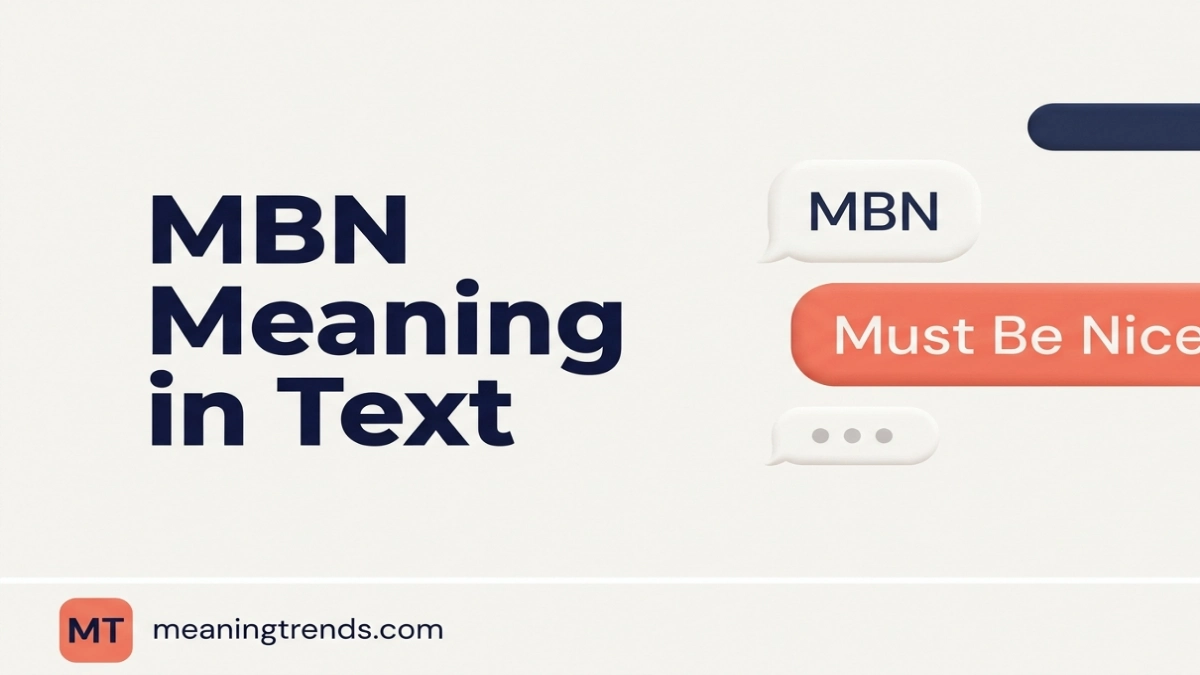
MBN usually means “must be nice” in text messages and online conversations. People use it to react to something another person has, experiences, or gets to do. Depending on the conversation, it can express genuine happiness for someone, playful envy, sarcasm, or mild frustration. For example, “You’re on vacation again? MBN” may suggest that the sender wishes they could take a vacation, too.
Seeing MBN in a message doesn’t automatically mean someone is jealous or being rude. The surrounding conversation and the relationship between the people involved help determine the intended tone.
Imagine telling a friend that you get to sleep in while they have an early shift. If they reply “mbn,” they might be teasing you, wishing they had the same opportunity, or simply acknowledging your good fortune. The challenge is that three letters can communicate different feelings without explaining them fully.
That is why context matters when interpreting texting abbreviations. Understanding the basic expression is useful, but recognizing If the sender sounds playful, supportive, or sarcastic helps you avoid reading too much into a short reply.
What Does MBN Mean in Text?
MBN is an initialism for “must be nice.” An initialism is a shortened expression formed from the first letters of its words, with each letter read separately.
In texting, people use MBN as a reaction when someone describes something enjoyable, fortunate, or appealing. The expression often carries an implied thought: “That sounds great, and I wish I could enjoy it, too.”
For example:
- Friend: “My flight got upgraded to first class!”
- You: “MBN 😂”
Here, the reply may be a playful way of saying, “Lucky you! I wish that were me.”
The slang reference Slang.net documents “must be nice” as the established texting meaning. However, the abbreviation alone does not establish If the sender is happy, envious, or sarcastic.
What Does Each Letter Stand For?
Each letter in MBN represents one word in the phrase “must be nice.”
| Letter | Word | Meaning |
| M | Must | Expresses an assumption or impression |
| B | Be | Connects the subject to a state or condition |
| N | Nice | Describes something favorable or enjoyable |
Together, the phrase comments on a situation that seems pleasant or advantageous.
In everyday English, “must be nice” can be sincere, as in “It must be nice to have more time off.” It can also be pointed, as when someone uses the phrase to highlight a difference between their circumstances and someone else’s.
MBN simply shortens the phrase for casual digital conversation. It does not have a separate, universally established word for each letter beyond this expansion in the texting context.
How Does Context Change the Meaning of MBN?
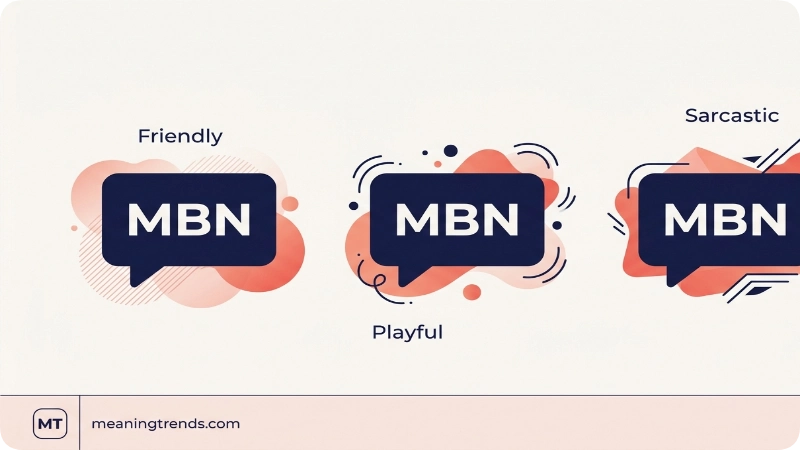
The words behind MBN remain the same, but the intended tone can change. To interpret a message fairly, consider what happened immediately before it, how the sender usually communicates, and If the exchange feels lighthearted or tense.
When a friend sends MBN
Friends may use MBN to tease each other about everyday differences in their schedules, plans, or luck.
Example:
Person A: “I finished all my assignments. I’m free for the weekend!”
Person B: “mbn 😭”
The reply may mean, “Lucky you! I’m still busy.” The crying emoji can add dramatic or humorous emphasis, although it does not prove the sender is joking.
When a romantic interest sends MBN
Someone you’re dating or talking to might use MBN after hearing about your plans, gifts, or free time. The message could be playful, but MBN is not inherently romantic or flirty.
Example:
Person A: “My boyfriend surprised me with dinner tonight.”
Person B: “MBN 🥹”
This could express admiration, a wish for a similar experience, or friendly envy. The message alone cannot establish romantic interest.
When a coworker sends MBN
A coworker might write MBN after hearing that you have a day off or an unusually light workload.
Example:
Person A: “I’m taking Friday off, so I get a three day weekend.”
Person B: “MBN!”
The response may be friendly teasing. If the coworker is struggling with a heavy workload, however, the same phrase might carry some frustration.
When someone comments MBN on social media
On a public post, MBN can react to a vacation, a new purchase, a special event, or another appealing experience.
Example:
Person A posts: “Spending the week by the ocean.”
Person B comments: “MBN 🌴”
The comment may communicate, “That looks wonderful. I wish I were there, too.”
A public comment provides less context than a private conversation, so it is especially important not to assume that the sender is criticizing or resenting the poster.
Examples of MBN in Conversation
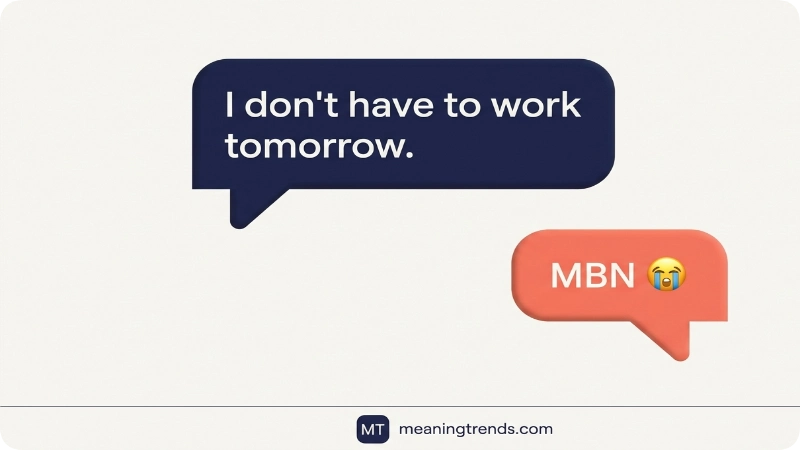
These illustrative conversations show how the abbreviation can work in different situations.
Example 1: Having time off
Person A: “I don’t have to work tomorrow.”
Person B: “MBN 😭”
Interpretation: The sender may be jokingly wishing they had the same day off.
Example 2: Going on vacation
Person A: “We’re going to Italy this summer!”
Person B: “MBN!! That sounds amazing.”
Interpretation: The response combines admiration with an explicit positive comment, making a friendly reading more plausible.
Example 3: Getting something expensive
Person A: “My parents bought me a new laptop.”
Person B: “mbn lol”
Interpretation: The sender may be teasing the recipient about their good fortune. If the comment is entirely playful depends on the relationship and conversation.
Example 4: Having an easy day
Person A: “I finished work early and spent the afternoon relaxing.”
Person B: “Must be nice 😂”
Interpretation: The full phrase conveys much the same idea as MBN, with the emoji suggesting a potentially humorous tone.
Example 5: Sharing relationship news
Person A: “She surprised me with flowers again.”
Person B: “MBN 🥹”
Interpretation: The sender may be admiring the gesture or wishing for a similar experience. The reply does not necessarily indicate jealousy.
Example 6: A potentially sarcastic response
Person A: “I got another week off while everyone else is working.”
Person B: “MBN.”
Interpretation: The short reply could be sincere or sarcastic. Without additional clues, it is not possible to determine the sender’s attitude confidently.
Is MBN Rude, Flirty, or Offensive?
MBN is not inherently rude or offensive. It is an informal expression whose tone depends on how and why someone uses it.
- Friendly: It acknowledges that someone has something enjoyable.
- Playfully envious: It suggests that the sender would like the same opportunity.
- Sarcastic: It can imply that the recipient has an unusually easy or fortunate situation.
- Potentially dismissive: In a tense conversation, it may minimize the recipient’s experience or sound resentful.
The distinction matters because the same words can be understood differently by different people.
For instance, replying MBN to a friend’s vacation announcement may be harmless teasing. Replying MBN to someone describing a difficult personal situation could sound dismissive if it suggests that their circumstances are easier than they really are.
MBN also does not automatically indicate flirting. A romantic interpretation requires other meaningful context, such as the broader conversation and the way the people communicate with each other.
If a message feels ambiguous, avoid treating three letters as proof of someone’s emotions or motives.
How Do You Reply to MBN?
Your response can be simple. Choose one that fits the conversation rather than assuming the sender is jealous.
| Situation | Possible reply |
| Friendly teasing | “Haha, you’ll get your turn 😂” |
| Sharing good news | “It’s been really nice!” |
| Responding to admiration | “Thanks! I’m excited about it.” |
| Inviting the person along | “You should come with me next time!” |
| Unsure about the tone | “Haha, do you mean that in a good way?” |
| Suspecting sarcasm | “Not sure how you mean that—everything okay?” |
You do not need to defend your good fortune or apologize for something positive happening to you.
If the conversation is lighthearted, a lighthearted response usually works well. If the message seems pointed, asking a calm question is more reliable than immediately assuming the sender is upset.
When Should You Use or Avoid MBN?
MBN works best in casual communication where both people understand the informal tone.
Good situations for using MBN:
- Texting friends about vacations, plans, or days off.
- Responding to a funny story about someone’s good luck.
- Commenting on a friend’s enjoyable experience.
- Sharing a playful reaction in a relaxed group chat.
Situations where spelling it out is better:
- Professional emails or formal workplace messages.
- Conversations with someone who may not recognize texting slang.
- Sensitive discussions where sarcasm could hurt someone’s feelings.
- Situations where you want to express clear congratulations or sincere support.
For example, if a colleague tells you they received a promotion, “Congratulations! That’s wonderful news” communicates your reaction more clearly than MBN.
Likewise, if a friend shares an important personal achievement, a direct compliment can avoid the possibility that your message will be interpreted as envy or sarcasm.
What Are Other Ways to Say MBN?
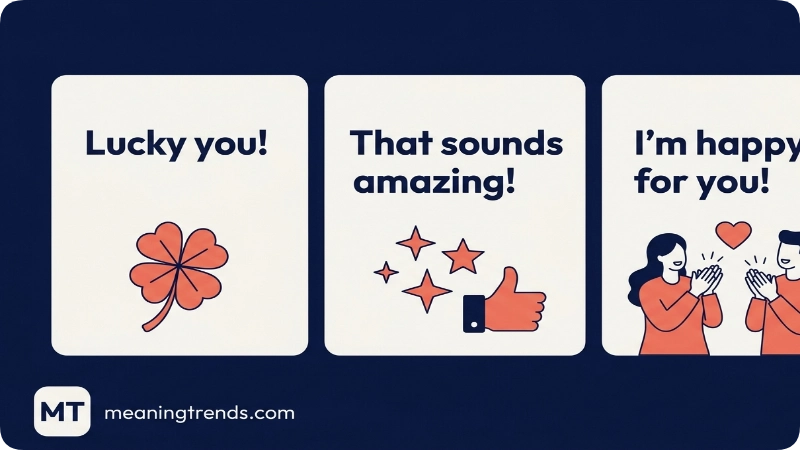
The best alternative depends on the feeling you want to communicate.
- “Lucky you!” — A casual reaction to someone’s good fortune.
- “That sounds amazing!” — Clear, positive admiration.
- “I wish I could do that, too.” — An honest expression of wanting the same experience.
- “Good for you!” — Can communicate approval, although tone matters.
- “I’m happy for you!” — An explicit expression of support.
- “Must be nice.” — The full phrase behind MBN.
- “I hope you enjoy it!” — A warm response that focuses on the other person’s experience.
These alternatives are not exact equivalents in every situation. “I’m happy for you” communicates support more directly, while “Lucky you” can retain the playful or envious undertone of MBN.
When your intended tone matters, writing the complete phrase is often the clearest choice.
FAQs
What does MBN stand for in texting?
MBN stands for “must be nice.” It is an informal abbreviation used to react to another person’s enjoyable or fortunate situation.
Does MBN mean someone is jealous?
Not necessarily. It can express playful envy, but it can also communicate admiration or humor. The abbreviation alone cannot establish genuine jealousy.
What does MBN mean from a girl or a guy?
The basic texting meaning remains “must be nice,” regardless of the sender’s gender. The relationship and conversation provide better clues about the intended tone than gender does.
Does MBN have a positive or negative meaning?
It can be either, depending on context. A friendly message may sound complimentary, while a pointed response may sound sarcastic or envious.
Is MBN the same as “must be nice”?
Yes. In this texting context, MBN is the initialism for the phrase “must be nice.”
Should I use MBN in a professional message?
Usually, spelling out your meaning is clearer in formal or professional communication. Use a direct phrase such as “That’s great news” or “I’m glad that worked out for you.”
Conclusion
MBN generally means “must be nice” in casual texting and online conversations. It is a compact way to react to someone else’s good fortune, enjoyable plans, or appealing circumstances. Depending on the situation, it can communicate admiration, playful envy, humor, or sarcasm.
The most important thing to remember is that the abbreviation’s definition does not reveal the sender’s exact feelings. A friend joking about your vacation may mean something very different from a coworker commenting on your workload. The words, relationship, and surrounding conversation all help shape the interpretation.
If someone sends you MBN, start with the ordinary meaning rather than assuming hostility or romantic interest. Reply naturally if the tone seems clear, or ask what they mean if it genuinely bothers or confuses you. When using the abbreviation yourself, consider If the other person will recognize the joke. A few extra words can make your intended meaning much easier to understand.

Alex writes about the words and shortcuts people use in texts, group chats, and social media. Each guide explains the meaning with everyday examples and tips on when to use it