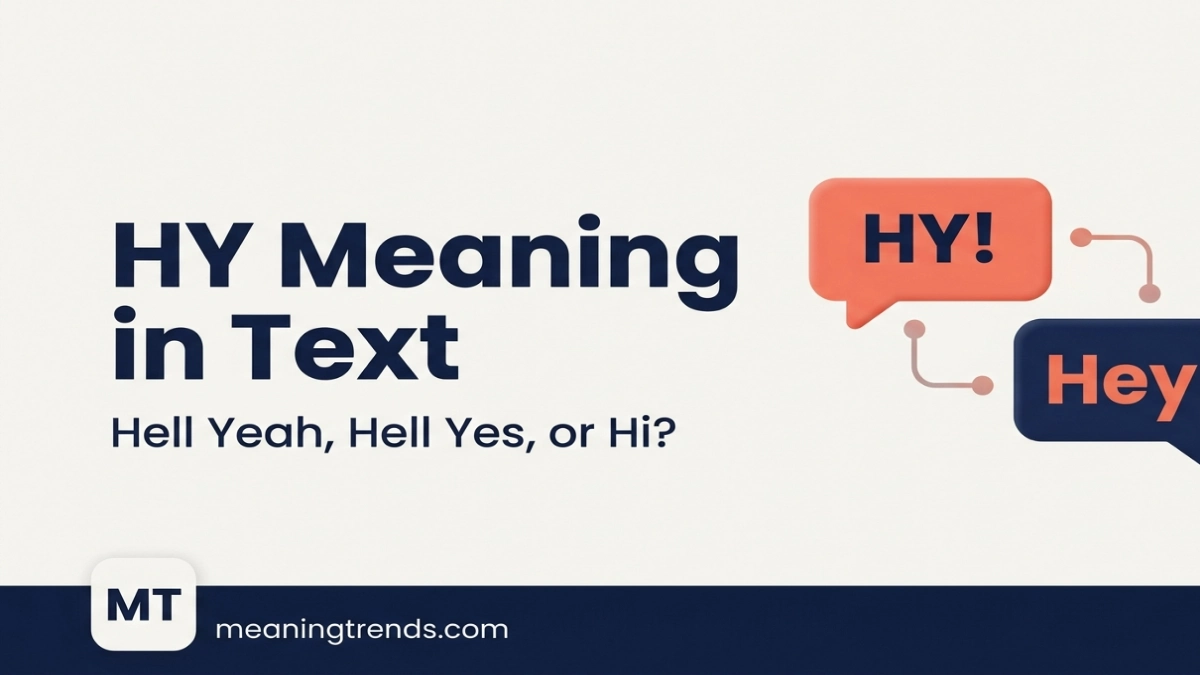
HY in text often means “hell yeah,” an enthusiastic way to say yes, express excitement, or strongly agree with someone. However, HY isn’t a universally standardized abbreviation. Depending on the conversation, it may have another meaning, so the surrounding messages matter.
For example, if someone texts, “Want to hang out tonight?” and the reply is “HY!” they’re likely saying an excited yes.
Imagine inviting a friend to a concert and receiving nothing but “HY 🔥.” That short response can feel enthusiastic, but what if someone sends “hy” at the beginning of a conversation instead?
Short messages can be difficult to interpret because they leave out the tone, facial expressions, and other clues we use in face to face conversations. A two letter message may be an abbreviation, an informal greeting, or even a typing mistake.
Understanding HY means looking beyond the letters. The previous message, punctuation, and conversational situation can help you decide whether someone is agreeing, greeting you, or expressing something else.
What Does HY Mean in Text?

In informal texting slang, HY can stand for “hell yeah.” It’s a casual, emphatic expression of agreement, approval, or excitement.
“Hell yeah” is stronger and more expressive than a simple “yes.” Someone might use HY when they’re particularly happy about an invitation, excited by good news, or strongly supportive of an idea.
Consider these illustrative exchanges:
Example 1:
- Person A: “Are you coming to the party?”
- Person B: “HY!”
Here, HY expresses enthusiastic agreement.
Example 2:
- Person A: “We finally finished the project!”
- Person B: “HY, we did it!”
In this case, HY celebrates an achievement.
Example 3:
- Person A: “Pizza tonight?”
- Person B: “HY 😂”
The response suggests an excited yes, with the emoji adding a playful tone.
These examples show how HY can function as a complete reply or appear within a longer sentence.
However, the “hell yeah” interpretation isn’t guaranteed every time you see those letters. If the message doesn’t involve agreement, celebration, or excitement, another reading may fit better.
What Does HY Stand For?
When used as the slang expression “hell yeah,” HY is an initialism formed from the first letters of two words.
- H = Hell
- Y = Yeah
The full expression is an emphatic version of “yes.”
The word “hell” adds intensity, making the response sound more energetic or forceful. Although the expression contains mild profanity, it’s often used positively in casual conversation.
HY is not a formal English word, and there is no reason to assume that every use of the letters has this expansion.
Unlike established abbreviations with one fixed interpretation, short informal messages can depend heavily on context.
Why Do People Use HY in Text Messages?
HY offers a quick way to communicate enthusiasm without typing out the entire phrase.
To show excitement
A person might use HY when they’re looking forward to something.
Example:
Person A: “We got tickets for Saturday!”
Person B: “HY!!”
The double exclamation marks reinforce the excitement already suggested by the response.
To express strong agreement
HY can also communicate support for a suggestion or opinion.
Example:
Person A: “We should take a vacation after exams.”
Person B: “HY, we deserve it.”
The response suggests that the sender strongly agrees.
To celebrate good news
A short, enthusiastic reply can acknowledge a positive update.
Example:
Person A: “I passed my driving test!”
Person B: “HY! Congrats!”
Here, HY functions as an excited reaction to someone else’s achievement.
To keep a conversation casual
In a friendly conversation, a brief response may feel more natural than a carefully written sentence.
Someone who regularly uses abbreviations might prefer “HY!” over “Absolutely, I’d love to.”
That doesn’t mean the abbreviation is appropriate for every audience. Its casual tone is an important part of its meaning.
What Else Can HY Mean?
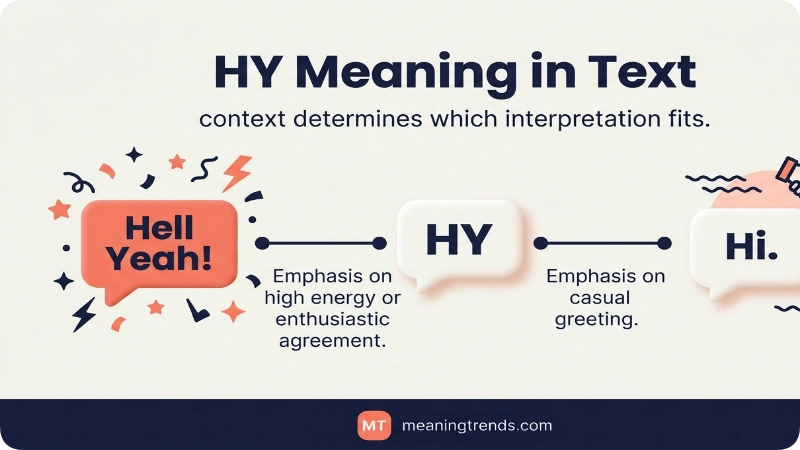
Although “hell yeah” is one interpretation of HY in slang, other readings are possible.
HY as a possible variation of “hi”
Someone might type “hy” as an informal greeting or an accidental variation of “hi.”
For example:
Person A: “hy”
Person B: “Hey! What’s up?”
When HY appears alone at the beginning of a conversation, a greeting may be a more reasonable interpretation than enthusiastic agreement.
This is a contextual possibility, not proof that HY is a universally recognized replacement for “hi.”
HY as initials or an abbreviation
HY can also represent initials, a label, or an abbreviation in a specialized setting.
For example, someone might use those letters as part of a person’s initials, an internal project name, or a code understood within a particular group.
Without additional context, there is no reliable way to assign one specific expansion to every such use.
HY as a typing mistake
Short messages are especially vulnerable to typing errors.
A person may accidentally enter “hy” when intending to write another word. If the letters don’t fit the conversation, a typo is worth considering before assuming a slang meaning.
The safest approach is to interpret the message in its actual conversational setting rather than treating every possible expansion as an established definition.
How Does Context Change the Meaning of HY?
The most useful clue is often the message that came immediately before HY.
| Conversation context | Possible interpretation |
| Reply to an invitation | Enthusiastic yes |
| Reaction to good news | Excitement or approval |
| First message in a chat | Possible greeting |
| Unrelated conversation | Initials, shorthand, or typo |
When HY comes from a friend
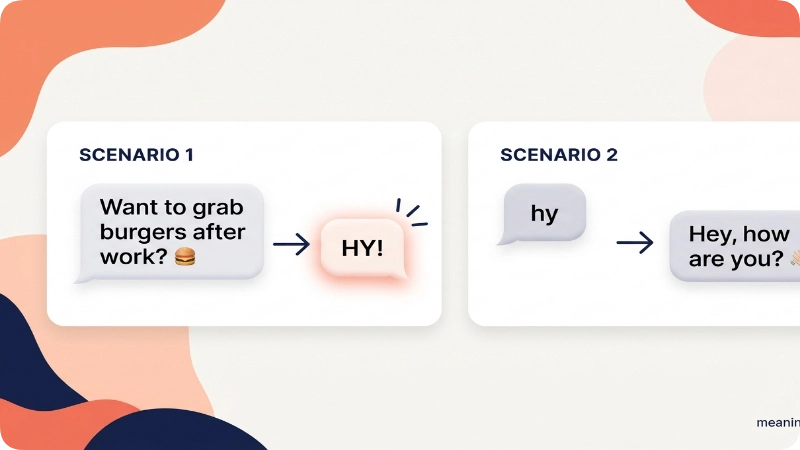
In a casual conversation between friends, HY may be an enthusiastic reaction, especially if the previous message asks a yes or no question.
For example:
“Want to grab burgers after work?”
“HY!”
The reply makes sense as an excited acceptance.
But if your friend sends “hy” out of nowhere, it might simply be their way of starting a conversation.
When HY comes from someone you’re dating
The same abbreviation can appear in a romantic conversation without having a specifically romantic meaning.
For example:
Person A: “Want to see me this weekend?”
Person B: “HY ❤️”
The reply may suggest enthusiasm about meeting, and the heart adds warmth. Still, the abbreviation alone doesn’t prove attraction or reveal how serious someone’s feelings are.
Look at the broader conversation and the person’s actions rather than drawing conclusions from two letters.
When HY appears in a group chat
Group conversations often involve quick reactions to plans, jokes, or announcements.
If someone suggests a weekend trip and another person replies “HY,” enthusiastic agreement is a plausible reading.
If the letters appear in a discussion about a specific project, person, or topic, they may instead be shorthand known to the group.
Does capitalization change HY’s meaning?
Not necessarily.
“HY,” “Hy,” and “hy” can all appear in casual messages. Uppercase letters may make a response look more emphatic, but capitalization alone doesn’t establish the meaning.
Compare:
“HY!!!” after exciting news.
“hy” as the first message of the day.
The surrounding situation provides more information than letter case by itself.
Examples of HY in Conversation
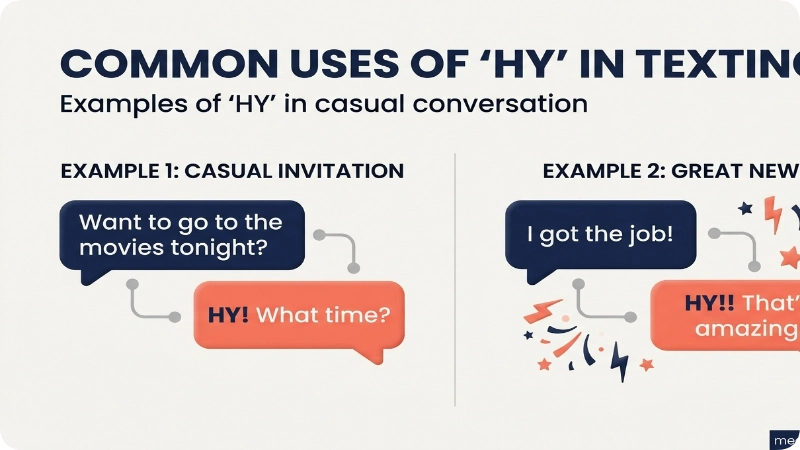
The following fictional conversations illustrate how HY may be understood in different situations.
Example 1: Accepting an invitation
Alex: “Want to go to the movies tonight?”
Jordan: “HY! What time?”
Meaning: Jordan is enthusiastically accepting the invitation.
Example 2: Celebrating an achievement
Taylor: “I got the job!”
Morgan: “HY!! That’s amazing!”
Meaning: Morgan is expressing excitement and support.
Example 3: Agreeing with a suggestion
Sam: “We should order tacos instead.”
Chris: “HY, tacos sound perfect.”
Meaning: Chris strongly agrees with the suggestion.
Example 4: Starting a conversation
Jamie: “hy”
Riley: “Hey, how are you?”
Meaning: Jamie’s message may be intended as a greeting rather than the slang expression “hell yeah.”
Example 5: Responding playfully
Casey: “Ready for another round of games?”
Drew: “HY 😂”
Meaning: Drew appears excited to continue, with the laughing emoji making the response feel playful.
Example 6: An unclear message
Avery: “Did you get my notes?”
Blake: “hy”
Avery: “Do you mean yes?”
Meaning: HY doesn’t clearly answer the question in this example. Asking for clarification is more reliable than assuming the sender’s intention.
These examples demonstrate why the same letters can produce different interpretations.
Is HY Rude, Flirty, or Offensive?
HY isn’t inherently rude or flirty. Its tone depends on what the sender means and how the message is used.
Can HY sound rude?
If HY means “hell yeah,” it includes mild profanity. Some people may find that wording too informal or inappropriate, particularly in professional or formal situations.
Among friends, it may sound completely natural.
For instance, “HY, that sounds awesome!” is likely to come across as positive in a relaxed conversation.
The expression’s appropriateness depends on the audience and setting.
Can HY be flirty?
HY can appear in a flirtatious exchange, but it doesn’t have a fixed romantic meaning.
If someone responds “HY 😉” to a date invitation, the message may feel playful or flirtatious because of the invitation and emoji.
Without that context, HY doesn’t establish romantic interest.
Can HY sound sarcastic?
It can, particularly when the surrounding words clearly suggest sarcasm.
For example:
“Another three hour meeting? HY, exactly what I wanted.”
The contrast between the complaint and the enthusiastic expression suggests the sender may be joking or expressing frustration.
Sarcasm is difficult to identify from a short message alone, so it’s worth avoiding firm conclusions without more context.
How Do You Reply to HY in Text?

Your response should match the conversation rather than the abbreviation by itself.
If HY clearly means an enthusiastic yes, you can continue with the plan or acknowledge the excitement.
Friendly
Awesome! Can’t wait.
Copy
Making plans
Perfect! Let’s meet at 7.
Copy
Playful
Haha, that’s the energy I like 😂
Copy
Celebrating
We did it! So excited!
Copy
Clarifying
Do you mean yes?
Copy
Replying to a greeting
Hey! What’s up?
Copy
You don’t need to imitate the sender’s slang to respond naturally.
If you aren’t sure what HY means, a simple question such as “Do you mean yes?” or “What does HY mean here?” can prevent confusion.
When Should You Use or Avoid HY?
HY fits best in informal conversations where the intended meaning is already clear.
It may work when you’re texting friends, reacting to exciting news, or enthusiastically accepting a casual invitation.
However, it’s less suitable in situations where clarity or professionalism matters.
For example, replying “HY” to a manager’s formal request could sound overly casual. “Yes, absolutely” or “I’d be happy to” would generally be clearer.
The abbreviation may also confuse someone who isn’t familiar with it. When communicating with a new contact, using the complete phrase or a plain English alternative can reduce ambiguity.
Remember that “hell yeah” contains mild profanity. Even when it’s meant positively, the full expression may not match every person’s communication preferences.
What Are Other Ways to Say HY?
If you want to express the same enthusiasm without using HY, several alternatives are available.
| Expression | Tone | Suitable situation |
| Hell yeah! | Very enthusiastic, casual | Friends and informal chats |
| Absolutely! | Strong and positive | Casual or professional |
| Definitely! | Confident agreement | Everyday conversations |
| For sure! | Relaxed and friendly | Informal texting |
| I’m in! | Enthusiastic acceptance | Invitations and plans |
| Sounds great! | Warm and positive | Making arrangements |
| Yes, I’d love to! | Friendly and clear | Accepting invitations |
The closest replacement depends on the sentence.
If HY answers an invitation, “I’m in!” may sound more natural than “Definitely!”
If it celebrates good news, “That’s awesome!” may capture the excitement better.
These alternatives communicate enthusiasm without requiring the reader to recognize a two letter abbreviation.
FAQs About HY Meaning in Text
Does HY mean “hell yeah” or “hell yes”?
Both expansions are used in explanations of texting slang. Cyber Definitions lists “hell yes,” while other slang references describe “hell yeah.” Both express enthusiastic agreement, and the exact wording may depend on the sender.
What does HY mean from a girl or a guy?
The meaning doesn’t depend on the sender’s gender. HY may express enthusiastic agreement or serve as a casual greeting. The conversation provides better clues than whether the sender is a girl or a guy.
What does HY mean on Snapchat or Instagram?
HY can mean “hell yeah,” “hell yes,” or an informal “hi” or “hey” in messages on these platforms. There’s no need to assume a special platform specific definition without evidence. Look at whether the message starts a conversation or responds to something.
Is HY the same as YH?
Not exactly. YH is an informal abbreviation for “yeah,” while HY can represent the stronger expression “hell yeah” or “hell yes.” HY may also function as a greeting, depending on context.
Does HY always mean yes?
No. Although an enthusiastic yes is one documented use, HY can also appear as a casual greeting or have a different meaning in a particular conversation.
Is HY appropriate for professional messages?
Generally, it’s better to use clearer expressions such as “Yes,” “Absolutely,” or “That sounds great.” HY is informal and may not be understood by every recipient.
Conclusion
HY in texting can express an enthusiastic yes, commonly interpreted as “hell yeah” or “hell yes.” It may also be used as a casual variation of “hi” or “hey.” The key is to consider where the message appears in the conversation. A reply to an invitation suggests agreement, while an opening message may simply be a greeting.
If someone sends you HY, respond to the apparent purpose of their message. You might confirm a plan, share their excitement, or greet them back. If the meaning isn’t clear, asking “What do you mean by HY?” is perfectly reasonable.
When using HY yourself, remember that it is casual shorthand and may contain implied mild profanity. A fuller expression is often better when you want to be especially clear or polite.

Alex writes about the words and shortcuts people use in texts, group chats, and social media. Each guide explains the meaning with everyday examples and tips on when to use it