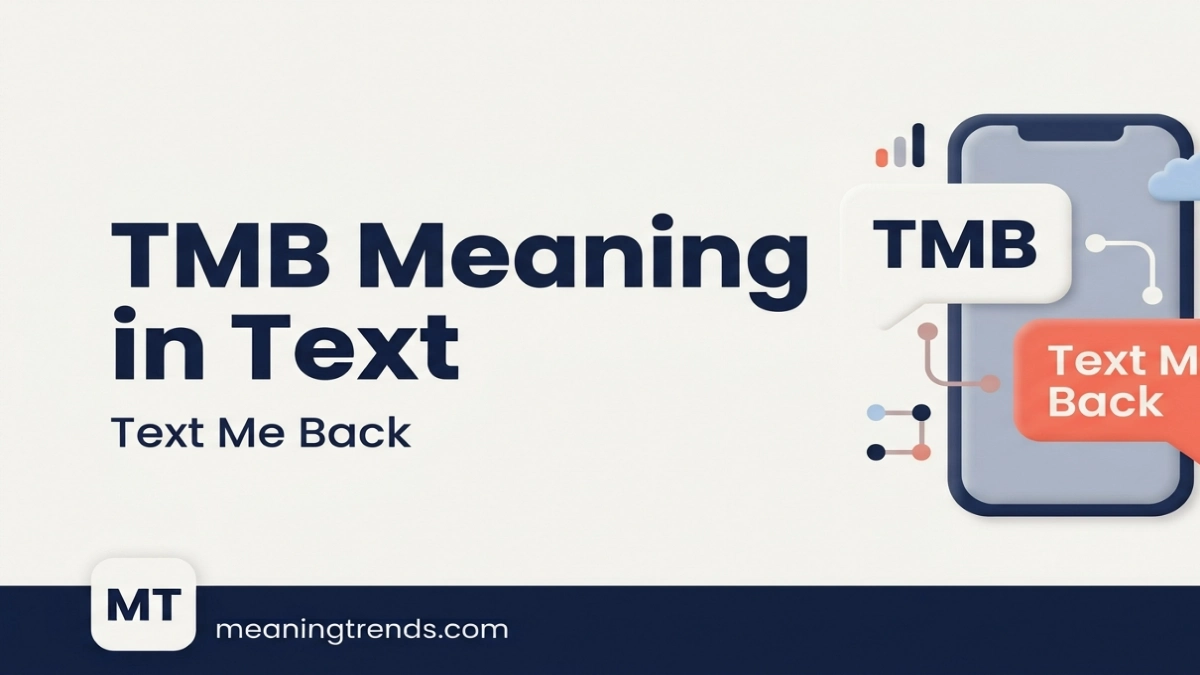
Quick Answer: TMB can mean “Text Me Back” in texting, asking someone to reply to a message. However, TMB isn’t limited to one interpretation. In some informal conversations, it may also mean “Take Me Back.” The surrounding words and conversation help determine which meaning fits.
Example: “I’m heading out now, TMB when you can.” Here, TMB means “Text Me Back.”
You receive a message that ends with “TMB,” but you’re not sure If the sender wants a reply, is remembering something, or means something else entirely. Three letters can be surprisingly difficult to interpret when there’s little context.
Text abbreviations often leave out the words that would normally explain a person’s intention. That’s why understanding TMB involves more than memorizing one possible expansion.
A message about making plans may suggest a request to text back, while a conversation about an old relationship or shared memory may point toward a different interpretation. The sender’s wording, previous messages, and overall topic matter more than the abbreviation alone.
What Does TMB Mean in Text?
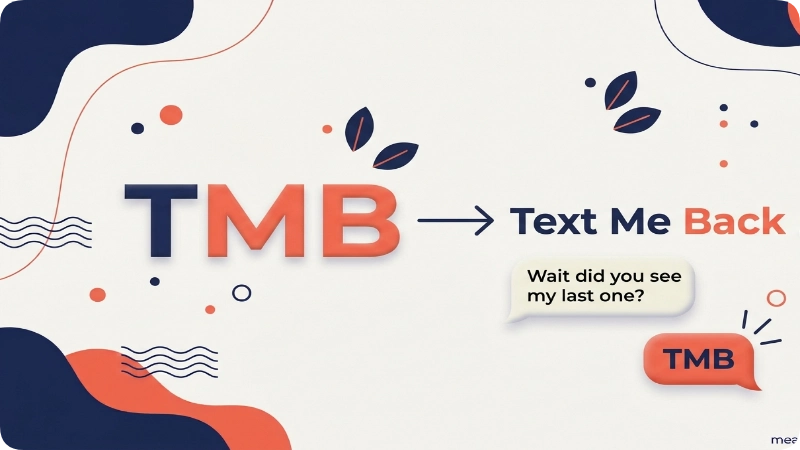
In an informal text conversation, TMB can stand for “Text Me Back.” It functions as a request for the recipient to send a reply.
For example:
- “TMB when you’re free.” — The sender wants a response when you have time.
- “Hey, TMB.” — The sender is asking you to reply, although the tone is unclear.
- “Can we talk later? TMB.” — The sender wants you to respond about having a conversation.
The abbreviation itself doesn’t specify how quickly you must respond. Words such as “ASAP,” “tonight,” or “when you get a chance” provide more information about timing.
TMB can also have other meanings, so “Text Me Back” should be treated as a possible reading rather than a universal definition.
Is TMB slang or an abbreviation?
TMB is an initialism, a type of abbreviation made from the first letters of several words.
When it represents “Text Me Back,” the letters stand for a three word phrase rather than a single slang word.
It’s mainly suited to casual communication because the reader must already understand the intended expansion or infer it from context.
What Does Each Letter in TMB Stand For?
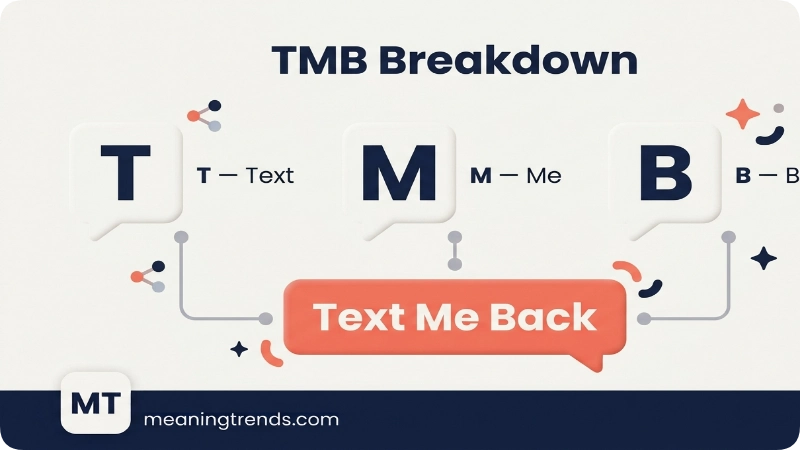
When TMB means “Text Me Back,” the letters break down as follows:
| Letter | Word | Meaning |
| T | Text | Send a written message |
| M | Me | The person sending the request |
| B | Back | Reply to the sender |
Together, the words form a straightforward request: “Text me back.”
Unlike a standard English sentence, the abbreviation doesn’t contain a subject. The implied subject is “you,” meaning the person receiving the message.
For example, “TMB later” can be understood as “Please text me back later.”
This breakdown applies only when the intended phrase is “Text Me Back.” Other interpretations of TMB have different letter expansions, and the abbreviation alone doesn’t establish which one the sender intended.
Why Do People Use TMB in Messages?
When someone uses TMB to mean “Text Me Back,” the purpose is usually to request a response without typing the full phrase.
It may appear when someone wants to:
- Continue a conversation after a break.
- Confirm plans or arrangements.
- Get an answer to a previous question.
- Ask someone to contact them when they’re available.
- Bring attention back to an unanswered message.
Consider the difference between these two examples:
“Let me know if you’re coming tomorrow.”
“TMB if you’re coming tomorrow.”
Both can request a response, but the first is clearer to someone unfamiliar with the abbreviation.
Shortened messages aren’t automatically impolite. The tone depends on the full wording, the relationship between the people, and the circumstances.
What Else Can TMB Mean?
TMB doesn’t have one guaranteed meaning across every conversation. Besides “Text Me Back,” another possible informal interpretation is “Take Me Back.”
TMB as “Take Me Back”
“Take me back” can express nostalgia or a wish to return to an earlier time, place, or relationship.
For example:
“Those summer nights were amazing. TMB.”
In this illustrative message, “Take Me Back” is a plausible interpretation because the sender is recalling a past experience.
The phrase itself is familiar English, but that doesn’t establish how widely its TMB abbreviation is recognized. It’s safer to treat this expansion as context dependent rather than assume every reader will understand it.
TMB as an abbreviation outside texting
TMB can also represent names, organizations, and specialized terms outside ordinary chat conversations.
Those uses don’t automatically apply to personal messages. A workplace document, gaming discussion, or technical conversation may use an abbreviation differently from a casual text.
If the topic is specialized, check If the abbreviation was explained earlier rather than substituting a texting definition.
How Does Context Change the Meaning of TMB?
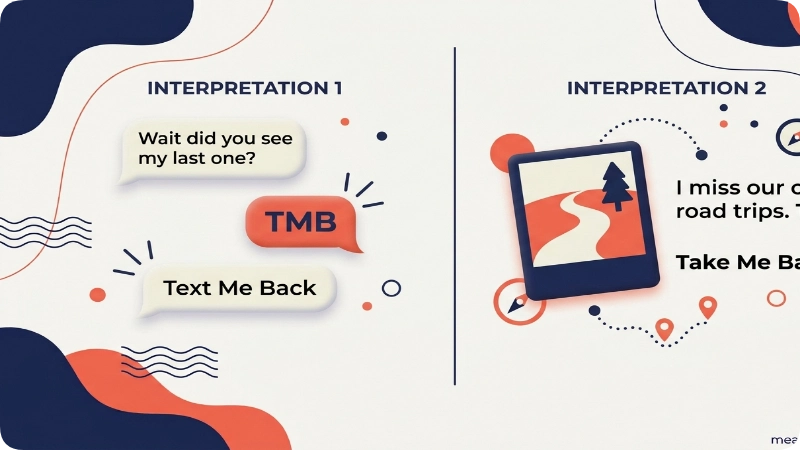
Context is the strongest clue when deciding what TMB means in a particular message.
A request for a reply
“I sent you the address. TMB when you see it.”
Likely interpretation: “Text Me Back,” because the sender expects confirmation.
A nostalgic message
“I miss our old road trips. TMB.”
Possible interpretation: “Take Me Back,” because the sender is remembering the past.
An unclear standalone message
“TMB”
No surrounding information establishes the meaning. Asking for clarification is reasonable.
TMB from a friend
A friend might use TMB while making plans or following up on a conversation.
For example, “TMB when you finish work” strongly suggests a request for a reply.
However, friendship alone doesn’t determine the meaning. The words around the abbreviation still matter.
TMB from someone you’re dating
In a romantic conversation, TMB might request a response or, in a nostalgic context, refer to wanting a relationship back.
Neither interpretation proves attraction, reconciliation, or any particular emotional intention.
A message such as “I miss how things were. TMB” could suggest “Take Me Back,” but the exact intention remains uncertain without clarification.
TMB in a group chat
In a group conversation, the abbreviation may be directed at one person or at everyone participating.
For example, “Alex, TMB about Saturday” makes the intended recipient clearer.
If someone writes only “TMB” in a busy group chat, both the meaning and intended recipient may be uncertain.
Examples of TMB in Text Conversations
The following are illustrative conversations showing how TMB could be interpreted in different situations. They aren’t quotations from actual messages or evidence of how frequently an expansion is used.
Example 1: Making plans
Person A: “Are you still coming to dinner tonight? TMB when you know.”
Person B: “Yes, I’ll be there around 7.”
Meaning: TMB means “Text Me Back.” Person A wants confirmation.
Example 2: Checking in
Person A: “Hope your appointment went okay. TMB when you have a minute.”
Person B: “Everything went well, thanks!”
Meaning: The sender is asking for an update without specifying an immediate deadline.
Example 3: Following up
Person A: “Did you get the information I sent? TMB.”
Person B: “Just saw it. Thanks!”
Meaning: The sender wants acknowledgment of an earlier message.
Example 4: Remembering the past
Person A: “Found pictures from our beach vacation. TMB!”
Person B: “That was such a fun trip.”
Meaning: “Take Me Back” is a plausible reading because the conversation focuses on a past experience.
Example 5: An unclear message
Person A: “TMB?”
Person B: “Do you mean text you back?”
Meaning: There isn’t enough information to establish the intended expansion, so Person B asks.
These examples show why a useful interpretation should fit the whole conversation rather than just the letters.
Is TMB Rude, Flirty, or Demanding?
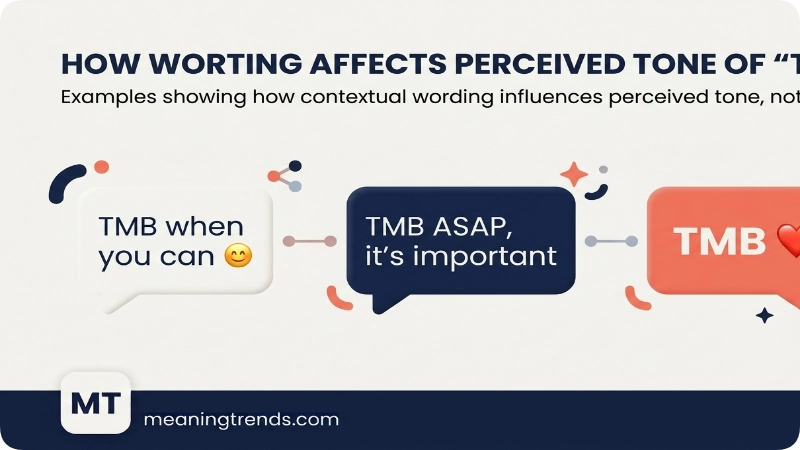
TMB isn’t inherently rude or flirty. Its tone depends on how the sender uses it.
When TMB means “Text Me Back,” it may sound friendly, neutral, impatient, or demanding depending on the surrounding language.
| Message | Possible tone | Why |
| “TMB when you can 😊” | Friendly | Allows the recipient flexibility |
| “Hey, TMB later!” | Casual | Suggests an ordinary follow up |
| “TMB ASAP, it’s important.” | Urgent | Explicitly requests a quick response |
| “Why aren’t you answering? TMB.” | Frustrated | The surrounding question conveys impatience |
| “TMB ❤️” | Possibly affectionate | The heart may soften the request, but doesn’t prove romantic intent |
Capital letters alone don’t establish anger. Some people type abbreviations in uppercase simply because that’s how they’re written.
Likewise, a heart emoji doesn’t prove someone is flirting. It may express warmth, affection, or friendliness.
When the message concerns personal information or a sensitive topic, a request to text back doesn’t create an obligation to share details. A brief response, delayed reply, or polite refusal can be appropriate depending on the situation.
How Do You Reply to TMB?
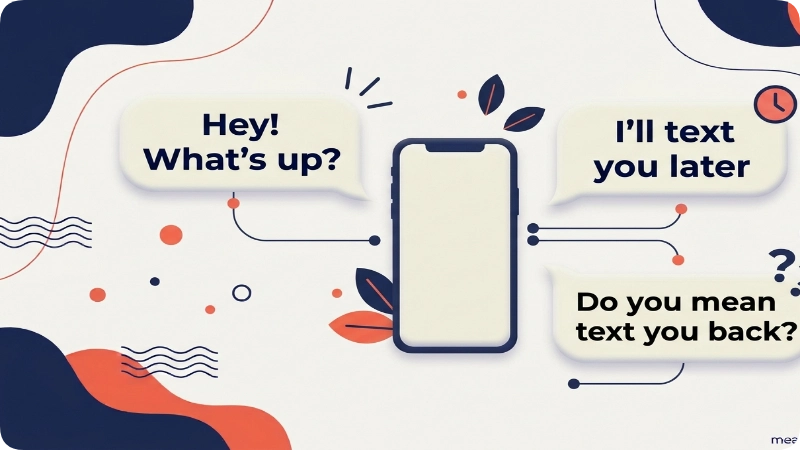
If someone uses TMB to request a text response, your reply can be as simple as answering their question.
The most natural response depends on If you’re available, interested in continuing the conversation, or unsure what the sender means.
Friendly replies
- “Hey! What’s up?”
- “Just saw your message!”
- “I’m here. What did you need?”
Replies when you’re busy
- “I’m tied up right now. I’ll text you later.”
- “Can I get back to you tonight?”
- “I saw your message, but I need a little time.”
Playful replies
- “I’m texting you back right now 😂”
- “You called?”
- “Look who finally replied!”
These are best suited to conversations where playful language is welcome.
Replies when you’re unsure
- “What do you mean by TMB?”
- “Do you mean text you back?”
- “Are you talking about the old days?”
A clarification question is particularly useful when the message contains no other clues.
Replies when you don’t want to continue
- “I can’t talk about this right now.”
- “I’d rather not discuss that.”
- “I need some space, so I won’t be replying for a while.”
You don’t have to match the sender’s urgency or tone. A clear, respectful response is usually more useful than guessing what they expect.
When Should You Use or Avoid TMB?
TMB can work in casual messages when you’re reasonably confident the recipient understands it.
It may be suitable for conversations with friends or people who already use similar abbreviations.
However, writing “Text me back” is clearer when the recipient may not recognize TMB.
Consider avoiding the abbreviation in:
- Professional emails or workplace requests where clarity matters.
- Messages to someone unfamiliar with your texting style.
- Important instructions involving deadlines or urgent decisions.
- Conversations where misunderstanding could cause unnecessary tension.
For example, instead of writing “TMB ASAP” in a work message, you could say, “Please reply as soon as you’re available.”
That version communicates the request directly without requiring the reader to decode an abbreviation.
What Are Other Ways to Say TMB?
When TMB means “Text Me Back,” several expressions communicate a similar request.
| Expression | Meaning | Typical use | Key distinction |
| Text me back | Send a reply by text | Casual conversation | Full, explicit wording |
| Reply when you can | Respond when available | Friendly or polite messages | Emphasizes flexibility |
| Get back to me | Respond later | Personal or professional messages | Doesn’t specify texting |
| Let me know | Give an answer or update | Plans and decisions | Focuses on providing information |
| Please respond | Send a response | More formal communication | Direct and broadly applicable |
These alternatives aren’t exact substitutes in every sentence.
For example, “Let me know” often introduces a particular question or decision, while “Text me back” directly requests a message.
If you’re writing to someone you don’t know well, fuller wording is usually the better choice.
Does TMB Mean the Same Thing on Every Platform?
The platform can provide context, but it doesn’t automatically determine what TMB means.
TMB on Snapchat
In a Snapchat chat, TMB can mean “Text Me Back,” particularly when someone wants a response to an earlier message.
For example, “TMB when you’re online” suggests the sender wants to continue talking.
The abbreviation doesn’t refer to a specific Snapchat feature.
TMB on Instagram
In an Instagram direct message, TMB can also mean “Text Me Back.”
In conversations about tagging people in posts, “Tag Me Back” is another reported interpretation.
For example, “I tagged you in my post. TMB” could mean the sender wants a tag in return.
That reading depends on the discussion about tagging, not simply on the fact that the message appears on Instagram.
TMB on TikTok
TMB may appear in TikTok comments or private conversations. A request to reply can suggest “Text Me Back,” while a discussion about tagging could support “Tag Me Back.”
There is no need to assume that TMB has a completely separate definition on TikTok.
TMB in Spanish language messages
One important language specific difference is lowercase “tmb” as a shortened spelling of the Spanish word “también,” meaning “also” or “too.”
For example:
“Yo tmb quiero ir.”
This means, “I want to go too.”
Unlike the English initialism “Text Me Back,” this Spanish usage shortens one word rather than representing the first letters of three separate words.
The language of the surrounding sentence is the clearest clue.
FAQs About TMB Meaning in Text
What does TMB stand for in a text message?
TMB stands for “Text Me Back” in documented English texting usage. It asks someone to send a response. Other interpretations are possible when the conversation provides different clues.
What does TMB mean from a girl or guy?
The sender’s gender doesn’t change the definition. TMB may request a reply or have another context dependent meaning. Read the surrounding message rather than assuming romantic interest.
Does TMB mean “Take Me Back”?
It can be interpreted that way in nostalgic or relationship related messages, but this reading is less firmly established than “Text Me Back.” Ask the sender if the intended meaning isn’t clear.
What does lowercase tmb mean?
In English texting, lowercase “tmb” can mean the same thing as uppercase “TMB.” In Spanish language chats, it may instead shorten “también,” meaning “also” or “too.”
Is TMB the same as TBH?
No. TBH means “To Be Honest,” an expression used to introduce a candid statement. TMB, when it means “Text Me Back,” asks someone to reply. The abbreviations have different functions.
Does TMB mean someone wants an immediate reply?
Not necessarily. “TMB when you can” allows flexibility, while “TMB ASAP” explicitly requests a quick response. The abbreviation alone doesn’t establish urgency.
Can TMB be used in professional communication?
It can appear in informal workplace chats, but writing “Please reply” or “Please get back to me” is clearer in professional communication.
Conclusion
TMB has a documented meaning of “Text Me Back” in English texting. It is a short way to ask someone to respond or continue a conversation. However, the same letters may appear in other contexts, including possible nostalgic uses such as “Take Me Back,” tagging related messages, and the Spanish shortened spelling of “también.” The most important rule is to interpret the abbreviation alongside the surrounding words rather than assuming one definition always applies.
When someone sends you TMB, look at what they said immediately before it. If they asked a question or mentioned plans, a request for a reply is a sensible interpretation. If the conversation concerns memories, tagging, or another language, consider those clues instead.
When you’re uncertain, a simple “Do you mean text me back?” can prevent confusion. And when writing your own messages, using the full phrase is often the easiest way to make your intention clear.

Alex writes about the words and shortcuts people use in texts, group chats, and social media. Each guide explains the meaning with everyday examples and tips on when to use it