QUICK ANSWER
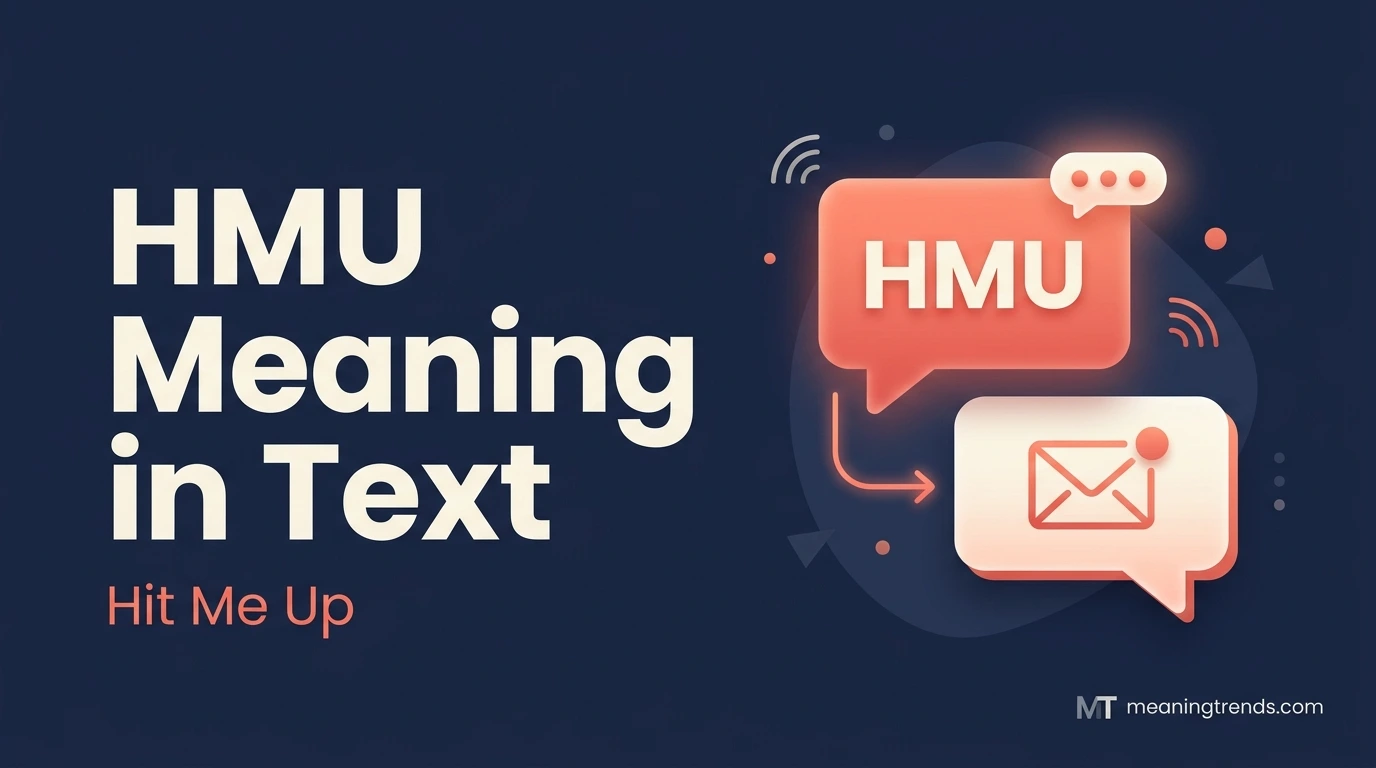
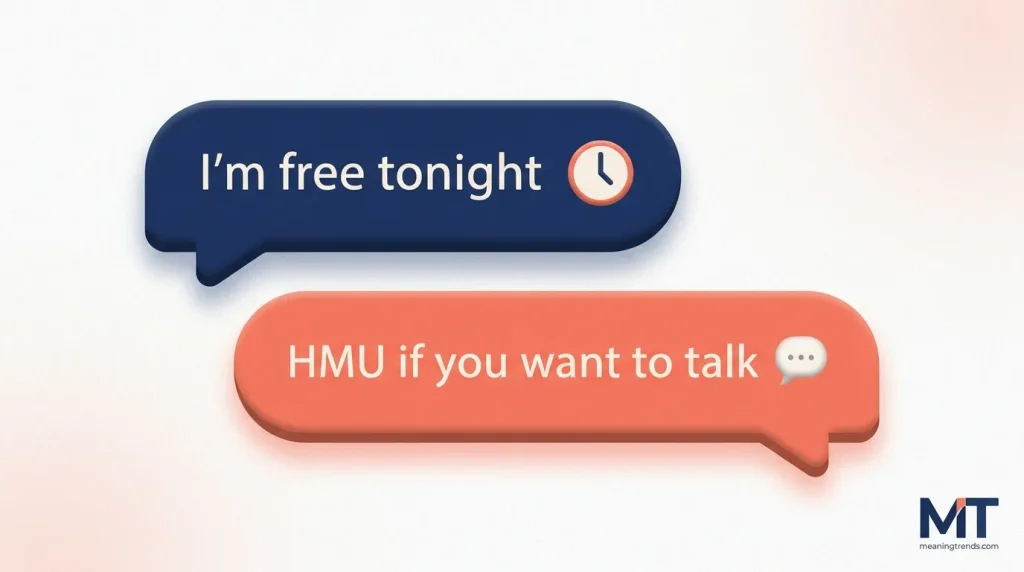
HMU means “hit me up.” In text messages, it is a casual way to ask someone to get in touch, send a message, or start a conversation. For example, “I’m free tonight, HMU” means “Contact me if you want to talk or hang out.” The exact intention depends on the conversation.
You receive a text that says, “hmu later,” but you are not sure If the person wants to chat, make plans, or call you. The abbreviation is short, but the situation around it can make a difference.
Understanding the phrase is straightforward. Figuring out what someone wants from you requires a little more attention. A friend might be inviting you to hang out, a classmate might be offering help, or someone you are interested in might be leaving the door open for a conversation.
The key is to separate the phrase’s basic meaning from the sender’s personal intention. Once you recognize how HMU works, you can understand the message and respond without overthinking three little letters.
What Does HMU Mean?

HMU is an abbreviation for “hit me up,” an informal English expression that means to contact or get in touch with someone.
In everyday texting, the phrase can communicate several closely related requests:
- Message me: Send me a text or direct message.
- Contact me: Get in touch when you have a chance.
- Talk to me: Start or continue a conversation.
- Make plans with me: Reach out if you want to meet or do something together.
- Let me know: Contact me when you have information, if the surrounding message supports that interpretation.
The specific request depends on the words around HMU.
For example, “HMU when you get home” asks someone to make contact after arriving. “HMU if you want to play” invites the other person to reach out if they are interested.
HMU does not specify If the person should text, call, or use a particular messaging app. The situation usually makes the intended method clear.
Is HMU an abbreviation or an acronym?
HMU is an initialism formed from the words “hit me up.” Each letter represents the first letter of one word in the phrase.
People generally read it as the individual letters H M U or understand it as the written shorthand for the full expression. In either case, its conversational meaning remains the same.
The phrase is informal rather than standard business language. It is suited to casual conversations, messages, and social interactions.
What Does Each Letter in HMU Stand For?
The three letters in HMU correspond directly to the words in “hit me up.”
| Letter | Word | Meaning in the phrase |
| H | Hit | Part of the informal expression |
| M | Me | The person asking to be contacted |
| U | Up | Completes the expression “hit up” |
Together, the letters form HMU, meaning “hit me up.”
Although the words may sound unusual when read literally, the expression is not normally about physical contact. In this context, “hit someone up” means to approach them, contact them, or communicate with them.
For instance, if someone writes “Hit me up tomorrow,” they are asking you to get in touch tomorrow. Writing “HMU tomorrow” communicates essentially the same thing in a shorter, more casual form.
Why Do People Use HMU?
HMU makes a message shorter while keeping the invitation informal and easy to understand.
Instead of writing, “Please contact me if you would like to talk later,” someone can write, “HMU later.” The shorter version sounds more relaxed and fits naturally into a casual conversation.
People may use it to:
- Invite a friend to talk or hang out.
- Offer help if someone needs it.
- Ask someone to get in touch when they are available.
- Invite interested people to send a message.
- Continue a conversation without setting a specific time.
- Share contact availability in a group chat or social post.
Consider the message, “I found those notes you needed. HMU.”
The sender is offering an opportunity to follow up. Depending on the previous conversation, they might want to arrange a time to share the notes or explain something about them.
HMU is useful because it leaves room for the other person to choose when and how to respond. However, it does not automatically mean there is no urgency. A message about an immediate problem could still require a prompt response.
How Does Context Change the Meaning of HMU?
The basic meaning of HMU stays consistent, but the reason someone uses it can change with the conversation.
Look at four details before interpreting the message:
- The surrounding words: “HMU if you need help” has a different purpose from “HMU tonight.”
- The previous conversation: A discussion about weekend plans makes a social invitation more likely.
- Your relationship: A close friend, a new acquaintance, and a dating match may use the same phrase for different reasons.
- The communication setting: A private message, a group chat, and a public post can have different audiences and purposes.
Here are some ways the context can shape the message.
When a Friend Says HMU
Between friends, HMU is often a straightforward invitation to talk, catch up, or make plans.
For example:
“I’m going to be around this weekend. HMU!”
The friend is inviting you to get in touch if you want to do something together. It does not necessarily mean they have a specific activity planned.
When a Classmate or Coworker Says HMU
In a school or work related conversation, HMU can be a practical way to offer help or arrange a discussion.
For example:
“I’m reviewing the assignment tonight. HMU if you have questions.”
The likely purpose is to make it easy for you to ask about the assignment. The phrase is casual, even though the subject is academic or professional.
When Someone You Like Says HMU
If someone you are attracted to says HMU, they may be inviting you to continue talking or spend time together. That invitation can be flirtatious, but the abbreviation alone does not establish romantic interest.
For example:
“I had fun talking to you. HMU sometime.”
The first sentence provides a reason to interpret the message as potentially interested or warm. Even so, it could simply express friendliness.
When Someone Posts HMU Publicly
In a public post, HMU may invite a broad group of people to respond.
For example:
“Looking for people to play games with tonight. HMU.”
The person is asking interested readers to contact them. The message is not necessarily directed at one particular person.
Examples of HMU in Conversation
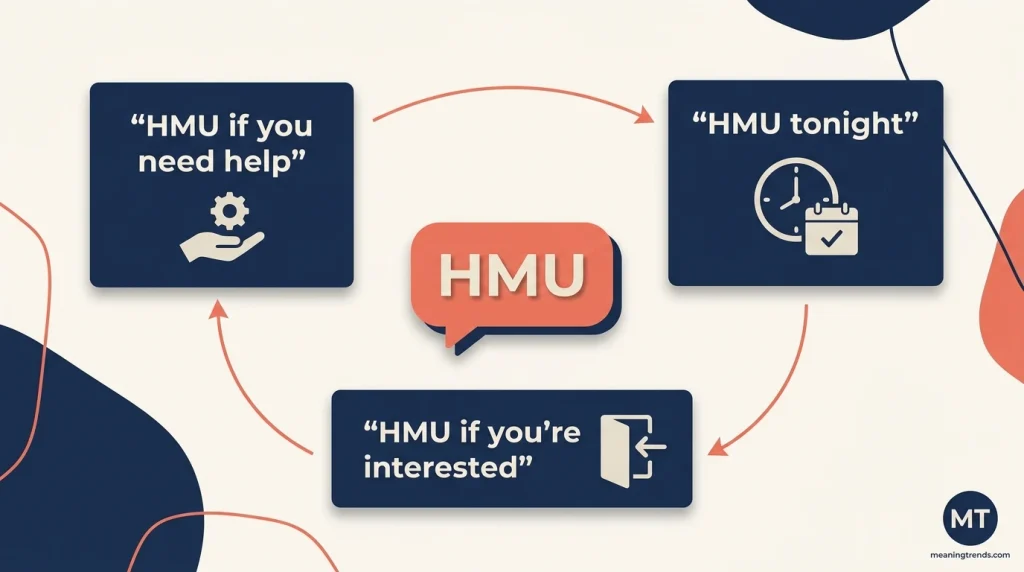
These illustrative conversations show how the abbreviation works in everyday situations.
Example 1: Making Plans
Person A: What are you doing this weekend?
Person B: Nothing much. HMU if you want to hang out.
Meaning: Person B is inviting Person A to get in touch if they want to make plans.
Example 2: Continuing a Conversation
Person A: I have to head out. Talk later?
Person B: Yeah, HMU tonight.
Meaning: Person B wants Person A to contact them later so they can continue talking.
Example 3: Offering Help
Person A: I’m still confused about the homework.
Person B: HMU if you need help with it.
Meaning: Person B is offering to help if Person A reaches out.
Example 4: Asking About an Event
Person A: Are you going to the concert?
Person B: Maybe! HMU if you find out when everyone is meeting.
Meaning: Person B wants Person A to get in touch with the details.
Example 5: A Potentially Flirty Message
Person A: I really enjoyed our coffee date.
Person B: Me too 😊 HMU when you’re free again.
Meaning: The positive comment and invitation could suggest romantic interest. However, the message alone cannot confirm what Person B feels.
Example 6: A Group Chat
Person A: Anyone want to play online later?
Person B: HMU after dinner.
Meaning: Person B is inviting the interested person to contact them after dinner, probably to arrange a time to play.
Across these examples, HMU consistently invites contact. What changes is the purpose of that contact.
Is HMU Rude, Flirty, or Offensive?

HMU is generally a casual expression, not an inherently rude or offensive one. Its tone depends on how it is used and the relationship between the people communicating.
Is HMU Flirty?
It can be. A message such as “HMU when you’re alone 😉” may sound suggestive because of the wording and emoji. By contrast, “HMU if you need the class notes” is a practical offer.
The important distinction is that HMU itself does not mean “I like you” or “I’m attracted to you.” It simply invites contact.
Is HMU Rude?
Usually, no. It can sound abrupt if sent without context to someone who expects more formal communication, but that does not make it inherently disrespectful.
For example, “HMU” sent to a close friend may feel perfectly natural. The same message sent to a new business contact might seem too informal or unclear.
Does HMU Mean Someone Wants Something From You?
Not necessarily. The sender may want to talk, make plans, exchange information, or ask for help. The surrounding words provide clues about the purpose.
If the message is vague, you do not have to guess. You can ask what they have in mind before deciding If to respond.
How Do You Reply to HMU?
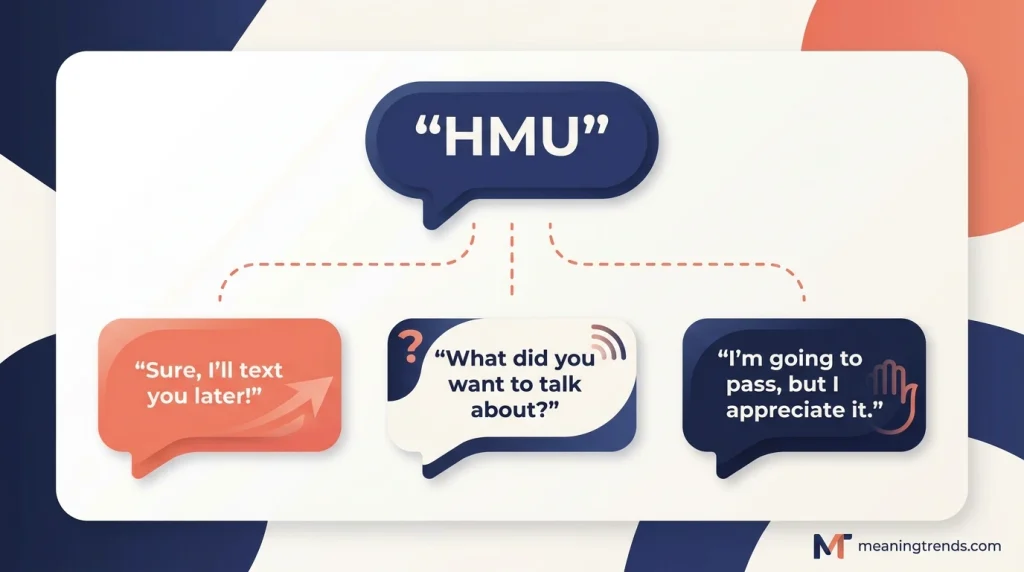
Your reply depends on If you want to talk, need clarification, or prefer not to engage.
Here are some natural responses.
| Situation | Possible reply |
| You want to talk | “Sure, I’ll text you later!” |
| You want to make plans | “Sounds good. What day works for you?” |
| You are interested but busy | “Definitely! I’m free this weekend.” |
| You need clarification | “Sure, what did you want to talk about?” |
| You want to keep things friendly | “For sure, talk soon!” |
| You are not interested | “Thanks! I’m going to pass, but I appreciate it.” |
You do not need to repeat HMU in your response. A simple, direct answer is usually enough.
What If Someone Just Texts “HMU”?
A message consisting only of “HMU” is an invitation to get in touch, but it does not explain why.
If you want to respond, you could write:
- “Hey, what’s up?”
- “What’s going on?”
- “Sure, did you need something?”
- “Hey! What did you have in mind?”
If you are comfortable initiating the conversation, you can simply send a message. You do not need to wait for the sender to explain further.
If you do not know the person well, it is reasonable to ask what they want to discuss before sharing personal details or agreeing to meet.
When Should You Use or Avoid HMU?
HMU works best when the conversation is informal and the other person is likely to understand the abbreviation.
When HMU Makes Sense
Use it when messaging friends, chatting with people you know, or inviting someone to contact you about a casual plan.
Examples include:
- “HMU when you get a chance.”
- “HMU if you want to grab lunch.”
- “I’m free after work, HMU.”
- “HMU if you have any questions.”
In these situations, the abbreviation keeps the message short without sacrificing much clarity.
When to Avoid HMU
Choose a fuller expression when communicating with someone who may not know the slang or when a professional message needs to be precise.
Instead of “HMU about the meeting,” you could write:
- “Please contact me about the meeting.”
- “Send me a message when you’re available.”
- “Let me know when you have an update.”
The best alternative depends on what you actually want the other person to do. If you need a specific action, such as a phone call or an email, state it directly.
What Are Other Ways to Say HMU?
Several expressions communicate a similar idea, although they are not interchangeable in every situation.
| Expression | Meaning | Typical use | Key distinction |
| Hit me up | Contact me | Casual conversation | Full version of HMU |
| Text me | Send me a text | Personal messaging | Specifies texting |
| DM me | Send me a direct message | Social media | Specifies a direct message |
| Call me | Phone me | Phone conversations | Specifies a call |
| Reach out | Make contact | Personal or professional | More neutral and polished |
| Contact me | Get in touch | General or formal communication | Clear and direct |
| Let me know | Give me information | Requests and updates | Focuses on receiving information |
For example, “DM me if you’re interested” specifies where to respond. “HMU if you’re interested” leaves the method of contact open.
Likewise, “Let me know when you arrive” focuses on receiving an update, while “HMU when you arrive” more broadly asks the person to get in touch.
FAQs
What does HMU mean from a girl?
It means “hit me up,” or get in touch with me. A girl using HMU may be inviting you to chat, make plans, or contact her about something. The phrase does not automatically indicate romantic interest.
What does HMU mean from a guy?
The meaning is the same: “hit me up.” The sender may want to talk, make plans, or continue a conversation. His gender does not establish the message’s tone or intention.
Does HMU mean text me or call me?
It can mean either, or another form of contact. The phrase does not specify a communication method. If the method matters, ask If the person prefers a text or a call.
What does HMU later mean?
“HMU later” means “Contact me later.” The sender is inviting you to reach out at a later time, but the message does not necessarily specify an exact time.
What does HMU if you’re free mean?
It means “Get in touch if you’re available.” Depending on the conversation, the person may want to chat, make plans, or ask you something.
Is HMU the same as WYD?
No. HMU means “hit me up,” an invitation to contact someone. WYD means “what are you doing?” and asks about someone’s current activity. They can appear together, but they serve different purposes.
Does lowercase hmu mean something different from HMU?
No. In ordinary texting, “hmu,” “HMU,” and “Hmu” generally represent the same expression. Capitalization alone is not a reliable clue to tone or intention.
Is HMU appropriate for work?
It can be fine in an informal workplace chat where everyone understands the abbreviation. For formal emails, client communications, or situations where clarity matters, “contact me” or “send me a message” is a better choice.
Conclusion
HMU means “hit me up,” an informal way to invite someone to get in touch. In a text message, that could mean sending a text, making a call, starting a conversation, or arranging plans. The phrase is flexible, so the surrounding words help explain what kind of contact the sender has in mind.
The most important thing to remember is that the abbreviation tells you to make contact, not why the person wants to hear from you. A message from a friend may be a simple invitation to hang out, while a message from someone you are dating may carry a flirtier tone. Neither interpretation is guaranteed by HMU alone.
If someone sends you HMU and you are unsure what they mean, a simple response such as “Sure, what’s up?” keeps the conversation natural. When the purpose is unclear, asking directly is better than assuming what the sender intends.

Alex writes about the words and shortcuts people use in texts, group chats, and social media. Each guide explains the meaning with everyday examples and tips on when to use it