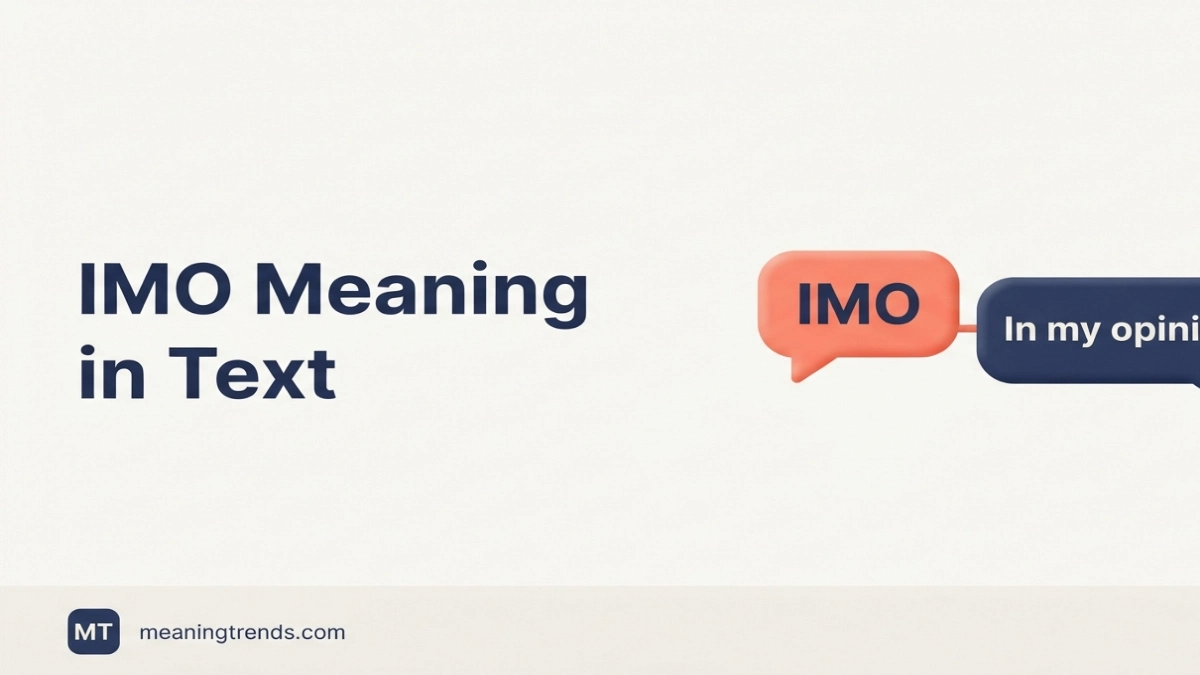
Quick Answer: IMO usually means “in my opinion” in text messages, chats, comments, and other informal online conversations. It tells the reader that the writer is giving a personal view, preference, or judgment rather than presenting the statement as an established fact. For example, “IMO, the second option is better” means “In my opinion, the second option is better.”
Slang usage verified: October 2026
You might see a message such as “IMO, that movie was way better than the first one” and wonder If IMO adds some special meaning beyond the words themselves. It does, but the difference is mostly about how the writer frames the statement.
The writer is marking the comment as their own viewpoint. That can make a recommendation, disagreement, criticism, or preference sound more personal and sometimes less absolute. Still, IMO doesn’t automatically make a message polite, uncertain, or open minded. The surrounding words and the relationship between the people matter.
You may also see imo in lowercase. In ordinary texting, that generally carries the same meaning as IMO. The capitalization is usually a matter of writing style rather than a change in definition.
What Does IMO Mean?
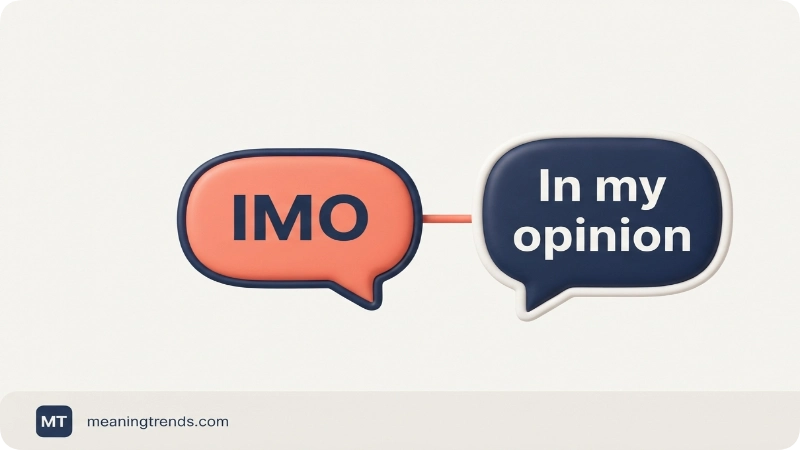
IMO is a written abbreviation or initialism for “in my opinion.” Cambridge Dictionary defines imo as a written abbreviation for “in my opinion” used when someone gives an opinion. Oxford Advanced Learner’s Dictionary likewise defines IMO as “in my opinion” and specifically notes its use in emails, text messages, and social media.
In a text, IMO can introduce a personal judgment:
“IMO, this is the easiest way to do it.”
The expanded version is:
“In my opinion, this is the easiest way to do it.”
The underlying message is the same. IMO simply makes the wording shorter and more conversational.
The abbreviation can appear at the beginning or end of a sentence:
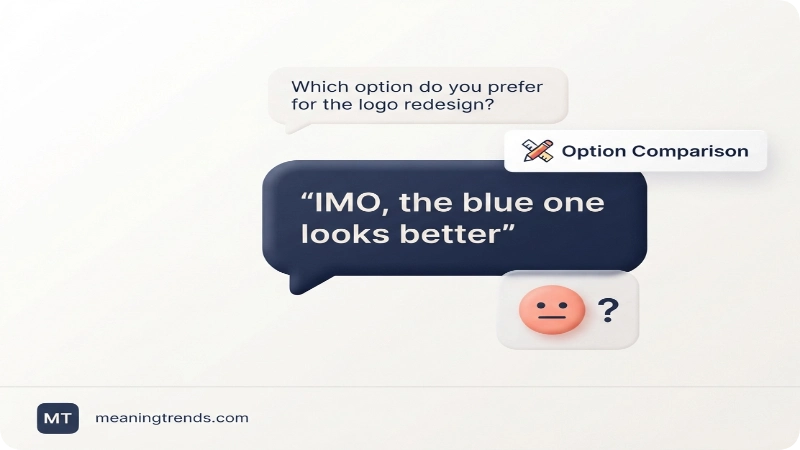
“IMO, the blue one looks better.”
or:
“The blue one looks better, IMO.”
Both mean essentially the same thing.
The important distinction is between what IMO literally means and what the sender intends emotionally. IMO tells you that the statement is being presented as the writer’s opinion. It does not, by itself, tell you If the writer is being friendly, sarcastic, argumentative, uncertain, or dismissive.
What Does Each Letter Stand For?
Because IMO is an initialism, each letter represents a word:
| Letter | Word |
| I | In |
| M | My |
| O | Opinion |
Together:
IMO = In My Opinion
This is an established expansion supported by major English dictionaries, including Cambridge Dictionary and Oxford Advanced Learner’s Dictionary.
You don’t need to interpret IMO as a phrase such as “I mean” or “in my observation.” In ordinary texting and social media usage, “in my opinion” is the relevant meaning.
There are also other established meanings of the letters IMO outside casual conversation. For example, Collins English Dictionary lists International Maritime Organization as another meaning of IMO. Context determines which meaning applies.
In a message such as:
“IMO, you should wait until tomorrow.”
the texting meaning is clear.
In a discussion about international shipping, however, IMO may refer to the International Maritime Organization. That’s a completely different use.
Why Do People Use IMO?
People use IMO primarily to signal that a statement represents their personal viewpoint.
That can be useful in several kinds of conversation.
To give a personal preference
“IMO, the first design looks cleaner.”
The writer is expressing a preference rather than claiming that everyone will agree.
To make a recommendation
“IMO, you should book the earlier flight.”
Here, IMO frames the advice as the sender’s judgment.
To express disagreement
“IMO, that’s not really the problem.”
The abbreviation can make it clear that the writer is offering their own assessment rather than declaring an unquestionable fact.
To discuss subjective topics
“IMO, that was the best episode.”
If something is the “best” episode is inherently subjective, so IMO fits naturally.
The abbreviation doesn’t necessarily mean the writer is unsure. Someone can be very confident in an opinion and still describe it as an opinion.
Likewise, IMO doesn’t guarantee that the statement is accurate. A person can write “IMO” before a claim that is actually factual and should be checked. The abbreviation identifies the writer’s framing; it doesn’t turn a factual claim into a subjective one.
What Else Can IMO Mean?
In everyday texting, “in my opinion” is the meaning most readers will consider first.
However, IMO has other documented meanings outside texting.
One important example is the International Maritime Organization, an organization associated with international shipping and maritime matters. Collins English Dictionary lists both “in my opinion” in messaging and social media and “International Maritime Organization” as meanings of IMO.
There are also other specialized expansions of IMO in particular fields. They aren’t interchangeable with the texting abbreviation.
Context is therefore important:
“IMO, that restaurant is overpriced.”
Here, IMO almost certainly means “in my opinion.”
Compare that with:
“The IMO adopted new maritime measures.”
Here, the surrounding subject makes the organizational meaning appropriate.
If you encounter IMO in a casual text, chat, comment, or direct message, there is normally no reason to assume a specialized meaning unless the conversation gives you a reason to do so.
How Does Context Change the Meaning?
The dictionary meaning of IMO is stable, but the sender’s intended tone isn’t.
A useful way to interpret a message is to look at four things:
- The words immediately around IMO
- What the conversation was already about
- Your relationship with the sender
- If the message contains obvious humor, sarcasm, or other tone markers
For example:
“IMO, you should definitely take the job.”
This could be supportive advice from a friend.
But:
“IMO, you should definitely take the job 🙄”
may suggest a different attitude because of the eye roll emoji.
The emoji doesn’t change what IMO stands for. It changes the clues surrounding the opinion.
When IMO introduces praise
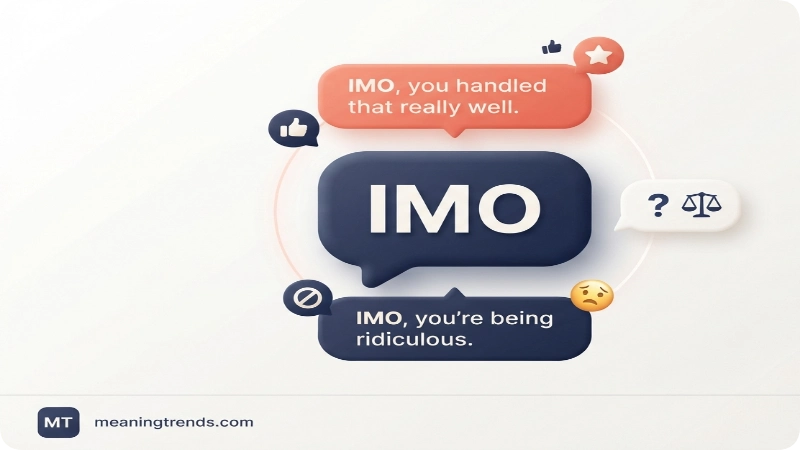
“IMO, you handled that really well.”
This may sound encouraging and personal.
When IMO introduces criticism
“IMO, you’re making this more complicated than it needs to be.”
The abbreviation doesn’t make the criticism automatically gentle. The rest of the sentence can still sound blunt.
When IMO appears after the opinion
“That was a terrible ending, IMO.”
Placing IMO at the end can feel particularly conversational. It works almost like a short reminder that the judgment belongs to the writer.
When the sender is arguing
“IMO, you’re completely wrong about this.”
IMO still means “in my opinion,” but the rest of the sentence is confrontational. It would be a mistake to assume that the abbreviation itself makes the message friendly.
This is why it’s better to separate literal meaning, purpose, tone, and motive. IMO tells you about the first two more reliably than it tells you about the last two.
Examples of IMO in Conversation
Here are some natural examples of how IMO can appear in texts and chats.
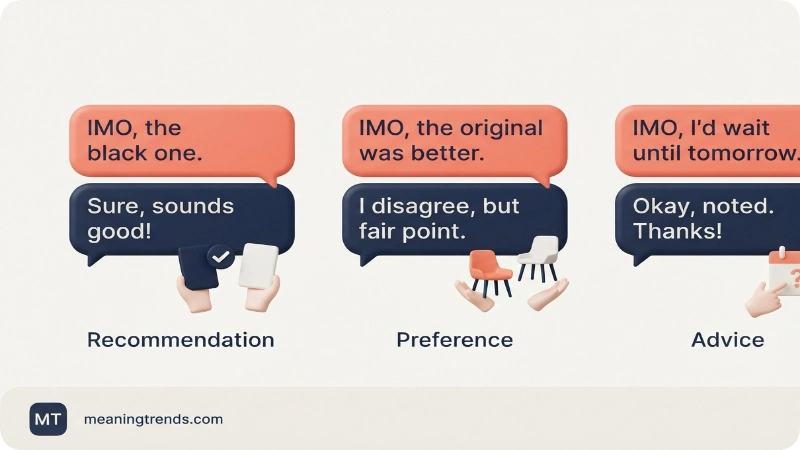
Example 1: Choosing between options
Person A:
“Which jacket should I get?”
Person B:
“IMO, the black one. It goes with more outfits.”
Interpretation: Person B is giving a personal recommendation.
Example 2: Talking about a movie
Person A:
“Did you like the sequel?”
Person B:
“IMO, the original was much better.”
Interpretation: The sender is expressing a subjective comparison.
Example 3: Giving advice
Person A:
“Should I send another message?”
Person B:
“IMO, I’d wait until tomorrow.”
Interpretation: The sender is offering their judgment rather than claiming there is one universally correct answer.
Example 4: Agreeing with someone
Person A:
“I think the smaller option looks better.”
Person B:
“IMO, you’re right.”
Interpretation: The sender is explicitly framing their agreement as their own view.
Example 5: Disagreement
Person A:
“This is definitely the best solution.”
Person B:
“IMO, there’s a simpler way.”
Interpretation: The sender is disagreeing while presenting an alternative viewpoint.
Example 6: IMO at the end
Person A:
“Was the new update worth it?”
Person B:
“Not really, IMO.”
Interpretation: The sender is giving a personal negative assessment.
These examples illustrate the established meaning of IMO. They don’t prove anything about a particular sender’s personality or motivation.
Is IMO Rude, Flirty, or Offensive?
IMO is not inherently rude, flirty, or offensive. It is a neutral abbreviation for “in my opinion.”
Its tone comes mainly from the statement around it.
For example:
“IMO, you look great in that outfit.”
can sound complimentary.
But:
“IMO, you need to rethink this.”
can sound critical.
Neither meaning is built into IMO itself.
The abbreviation can sometimes make a disagreement feel less absolute because the writer is explicitly presenting it as their own opinion. However, that isn’t a universal rule. A blunt statement remains blunt even when it begins with IMO.
For example:
“IMO, you’re being ridiculous.”
is unlikely to become polite simply because IMO appears at the beginning.
Similarly, IMO doesn’t automatically make a message sarcastic or passive aggressive. Those interpretations require evidence from the wording and conversation.
If you’re unsure about someone’s intended tone, a simple clarification is safer than trying to infer motive from the abbreviation alone:
“Do you mean that as your personal opinion, or are you saying there’s something I should know?”
How Do You Reply to IMO?
Because IMO usually introduces an opinion, your reply can depend on If you agree, disagree, or need clarification.
If you agree
“Yeah, I agree.”
or:
“Same here, honestly.”
If you disagree
“I see your point, but I think the other option works better.”
This acknowledges the person’s opinion without pretending to share it.
If you want their reasoning
“What makes you think that?”
This works well when the opinion isn’t self explanatory.
If you’re not sure what they mean
“Do you mean that’s just your preference?”
This can be useful when the distinction between opinion and factual claim matters.
If the topic is sensitive
You don’t have to respond to every opinion in detail. A neutral response such as “I understand where you’re coming from” can acknowledge the message without signaling agreement.
When Should You Use or Avoid IMO?
IMO is best suited to informal communication.
It works naturally in:
- Text messages
- Group chats
- Direct messages
- Social media comments
- Online discussions
- Forums
- Casual emails
For example:
“IMO, we should leave earlier.”
sounds natural in a casual group chat.
In formal writing, spelling out the phrase is usually clearer:
“In my opinion, the proposed approach is more practical.”
For academic, legal, business, or other formal contexts, the right choice depends on the writing standard and purpose. In many cases, it’s better to state the actual basis for an evaluation rather than rely on an abbreviation.
You also don’t need to use IMO every time you express an opinion. In ordinary conversation, phrases such as “I think,” “I believe,” and “I’d say” are often more natural.
What Are Other Ways to Say IMO?
The simplest equivalent is:
“In my opinion.”
Depending on the sentence and level of formality, you can also use:
- I think…
- I believe…
- I’d say…
- From my perspective…
- In my view…
- As I see it…
- Personally, I think…
These aren’t always perfect substitutes because their tone and emphasis differ.
For example:
“IMO, the first option is better.”
can become:
“I think the first option is better.”
In a more formal setting:
“In my view, the first option is preferable.”
The last version is more formal and deliberate, while IMO is compact and conversational.
How Is IMO Different from Similar Terms?
IMO is often grouped with other online abbreviations, but their meanings aren’t identical.
| Expression | Meaning | Typical use | Key distinction |
| IMO | In my opinion | Giving a personal view | Directly marks something as the writer’s opinion |
| IMHO | In my humble opinion / in my honest opinion | Giving an opinion with an added “humble” or “honest” element | Adds wording that isn’t present in IMO |
| TBH | To be honest | Introducing a candid statement | Focuses on honesty or candor, not simply opinion |
| FWIW | For what it’s worth | Offering a thought, fact, or perspective | Doesn’t specifically mean “my opinion” |
| I think | Personal belief or judgment | Conversation and writing | Usually more natural in standard prose |
One especially important distinction is between IMO and IMHO.
IMO means:
“In my opinion.”
IMHO is commonly expanded as:
“In my humble opinion.”
Dictionary.com records “in my (honest/humble) opinion” for IMHO related usage. The exact force of “humble” or “honest” can vary in casual online conversation, so you shouldn’t assume that IMHO always indicates genuine modesty.
Common Mistakes and Confusion About IMO
One common point of confusion is treating IMO as if it automatically tells you how strongly someone feels.
It doesn’t.
Someone can write:
“IMO, this is definitely the best choice.”
The writer has clearly marked the statement as an opinion, but they may still feel extremely confident about it.
Another possible mistake is assuming that IMO means the statement is factually unimportant. It doesn’t. A message can combine an opinion with factual information:
“IMO, the new policy is better because it reduces processing time.”
The preference is subjective, while the claim about processing time could be independently verifiable.
It’s also important not to infer a person’s age, gender, personality, or emotional state from their use of IMO. The abbreviation is simply a common form of digital shorthand.
Finally, IMO doesn’t always mean “in my opinion” in every possible context. If you’re reading a technical, maritime, academic, or organizational document, look at the surrounding subject before choosing an expansion.
Where Did IMO Come From?
IMO is a straightforward initialism formed from the words “in my opinion.”
For its digital communication meaning, Dictionary.com gives a first recorded period of 1980–85 and describes the term as arising from digital communications. Collins English Dictionary also lists IMO as a messaging and social media abbreviation meaning “in my opinion.”
That evidence supports an early digital communication history, but it does not establish a particular person as the inventor of IMO.
It’s also useful to distinguish the history of the abbreviation from the history of internet shorthand generally. The fact that IMO belongs to a broader category of digital abbreviations doesn’t mean every claim about the development of that category applies specifically to IMO.
The abbreviation has remained recognizable because its function is straightforward: it compresses a familiar phrase while signaling that the writer is expressing a personal viewpoint.
Does IMO Mean the Same Thing Everywhere?
For ordinary English texting, IMO generally carries the same basic meaning: “in my opinion.”
You can encounter it in different forms, including:
- IMO
- imo
- Imo
Capitalization normally doesn’t change the texting meaning.
Its use isn’t limited to one particular messaging service. Dictionaries such as Oxford and Cambridge describe it across forms of digital communication including messages, emails, and social media.
What can change is the context and tone. A person might use IMO sincerely, casually, humorously, or while disagreeing strongly. Those differences come from the surrounding message rather than from a separate definition of IMO.
There is also the separate organizational meaning, International Maritime Organization, which becomes relevant in maritime or institutional contexts.
So the safest rule is simple: read the subject of the conversation before deciding which meaning applies.
FAQs
What does IMO stand for in texting?
IMO stands for “in my opinion.” It is used to introduce or qualify a personal view, preference, recommendation, or judgment.
Is IMO slang or an abbreviation?
IMO is best described as an initialism or written abbreviation used in informal digital communication. It is common in texting, online discussions, social media, and similar settings.
Does IMO mean “in my humble opinion”?
No. IMO means “in my opinion.” “In my humble opinion” is associated with IMHO, not IMO.
Does lowercase “imo” mean something different?
Usually not. In ordinary texting, imo and IMO generally have the same meaning. Lowercase writing is simply a common informal style.
Can IMO be used in a formal email?
It can be understood, but it may be less appropriate in formal writing. In a professional or formal context, “in my opinion,” “in my view,” or “I think” may be clearer and better suited to the register.
Is IMO rude?
Not by itself. IMO is neutral. If a message sounds rude depends on the words around it and the broader context.
Can IMO mean something other than “in my opinion”?
Yes. In a different context, IMO can refer to the International Maritime Organization, among other specialized uses. In ordinary texting, however, “in my opinion” is the relevant interpretation.
How do you pronounce IMO?
When spoken as the initialism, IMO is commonly pronounced “eye em oh.” In everyday text, however, many people simply read it as the phrase “in my opinion.”
Is IMO the same as “I think”?
They are close, but not identical in every sentence. Both can introduce a personal viewpoint. IMO is a compact digital abbreviation, while “I think” is ordinary conversational English and often sounds more natural when spoken or written out.
Conclusion
In text messages and online conversations, IMO means “in my opinion.” It tells you that the writer is presenting a personal judgment, preference, recommendation, or viewpoint. The most important contextual rule is that IMO identifies the statement as an opinion, but it doesn’t tell you exactly how the sender feels about the subject or how their message is intended to sound.
If someone sends you a message containing IMO, read the whole sentence before judging its tone. If you agree, disagree, or aren’t sure what they mean, respond to the actual idea rather than trying to decode the abbreviation itself. When the distinction matters, you can simply ask, “Do you mean that’s your personal opinion?” In formal writing, spelling out “in my opinion” is usually the clearer choice.

Alex writes about the words and shortcuts people use in texts, group chats, and social media. Each guide explains the meaning with everyday examples and tips on when to use it