QUICK ANSWER: In text messages, WTW usually means “What’s the word?” It’s a casual way to ask what’s going on, what you’re doing, what’s new, or what the plans are. For example, “WTW tonight?” usually means “What are the plans tonight?” Context can support other readings, but “What’s the word?” is the safest default for a standalone “WTW?”
A three-letter message can be surprisingly difficult to interpret when there’s no context around it. If someone texts you “WTW?” after not talking for a while, they may simply be checking in. If they write “WTW tonight?” the same abbreviation is more likely connected to plans.
That flexibility is the important part. WTW is an informal abbreviation, but the abbreviation itself doesn’t tell you exactly what the sender wants. The words around it, the previous messages, and the topic of the conversation provide those clues. Current slang references consistently document “What’s the word?” as the main texting meaning, while also recording other context-dependent expansions.
What Does WTW Mean?
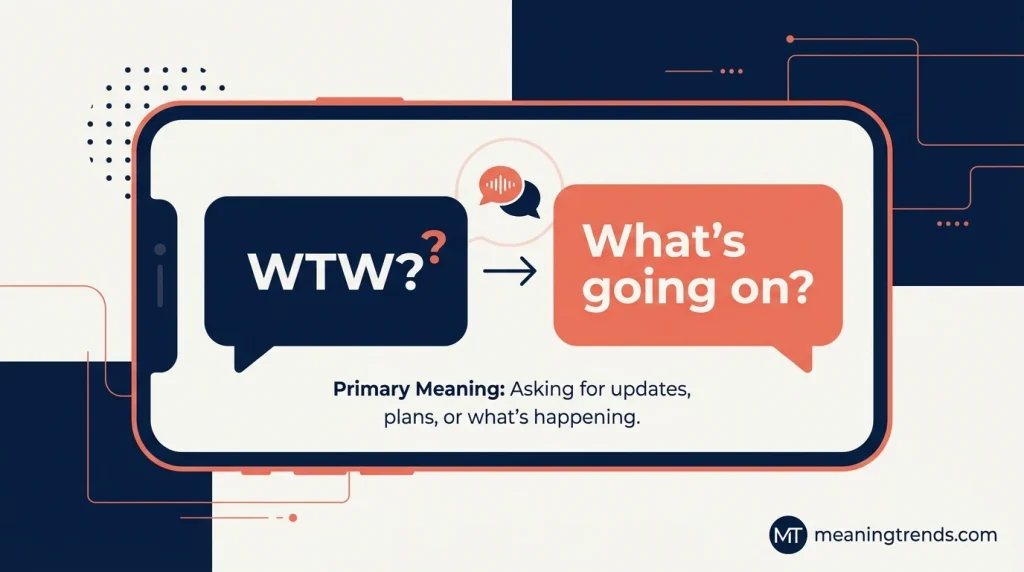
In casual texting, WTW stands for “What’s the word?” The phrase is not normally asking for a literal word. Instead, it functions as a relaxed conversational prompt.
Depending on the situation, “WTW?” can amount to:
- “What’s up?”
- “What’s going on?”
- “What are you doing?”
- “What’s new?”
- “What are the plans?”
- “What’s happening?”
Slang references such as Slang.net and Cyber Definitions describe WTW as a greeting or conversation starter used to ask what someone is doing or to get an update.
The abbreviation can therefore cover slightly different questions without actually changing its basic function. Someone who sends “WTW?” may not have a precise question in mind. They may simply be opening the conversation and giving you room to tell them what’s happening.
What Does Each Letter Stand For?
WTW is an initialism formed from What’s The Word.
The expanded phrase is “What’s the word?” in the main documented texting use. It’s better to treat that as the established default rather than assuming that every possible phrase matching W-T-W is an equally common “full form.”
Abbreviation databases list many unrelated expansions for WTW outside casual texting, including business, government, sports, and other specialized uses. Those meanings shouldn’t automatically be imported into an ordinary text conversation.
Why Do People Use WTW?
WTW is useful because it compresses a longer, informal question into three letters.
Instead of typing:
“What’s going on?”
someone can simply write:
“WTW?”
The purpose is usually conversational rather than informational in a formal sense. The sender may want an update, be checking whether you have plans, or be opening the door to making plans together.
For example:
A: WTW?
B: Just got home from work. You?
Here, B has interpreted WTW as a general “What’s up?” or “What are you doing?” check-in.
The abbreviation is particularly suited to casual digital communication because it assumes the people involved already understand informal shorthand. It doesn’t carry the formality or precision you’d expect in professional writing.
What Else Can WTW Mean?
“What’s the word?” is the main texting meaning, but WTW can have other interpretations. The important distinction is that these alternatives depend much more heavily on context.
One documented alternative is “What the what?”, an informal expression of surprise or confusion. Slang.net lists both “What’s the word” and “What the what” as meanings of WTW, while abbreviation references also list “What to Watch” and “What to Wear.”
| WTW reading | What it can mean | Typical context |
| What’s the word? | What’s up? What’s happening? | Casual conversation |
| What the what? | What?! / What just happened? | Surprise or confusion |
| What to wear? | What should I wear? | Clothes or event planning |
| What to watch? | What should we watch? | Movies or TV |
These aren’t interchangeable. If someone sends only “WTW?”, “What’s the word?” is the safest interpretation. If you’re discussing an outfit and they write “WTW for the wedding?”, “What to wear?” becomes much more plausible.
Similarly, if someone reacts to shocking news with “WTW?!”, the punctuation and preceding message can support the “What the what?” interpretation.
Some online references also propose additional expansions such as “What’s the wave.” Those uses may occur in particular communities, but the available evidence is less consistent than the established “What’s the word?” meaning. They shouldn’t be presented as the universal definition of WTW.
How Does Context Change the Meaning?
The easiest way to understand WTW is to read the whole message, rather than translating the three letters in isolation.
When WTW Appears by Itself
If someone sends:
“WTW?”
they’re most naturally asking something like:
“What’s up?”
or:
“What’s going on?”
A simple reply about what you’re doing is usually enough.
When WTW Includes a Time
Consider:
“WTW tonight?”
The addition of “tonight” shifts the question toward plans. The sender may want to know what you’re doing later or whether there’s something to do together.
A natural response could be:
“Nothing planned yet. You?”
When WTW Follows an Earlier Topic
Suppose the conversation was about a concert:
A: Did you hear whether the concert is still happening?
B: Not sure.
A: WTW with it?
Here, WTW is better understood as asking for an update about the situation, rather than simply saying “what’s up?”
When the Conversation Is About Clothes
If you’re discussing an event and someone writes:
“WTW for Saturday?”
the clothing context makes “What to wear?” a reasonable interpretation.
The same three letters can therefore produce a different reading when the surrounding topic supplies strong evidence.
When WTW Is a Reaction
If someone sends:
“WTW?!”
immediately after hearing something unexpected, “What the what?” may be intended. That interpretation is especially plausible when WTW functions as a reaction rather than as the opening of a conversation. Slang references document this secondary use.
The key principle is simple: context can establish what the sender is doing with the abbreviation, but the abbreviation alone cannot prove the sender’s exact intention.
Examples of WTW in Conversation
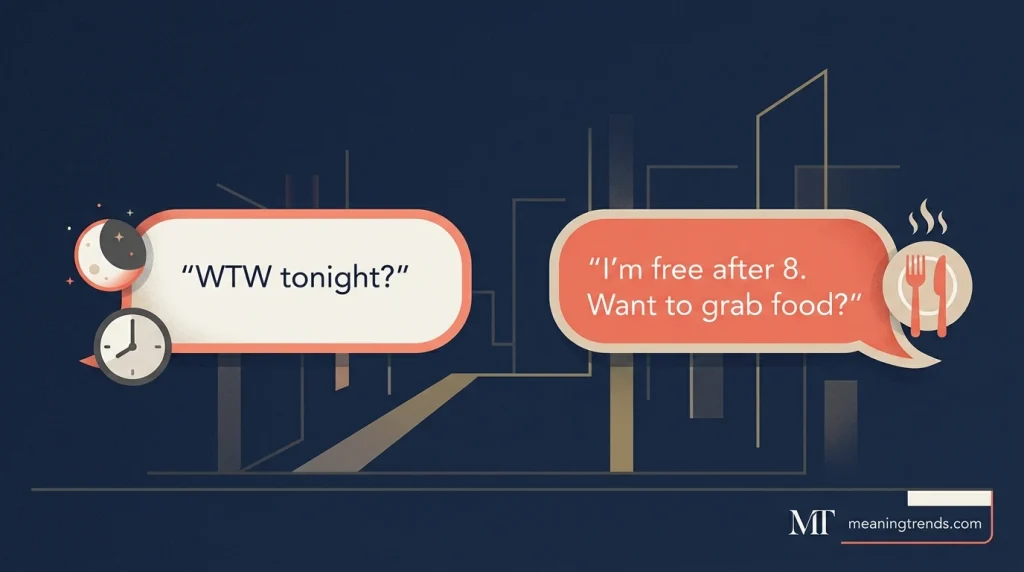
Here are illustrative examples showing how the meaning can shift.
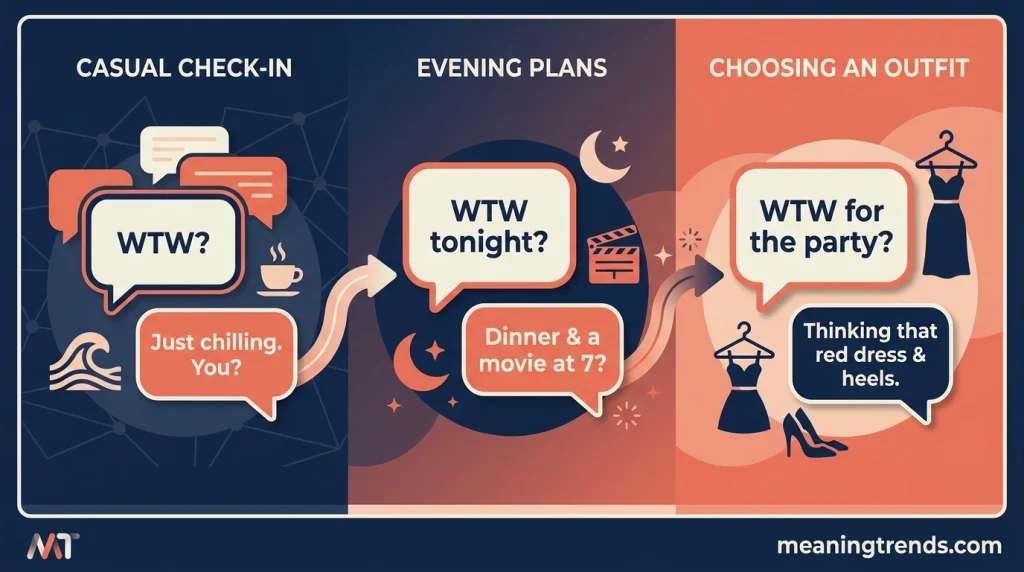
Example 1: Casual check-in
Person A: Yo, WTW?
Person B: Not much, just chilling. You?
Interpretation: Person A is probably asking what’s going on or what Person B is up to.
Example 2: Making plans
Person A: WTW tonight?
Person B: I’m free after 8. Want to grab food?
Interpretation: Here, WTW is essentially asking about the evening’s plans.
Example 3: Asking for an update
Person A: WTW with the trip?
Person B: We moved it to next weekend.
Interpretation: The sender wants the latest information about the trip.
Example 4: Group plans
Person A: WTW this weekend?
Person B: A few of us are going downtown Saturday.
Interpretation: The question is about what’s happening or what everyone is planning.
Example 5: Clothing context
Person A: The invitation says semi-formal.
Person B: WTW for the party?
Interpretation: Because the conversation is about clothes and an event, WTW can plausibly mean “What to wear?”
Example 6: Surprise
Person A: He actually quit his job yesterday.
Person B: WTW?!
Interpretation: Here, WTW can be read as “What the what?”—an expression of surprise or disbelief.
These examples are illustrative rather than evidence that every sender uses WTW in exactly the same way. The surrounding words and previous conversation remain the strongest clues.
Is WTW Rude, Flirty, or Offensive?
WTW is generally casual rather than inherently rude, flirty, or offensive. Its tone depends more on the relationship and the surrounding conversation than on the abbreviation itself.
A friend saying:
“Hey, WTW?”
may simply be checking in.
A person you’re interested in could also send:
“WTW tonight?”
That might lead to making plans, but WTW by itself doesn’t establish romantic or sexual interest. A sender’s motive cannot reliably be inferred from the abbreviation alone.
Likewise, WTW isn’t automatically rude because it’s short. A very brief message can feel abrupt in some situations, but that depends on the broader interaction.
If you’re unsure about the intended tone, don’t overread the acronym. Look at the conversation before it and respond to the literal question you can reasonably identify.
How Do You Reply to WTW?
Your reply can be as simple as the question.
If they’re asking what you’re doing
“Just relaxing at home. You?”
If you’re busy
“At work right now, what’s up?”
If you don’t have plans
“Nothing planned yet.”
If you think they’re asking about plans
“Not sure yet. What are you thinking?”
If you don’t understand the context
“You mean what’s up or what are the plans?”
That last response is perfectly reasonable when the message is genuinely ambiguous. You don’t need to guess at a hidden meaning when a short clarification will settle it.
If the sender wrote “WTW tonight?” and you’re interested in making plans, you can also answer directly:
“I’m free tonight. What did you have in mind?”
The best reply is usually the one that addresses the likely question rather than trying to decode every possible expansion of WTW.
When Should You Use or Avoid WTW?
Use WTW when the conversation is casual and the other person is likely to understand texting shorthand.
It can fit naturally in:
- Text messages with friends
- Casual group chats
- Informal DMs
- Conversations about plans
- Relaxed social conversations
It’s less appropriate when clarity and formality matter.
For example, instead of writing:
“WTW about the meeting?”
to a professional contact, you could write:
“Do you have an update about the meeting?”
Or instead of:
“WTW tomorrow?”
you could say:
“What are the plans for tomorrow?”
WTW is not wrong simply because it’s informal. The issue is register: the abbreviation assumes a relaxed communication setting.
What Are Other Ways to Say WTW?
If you want to express the main meaning of WTW in standard or clearer English, you have several choices:
- What’s up? — casual
- What’s going on? — casual and clear
- What’s new? — friendly
- What are you up to? — asks about someone’s activity
- What are the plans? — focuses on arrangements
- What’s happening? — asks about an event or situation
- Do you have any plans? — more explicit
- Do you have an update? — useful when discussing a specific situation
The best equivalent depends on what the sender actually wants to know.
For example, “WTW?” may be closest to “What’s up?”, while “WTW tonight?” may be closer to “What are the plans tonight?”
How Is WTW Different from Similar Texting Terms?
WTW overlaps with several common texting expressions, but they aren’t identical.
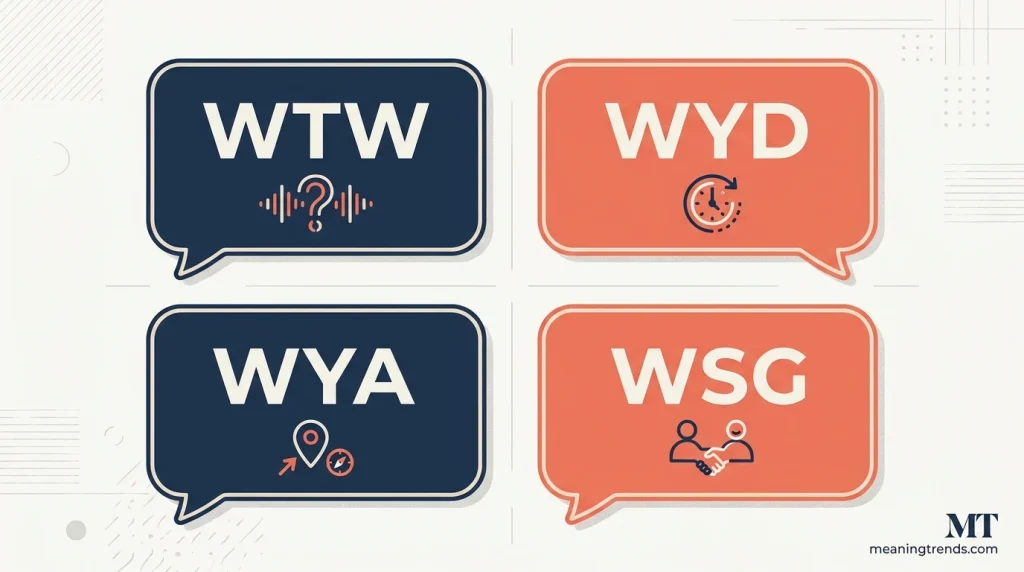
| Expression | Meaning | Typical use | Key distinction |
| WTW | What’s the word? | Check-ins, updates, plans | Broad and context-dependent |
| WYD | What are you doing? | Asking about someone’s current activity | More directly focused on the person’s activity |
| WYA | Where are you at? | Asking someone’s location | Specifically about location |
| WSG | What’s good? | Casual greeting or check-in | Often functions as a greeting |
| What’s up? | What is happening? / How are you? | General conversation | Standard wording rather than an initialism |
These expressions can overlap in actual conversation. For example, “WTW?” and “WSG?” can both work as casual openers, while “WYD?” more directly asks what someone is doing.
The distinction matters most when you need a precise interpretation. Don’t assume that every short texting abbreviation is interchangeable just because the replies might be similar.
Common Mistakes and Confusion About WTW
The biggest mistake is assuming that WTW always has one meaning in every conversation.
The main texting sense is well supported as “What’s the word?”, but abbreviation databases also document unrelated meanings outside casual chat.
Another possible mistake is treating every reported expansion as equally common. A list of possible WTW definitions doesn’t mean that all of them are equally likely in an ordinary text.
For example, if a friend sends only:
“WTW?”
there is little reason to jump immediately to “What to wear?” or “What to watch?” without a clothing, event, movie, or similar context.
It’s also a mistake to assume that WTW reveals the sender’s motive. The abbreviation can open a conversation or ask about plans, but it doesn’t prove that the sender wants to flirt, meet up, or discuss something specific.
FAQs
Does WTW mean “What’s the word” in texting?
Yes. “What’s the word?” is the main documented texting meaning of WTW. In practice, it usually means something like “What’s up?”, “What’s going on?”, or “What are the plans?”
What does WTW mean in a text from a friend?
A friend sending “WTW?” is usually making a casual check-in. They may want to know what you’re doing, what’s happening, or whether you have plans.
What does “WTW tonight?” mean?
“WTW tonight?” usually asks about plans for the evening. Depending on the conversation, it can mean “What are you doing tonight?” or “What are the plans tonight?”
Can WTW mean “What the what?”
Yes. “What the what?” is a documented secondary interpretation used to express surprise or confusion. The surrounding message and punctuation can help distinguish it from the more common “What’s the word?” meaning.
Can WTW mean “What to wear?”
It can in a clothing or event-planning context. If someone is discussing an outfit and asks “WTW for the party?”, “What to wear?” is a plausible interpretation. It isn’t the safest reading of a standalone “WTW?” with no context.
Is WTW formal?
No. WTW is informal texting shorthand. If you’re writing professionally or communicating with someone who may not know the abbreviation, a clearer phrase such as “What’s going on?” or “Do you have an update?” is better.
How should I reply to “WTW?”
If you think it means “What’s the word?”, give a short update. For example: “Not much, just got home. You?” If the context is unclear, you can simply ask, “What do you mean?”
Does WTW mean the same thing everywhere?
Not necessarily. “What’s the word?” is the main meaning documented for texting, but WTW has other meanings in different contexts. Abbreviation references list numerous specialized expansions outside ordinary chat, so the surrounding subject matters.
Conclusion
In ordinary texting, WTW usually means “What’s the word?” It works as a casual way to ask what’s happening, what someone is doing, or what the plans are. The most important rule is not to treat the three letters as a complete explanation of the sender’s intent. Read the words around WTW, the earlier messages, and the subject of the conversation.
If someone sends you a standalone “WTW?”, a relaxed reply such as “Not much, you?” is usually enough. If the message includes a time or event, answer the plans question directly; if the surrounding topic is clothing or another specific subject, consider that context before choosing an interpretation.
There are other documented meanings, including “What the what?” and context-specific uses such as “What to wear?” When the context doesn’t make the intended meaning clear, a brief clarification is better than guessing.

Alex writes about the words and shortcuts people use in texts, group chats, and social media. Each guide explains the meaning with everyday examples and tips on when to use it