Slang usage verified: October 2026.
QUICK ANSWER: In casual texting, GTS most commonly means “Go To Sleep.” It can tell someone to get some rest, especially during a late night conversation. Depending on context, GTS can also represent other phrases, including “Google That Shit” in some informal usage. For example, “It’s 2 a.m., gts 😂” means “It’s 2 a.m., go to sleep.”
If someone sends you just three letters “gts” the surrounding conversation usually matters more than the abbreviation itself. A message sent late at night after someone says they’re tired points toward “Go To Sleep.” A reply to a question may have a completely different reading.
That distinction matters because GTS is an informal initialism, not a term with one universal meaning in every conversation. Current slang references consistently document “Go To Sleep” as a texting use, while other references document additional interpretations. Slang.net, for example, lists “Go to sleep” as the main messaging meaning, while Wiktionary’s glossary of military slang documents “Google That Shit” in a specific U.S. Air Force slang context.
What Does GTS Mean?
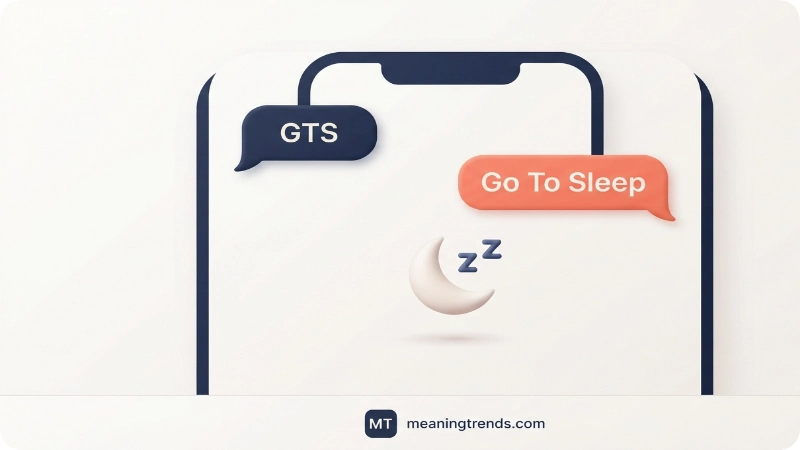
In ordinary texting, GTS usually means “Go To Sleep.” It is an informal abbreviation used to tell another person to get some rest or, in some messages, to indicate that the sender is going to sleep.
The wording can function in slightly different ways:
- A direct suggestion: “You have work at 7. GTS.”
- A playful command: “Bro, it’s 3 a.m. gts 😂”
- A caring reminder: “You’re exhausted. GTS and get some rest.”
- A sign off: “I’m gts. Talk tomorrow.”
The exact grammatical expansion isn’t always rigid in texting. Some user generated slang references also record “going to sleep” as a GTS interpretation, particularly when the sender is describing their own action rather than telling someone else what to do. Urban Dictionary contains examples of both “go to sleep” and “going to sleep,” but those entries are user submitted rather than authoritative dictionary evidence.
So if someone writes, “I’m gts, goodnight,” the practical meaning is clear even if the abbreviation is being used loosely: the person is saying they are going to sleep.
What Does Each Letter Stand For?
When GTS means “Go To Sleep,” the letters correspond directly to:
- G = Go
- T = To
- S = Sleep
This makes GTS an initialism: a shortened expression formed from the initial letters of its words.
However, GTS should not automatically be expanded into “Go To Sleep” every time you see it. Other documented uses exist, and the correct expansion depends on the subject of the conversation.
For example, Wiktionary’s glossary of military slang records “Google That Shit” as a U.S. Air Force slang use. Urban Dictionary also contains multiple user submitted entries for that expansion. Because “Google That Shit” contains profanity and is informal, it should be treated as a context specific slang interpretation rather than a universal definition of GTS.
Why Do People Use GTS?
People use GTS because it is a short, informal way to communicate an idea that would otherwise take several words.
In a late night conversation, “GTS” can be quicker than typing “You should probably go to sleep.” The abbreviation can also add a casual internet chat style to the message.
The purpose changes with the wording around it. Consider these examples:
“You have class tomorrow, GTS.”
Here, the sender is probably encouraging the other person to stop chatting and sleep.
“Why are you still awake 😭 gts.”
The same abbreviation sounds more teasing because the sender is reacting to someone staying awake late.
“I’m exhausted. I’m gts. Goodnight.”
Here, the sender is talking about their own action rather than giving someone else an instruction.
Texting abbreviations also allow tone to be expressed through punctuation, capitalization, emoji, and surrounding words. Those clues can influence how GTS feels without changing its basic meaning.
What Else Can GTS Mean?
GTS has several other documented or context specific uses. They should not all be treated as equally likely in an ordinary text conversation.
“Google That Shit”
“Google That Shit” is a documented informal expansion of GTS. It means that someone should search for an answer themselves instead of asking the other person.
For example:
Person A: “What year did that movie come out?”
Person B: “GTS 😂”
Here, GTS could mean “Google That Shit.”
This interpretation can sound sarcastic, dismissive, or joking because the wording is deliberately blunt. Wiktionary documents the phrase in a U.S. Air Force slang glossary, and Urban Dictionary contains multiple user submitted examples of the expression in online conversation.
Because this meaning is more specialized and potentially rude, don’t assume it is intended simply because someone asks a question.
“Good Times”
Some current slang sites list “Good Times” as another GTS interpretation, particularly around memories, photos, or nostalgic conversations. However, the evidence for this meaning is less consistent than the documentation for “Go To Sleep.”
If someone writes “GTS” under a memory or in a conversation about a past event, context may support a “Good Times” reading. But the three letters alone don’t establish that interpretation.
“Going To Sleep”
“Going to sleep” appears in user generated slang references as another GTS expansion. The distinction from “Go To Sleep” is grammatical:
- “GTS, you’re exhausted” → Go To Sleep
- “I’m gts, talk tomorrow” → Going To Sleep
This usage is informal and not necessarily standardized. Urban Dictionary includes examples of both forms, so it is reasonable to recognize the possibility without presenting it as a universal expansion.
Specialized meanings
Outside ordinary texting slang, GTS can refer to completely different things. For example, gaming communities have used GTS for names or features associated with particular games, while older online usage includes the Global Trading Station associated with Pokémon. Urban Dictionary records this gaming specific use.
That is why the subject of a conversation can be decisive. If the discussion is about sleep, “Go To Sleep” makes sense. If it is about a particular game, organization, product, or technical subject, the same three letters may belong to that vocabulary instead.
How Does Context Change the Meaning?
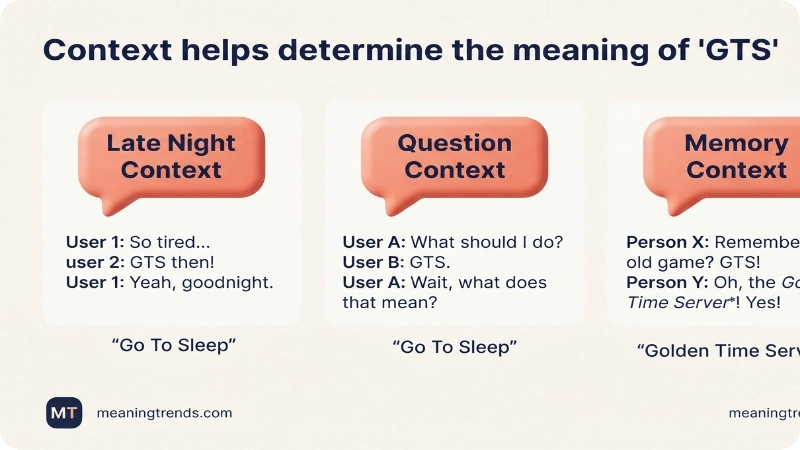
Context is the safest way to interpret GTS because the abbreviation itself does not prove what the sender intended.
When the conversation is about sleep
This is the clearest setting for “Go To Sleep.”
“You said you were tired an hour ago.”
“Yeah lol.”
“Then gts 😂”
The preceding message about being tired supports the sleep related interpretation.
When it is late at night
Timing can be a useful clue, although it is not proof by itself.
“Why are you still online?”
“I can’t sleep.”
“gts 😭”
The message strongly points toward “Go To Sleep.”
When someone asks a question
A question can support the “Google That Shit” interpretation:
“Do you know what time the store closes?”
“Nope. GTS lol.”
Here, the conversation is about finding information rather than sleeping.
Still, context does not make every interpretation certain. If you aren’t sure, a simple clarification is better than guessing.
When you’re talking about a memory
A conversation about a vacation, old friends, photographs, or a favorite event could make a “Good Times” interpretation possible. Because this use is less consistently documented, however, the surrounding words should provide meaningful support before you settle on it.
The key rule is simple: interpret the whole message, not just the three letters.
Examples of GTS in Conversation
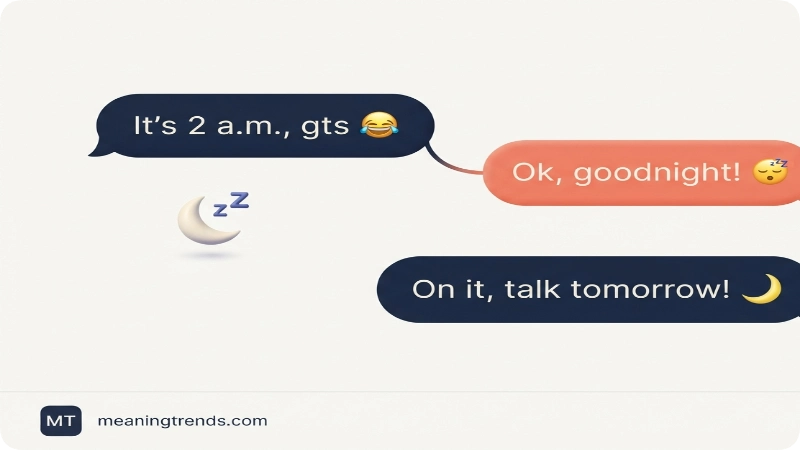
Example 1: Late night teasing
Person A: “I have to be up at 6 and I’m still scrolling.”
Person B: “GTS 😭”
Interpretation: “Go To Sleep.” The sender is teasing or encouraging Person A to get some rest.
Example 2: A caring reminder
Person A: “I’m so tired but I have so much to finish.”
Person B: “Forget it for tonight. GTS.”
Interpretation: “Go To Sleep.” The wording makes the message sound more concerned than dismissive.
Example 3: Ending your own night
Person A: “You still watching the game?”
Person B: “Nah, I’m gts. Goodnight.”
Interpretation: Here, “going to sleep” fits the grammar because Person B is describing what they are about to do. This is an informal reading documented in user generated slang references.
Example 4: Telling someone to search
Person A: “What was the name of that actor?”
Person B: “GTS 😂”
Interpretation: “Google That Shit” is possible because the subject is finding information, not sleeping. This interpretation is documented in slang references, including Wiktionary’s military slang glossary.
Example 5: Ambiguous one word message
Person A: “GTS.”
Interpretation: On its own, this is ambiguous. Without the preceding conversation, there isn’t enough information to know If the sender means “Go To Sleep,” “Google That Shit,” or another context specific use.
Is GTS Rude, Flirty, or Offensive?
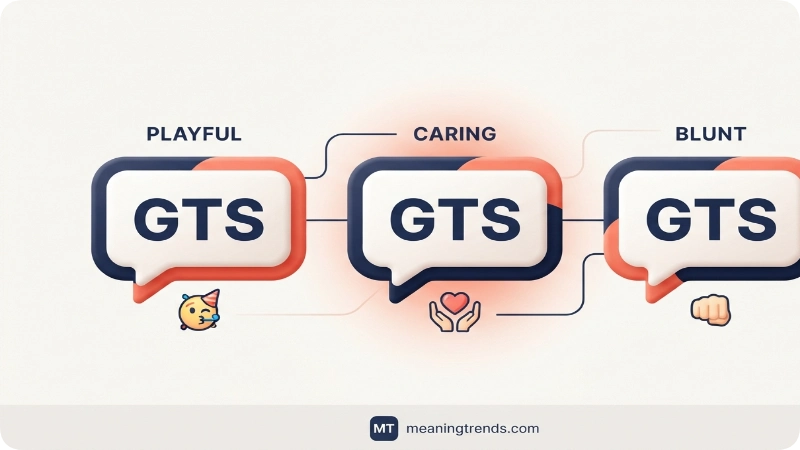
GTS is not inherently rude or flirty. Its tone comes from the surrounding conversation and the relationship between the people involved.
“GTS 😴” from a close friend may sound playful or caring.
“GTS.” sent during an argument may feel blunt or dismissive.
“GTS 😂” after someone makes an obviously silly late night comment may be teasing.
The abbreviation itself does not reliably establish romantic interest, annoyance, hostility, or affection. Avoid assigning a motive based only on GTS.
The “Google That Shit” interpretation deserves extra caution because it contains profanity and can function as a dismissive response. If you want to be polite, “You can probably find that with a quick search” communicates the same general idea without the aggressive wording.
How Do You Reply to GTS?
Your response can depend on what the sender appears to mean.
If GTS means “Go To Sleep,” you could reply casually:
- “I’m trying 😂”
- “Five more minutes.”
- “Okay okay, goodnight.”
- “You too 😴”
If you aren’t sure what the sender means, ask directly:
“Wait, what do you mean by GTS?”
If the message feels dismissive, you don’t need to guess at the sender’s intention. You can simply clarify:
“Do you mean I should go to sleep, or something else?”
That is especially useful when “GTS” appears without any surrounding context.
When Should You Use or Avoid GTS?
GTS works best in informal digital conversation with people who understand texting shorthand.
It can fit naturally in:
- Casual text messages
- Friend group chats
- Informal direct messages
- Late night conversations
- Playful conversations where abbreviations are already common
Use the full phrase instead when clarity or professionalism matters.
For example, a message to a coworker might be clearer as:
“You should get some rest.”
rather than:
“GTS.”
Likewise, in a professional email, customer service message, school assignment, or formal document, “Go to sleep” or another complete phrase is usually more appropriate.
The same principle applies when you don’t know If the recipient understands the abbreviation. Shorter isn’t always clearer.
What Are Other Ways to Say GTS?
If you mean “Go To Sleep,” natural alternatives include:
- “Go to sleep.”
- “Get some sleep.”
- “Get some rest.”
- “You should get some rest.”
- “You should probably go to bed.”
- “Time for bed.”
- “Get some sleep and talk tomorrow.”
The best alternative depends on the tone you want.
“Go to sleep” is direct.
“Get some rest” sounds gentler.
“You should probably get some sleep” is conversational without sounding like a command.
“Time for bed” can sound playful when used with someone you’re comfortable with.
If you mean “Google That Shit,” a more neutral alternative would be:
- “You can look that up.”
- “Try searching for it.”
- “A quick search should answer that.”
- “You can probably find it online.”
These alternatives are useful when you want to preserve the meaning without the profanity or dismissive tone.
How Is GTS Different from Similar Texting Abbreviations?
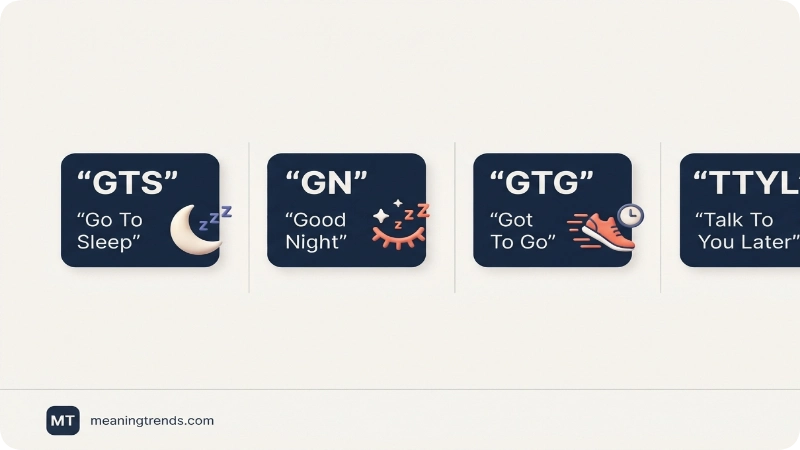
| Expression | Meaning | Typical use | Key distinction |
| GTS | Go To Sleep | Telling someone to sleep | Focuses on going to sleep |
| GN | Good Night | Ending a conversation for the night | Usually a farewell, not an instruction |
| GTG | Got To Go | Leaving a conversation | Means the sender has to leave, not necessarily sleep |
| TTYL | Talk To You Later | Ending a conversation temporarily | Says you’ll talk later without specifying why |
| BRB | Be Right Back | Temporarily leaving | Usually implies a return soon |
For example, “GN” usually works as a straightforward nighttime farewell:
“I’m heading to bed. GN!”
GTS is different:
“You’re still awake? GTS.”
The first primarily ends the conversation. The second tells someone to sleep.
These abbreviations can appear together, though:
“I’m exhausted. GTS. GN ❤️”
Here, GTS communicates the idea of going to sleep, while GN functions as the farewell.
Common Mistakes and Confusion About GTS
One common interpretive mistake is assuming that GTS always means “Go To Sleep.” That is a useful first guess in casual late night texting, but it isn’t a universal rule.
Another mistake is treating an expansion as proof of the sender’s intention. Even if “Go To Sleep” is the most relevant definition in a slang reference, a particular sender could be using GTS differently.
It’s also easy to overread tone. GTS doesn’t automatically mean someone is angry, flirting, annoyed, caring, or trying to end the relationship. Those conclusions require evidence from the broader exchange.
Finally, don’t assume capitalization settles the question. GTS, gts, and Gts can all occur in informal digital writing. The surrounding words are generally more informative than capitalization alone.
FAQs
What does GTS mean in a text message?
GTS most commonly means “Go To Sleep” in casual texting. It is often used to tell someone to get some rest, particularly when they’re awake late or talking about being tired.
Does GTS always mean “Go To Sleep”?
No. Other documented uses include “Google That Shit,” while some informal references also record “going to sleep” and “Good Times.” Specialized communities may use GTS for unrelated terms.
Is GTS a slang word or abbreviation?
It is best described as an informal initialism or abbreviation used in digital communication. When it means “Go To Sleep,” each letter comes from the beginning of one of those three words.
What does lowercase “gts” mean?
Lowercase “gts” can carry the same meaning as uppercase GTS. Capitalization alone does not establish a different definition.
Is GTS rude?
Not automatically. “Go To Sleep” can sound friendly, playful, caring, impatient, or blunt depending on the conversation. A different interpretation, such as “Google That Shit,” can be more dismissive because of its wording.
What does GTS mean from a guy or girl?
The abbreviation itself does not have a different meaning based on the sender’s gender. A person of any gender can use GTS to mean “Go To Sleep” or another context specific phrase.
What does GTS mean on social media?
In casual social media conversations, GTS can have the same slang meanings found in texting. The platform alone does not establish which expansion is intended. Look at the surrounding comment, message, or topic.
How can I tell which GTS meaning someone intended?
Look at the words immediately before and after GTS, the subject of the conversation, and If the message concerns sleep, searching for information, memories, or a specialized topic. If those clues don’t resolve it, ask what the sender meant.
Conclusion
When you see GTS meaning in text, “Go To Sleep” is the most useful starting interpretation for ordinary casual messaging, especially when someone is awake late or talking about being tired. But it isn’t a universal expansion. Other documented uses exist, including “Google That Shit,” and informal references record additional possibilities.
The safest way to interpret GTS is to read the surrounding conversation before deciding what the sender meant. If you’re using it yourself, reserve it for casual conversations where the abbreviation and tone are likely to be understood. When clarity matters, simply write “go to sleep” or “get some rest” instead.
If a message containing only “GTS” leaves you uncertain, a short question such as “What do you mean by GTS?” is usually clearer than guessing at the sender’s intent.

Alex writes about the words and shortcuts people use in texts, group chats, and social media. Each guide explains the meaning with everyday examples and tips on when to use it