Slang usage checked: October 2026
QUICK ANSWER
WYF usually means “Where You From?” in text messages and online chats. The grammatically complete version is “Where are you from?” It’s a casual way to ask about someone’s city, country, hometown, or general background. Because WYF can have other informal readings, the surrounding conversation matters.
For example: “Hey, WYF?” usually means “Where are you from?”
Seeing three unexplained letters in a message can make a simple conversation surprisingly hard to read. “WYF?” might look like a typo, an acronym, or a question about something other than location.
The most useful clue is what the conversation is already about. If two people have just started talking, “WYF?” can naturally be read as a question about where someone is from. If the conversation is about food, preferences, plans, or feelings, another interpretation may be possible.
Current slang reference pages and user generated examples consistently document “Where You From?” as a major use of WYF. Hushed Support also identifies “Where You From?” as the usual texting meaning, while Urban Dictionary contains dated user submissions showing that this interpretation has been used for years. These sources are useful evidence of informal usage, but WYF does not have the kind of fixed, standardized definition you would expect from a formal dictionary.
What Does WYF Mean?
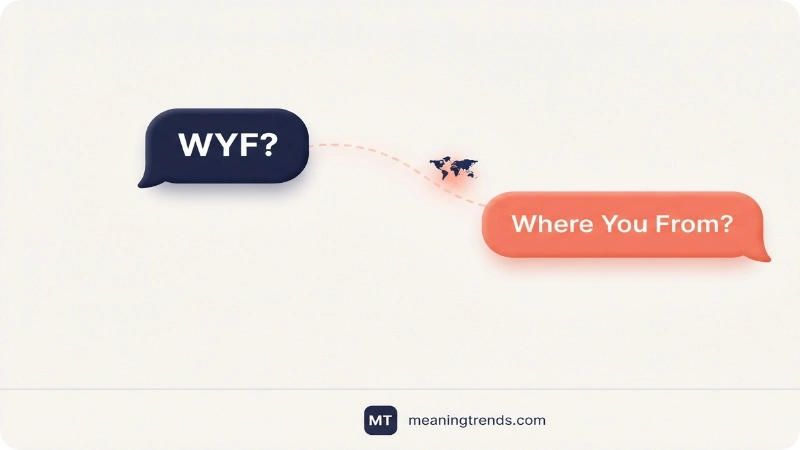
In casual texting, WYF is an informal abbreviation for “Where You From?”, which corresponds to the standard English question “Where are you from?”
The shortened wording is deliberately informal. It leaves out “are,” then compresses the remaining words into their initial letters:
- W = Where
- Y = You
- F = From
So:
Where are you from? → Where you from? → WYF?
The final version is texting shorthand rather than formal written English. It works because the reader can reconstruct the intended question from the letters.
Usually, the question is about general origin or location, not an exact physical address. Depending on the conversation, someone answering WYF might give a city, country, state, region, or hometown.
For example:
A: WYF?
B: I’m from Lahore. You?
Or:
A: Hey, WYF?
B: Originally from Chicago, but I live in Dallas now.
The exact amount of information is up to the person answering. A question about where someone is from does not automatically require them to disclose a precise location.
What Does Each Letter Stand For?
WYF is best treated as a texting abbreviation rather than a formal acronym with one universally standardized expansion.
In its common location related use:
| Letter | Word |
| W | Where |
| Y | You |
| F | From |
The natural full English question is “Where are you from?”
The difference matters because “Where You From?” is itself an informal shortened sentence. The abbreviation does not mean that “Where you from?” is the preferred form in formal English.
You would normally write:
“Where are you from?”
rather than:
“WYF?”
in a formal email, application, report, or professional message.
There is also an important limitation: not every three letter interpretation that can be constructed from W, Y, and F is an established meaning. A plausible expansion is not automatically a recognized slang definition. Current online references document several alternate uses, but they are less consistently supported than the location related reading.
Why Do People Use WYF?
The main purpose of WYF is brevity in casual digital conversation.
Someone can type three letters instead of a complete question, and the intended meaning can be understood when the context is clear. This fits the general style of texting, where people often shorten familiar phrases.
WYF can also make a question feel less formal. Compare:
“Where are you from?”
with:
“WYF?”
The second version is much more conversational and compressed.
That does not necessarily tell you anything about the sender’s personality or intentions. A short abbreviation may simply reflect the informal setting.
If someone you have never spoken with sends “WYF?” after saying hello, they may be starting a conversation by asking where you’re from. If a friend uses it during an ongoing conversation, the surrounding messages are more important than the abbreviation itself.
What Else Can WYF Mean?
WYF is not completely unambiguous.
Some current slang references document alternative interpretations such as “What You Feeling?” or “What’s Your Favorite?” These uses are less straightforward and should not automatically replace the location related meaning.
For example, consider:
A: We can order pizza or burgers. WYF?
Here, “Where You From?” does not fit the topic well. A preference related interpretation may make more sense.
Another example:
A: I’m bored tonight. WYF?
Depending on the surrounding conversation, the sender may be asking what the other person feels like doing or what they want.
The important distinction is between documented alternate uses and expansions that merely seem possible. Online slang changes quickly, and user generated slang sites can contain isolated or conflicting definitions. For that reason, an unusual interpretation should be treated as context dependent rather than presented as a universal second definition.
There is also a potentially explicit interpretation recorded in some user generated slang material. Because such entries are not evidence that the meaning is standard or broadly used, it is better not to assume that reading without strong contextual clues.
If the message is only:
“WYF?”
with no other context, “Where You From?” is the clearest starting interpretation in the current sources checked for this article.
How Does Context Change the Meaning?
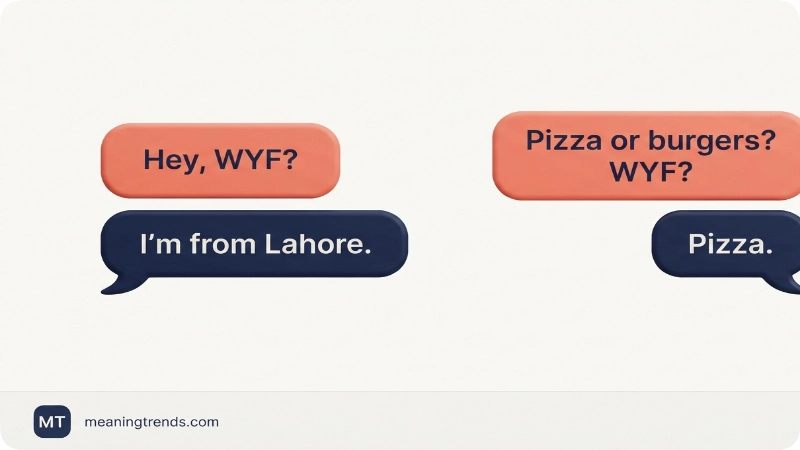
Context is especially important with short abbreviations because the letters themselves provide very little information.
Look at four clues together: the words around WYF, the topic, the relationship between the people, and what came immediately before it.
When a new person sends WYF
If someone has just introduced themselves or started a conversation, “Where You From?” is a natural reading.
A: Hey, nice to meet you.
B: You too! WYF?
A location or hometown answer makes sense here:
“I’m from Islamabad. What about you?”
That does not prove what the sender intended, but the conversational sequence strongly supports the location question.
When a friend sends WYF
With an established friend, the topic may provide a better clue.
A: We need to decide where to eat.
B: I’m good with anything.
A: WYF?
Here, the sender probably isn’t suddenly asking about the friend’s hometown. The discussion is about a choice, so a preference related interpretation may fit better.
When WYF appears after a question
Look at the previous message.
A: I can’t decide between these two movies.
B: WYF?
In that context, “What’s your favorite?” or another preference related reading could be intended.
By contrast:
A: I just moved here last month.
B: WYF?
makes “Where You From?” a much more natural interpretation.
When the message includes extra clues
Additional words can make the intended meaning easier to identify.
“WYF? I’m from Boston.”
The follow up directly supports the location meaning.
Likewise:
“Pizza or tacos? WYF?”
points toward a preference or choice rather than someone’s geographical origin.
No single feature proves intent. Capitalization, punctuation, the sender’s gender, or one emoji should not be treated as definitive evidence of what the person meant.
Examples of WYF in Conversation
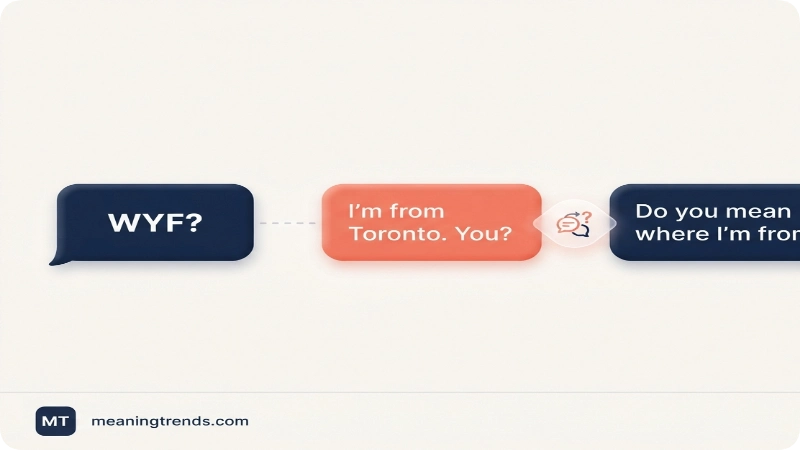
Here are illustrative examples showing how the same abbreviation can work differently depending on context.
Example 1: Asking where someone is from
Person A: Hey! I don’t think we’ve talked before. WYF?
Person B: I’m from Toronto. You?
Interpretation: The sender is asking where the other person is from.
Example 2: Asking about someone’s background
Person A: Your accent sounds familiar. WYF?
Person B: Originally from Manchester.
Interpretation: The context makes a question about geographic background plausible.
Example 3: Asking about a preference
Person A: I can’t choose between the blue and green one. WYF?
Person B: Blue, definitely.
Interpretation: “Where You From?” does not fit the conversation. The sender is likely asking for the other person’s preference, although the exact expansion cannot be established from WYF alone.
Example 4: Asking what someone wants
Person A: We can watch a movie or play a game. WYF?
Person B: Movie sounds good.
Interpretation: The conversation concerns a choice, so a preference oriented reading is more plausible than the location meaning.
Example 5: Unclear context
Person A: WYF?
If that is the entire message, there may not be enough information to identify the sender’s intended meaning with certainty. The safest approach is to consider what you were discussing immediately beforehand.
If nothing provides a clue, you can simply ask:
“Do you mean where I’m from?”
That is clearer than guessing.
Is WYF Rude, Flirty, or Offensive?
WYF is generally casual rather than inherently rude, flirty, or offensive. Its tone depends on the conversation and the relationship between the people involved.
A new acquaintance asking:
“WYF?”
may simply be making conversation.
Someone on a dating app might use the same question while getting to know you. That can occur within a flirtatious conversation, but the abbreviation itself does not prove romantic interest.
Likewise, a blunt:
“WYF”
could feel abrupt to some readers, especially without punctuation or any greeting. But that does not establish that the sender is annoyed or disrespectful. Short texting style can reflect nothing more than habit.
There is also a privacy consideration. “Where are you from?” can be answered at different levels of detail. You can give a country or broad region instead of a city, neighborhood, workplace, school, or exact current location if that is more comfortable.
For example:
“I’m from Pakistan.”
or:
“I’m originally from the north.”
You don’t need to provide more detail simply because someone asked.
How Do You Reply to WYF?
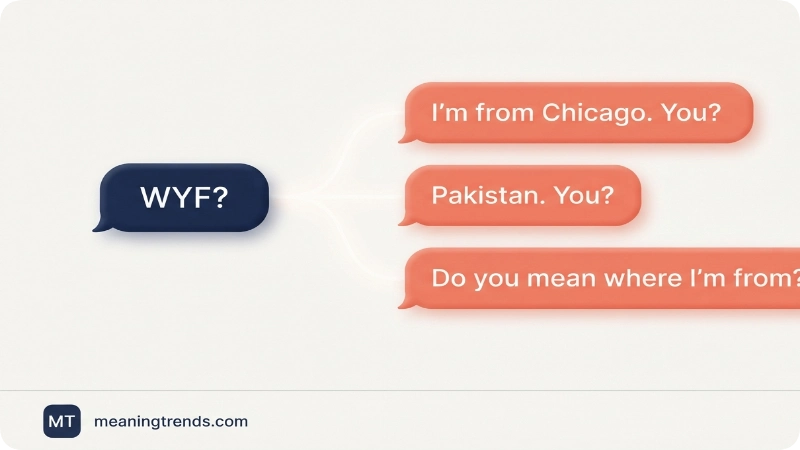
If WYF means “Where You From?”, the simplest response is a general location.
Direct:
“I’m from Chicago. You?”
Friendly:
“Originally from London, but I live in New York now. What about you?”
Brief:
“Pakistan. You?”
If you want to clarify the question:
“Do you mean where I’m from?”
If you prefer not to give details:
“I’d rather keep my location general, but I’m from the area.”
The best response depends on what you’re comfortable sharing. A short answer is completely sufficient.
If the context suggests a different meaning, answer the question that actually fits the conversation. For example, if you’re discussing two restaurants and someone sends WYF, responding with your hometown could create unnecessary confusion.
When Should You Use or Avoid WYF?
Use WYF mainly in casual texting, informal chats, and other situations where abbreviated language is already normal.
It can work naturally in:
- Text messages with friends
- Casual DMs
- Informal online conversations
- Some social media conversations
- Other relaxed chats where texting shorthand is expected
Avoid it when clarity and formality matter.
For example, instead of writing:
“WYF?”
in a professional message, use:
“Where are you from?”
The full version is clearer and grammatically standard.
This distinction isn’t about one form being universally better. It is about register. WYF signals a highly informal style, so it should match the setting.
If you’re unsure If the other person understands texting abbreviations, writing the full question is usually clearer.
What Are Other Ways to Say WYF?
If you mean the location related WYF, there are several alternatives:
- Where are you from? — standard and natural
- Where are you originally from? — asks specifically about roots or origin
- Where do you live? — asks about current residence instead
- What city are you from? — specifically asks about a city
- What part of the country are you from? — asks about a broader region
- Where are you based? — asks about someone’s current base or location
These aren’t exact substitutes in every situation.
For example, “Where are you from?” can refer to someone’s background or hometown, while “Where do you live?” more directly asks about their current residence.
That difference can matter. If someone moved from one city to another, they might answer those two questions differently.
How Is WYF Different from Similar Texting Abbreviations?
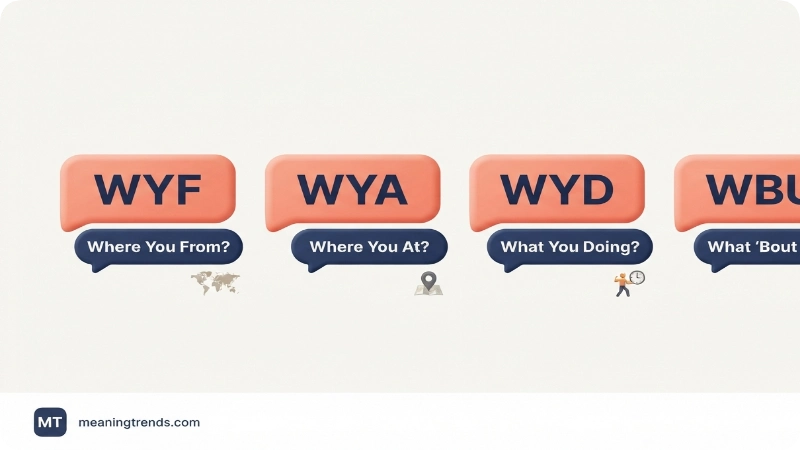
WYF is easy to confuse with other short questions because several texting abbreviations begin with W and Y.
| Expression | Meaning | Typical use | Key distinction |
| WYF | Usually “Where You From?” | Asking about origin or location | Focuses on where someone is from |
| WYA | “Where You At?” | Asking someone’s current location | Usually concerns where someone is now |
| WYD | “What You Doing?” | Asking what someone is doing | Focuses on an activity |
| WBU | “What ’Bout You?” | Returning a question | Asks the other person the same or a related question |
| HBU | “How ’Bout You?” | Returning a question | Often asks for the other person’s answer or preference |
For example:
WYF?
“I’m from Seattle.”
versus:
WYA?
“I’m at the mall.”
The distinction is simple but useful: WYF is generally about where someone is from, while WYA is generally about where they are now.
Common Mistakes and Confusion About WYF
The biggest mistake is assuming that every occurrence of WYF must mean exactly the same thing.
“Where You From?” is the clearest documented texting interpretation in the sources checked here, but alternative user generated definitions exist. The surrounding conversation should therefore be considered before deciding what a sender meant.
Another possible mistake is treating “Where You From?” as identical to “Where do you live?” They can overlap, but they don’t always ask the same thing. Someone can be from one place and currently live somewhere else.
It is also worth avoiding unsupported claims about who “always” uses WYF or what a sender “really” intends. Slang is highly dependent on community and context, and a three letter abbreviation cannot reliably reveal someone’s motives, age, gender, mood, or romantic interest.
Finally, don’t assume that an unusual expansion is established simply because you can find it on a slang website. User generated dictionaries are useful for discovering possible uses, but an isolated entry does not establish widespread usage.
FAQs
What is the WYF meaning in text?
WYF usually means “Where You From?”, an informal way of asking “Where are you from?” It commonly asks about someone’s city, country, hometown, or general background.
What does WYF stand for?
In its common location related use, WYF represents Where You From? The standard English equivalent is “Where are you from?”
Is WYF the same as “Where are you from?”
Usually, yes in casual texting. “Where You From?” is an informal shortened form, while “Where are you from?” is the complete standard English question.
Does WYF mean where someone lives?
It can be understood that way in some conversations, but “Where are you from?” and “Where do you live?” aren’t always identical. The first can ask about origin or background; the second more directly asks about current residence.
Can WYF have another meaning?
Yes. Current slang references document other informal readings, including preference or feeling related interpretations. These are more dependent on context and shouldn’t automatically be assumed.
Is WYF a formal abbreviation?
No. WYF is best understood as informal texting shorthand. The full question “Where are you from?” is more appropriate in formal or professional writing.
How should I answer “WYF?”
If the sender means “Where You From?”, you can simply give a broad location, such as “I’m from Toronto” or “Pakistan, you?” You can also keep your answer general if you don’t want to share more personal location information.
Is WYF flirty?
Not by itself. Someone may use WYF during a flirtatious conversation, but the abbreviation itself only provides limited information. The rest of the conversation is a better clue to tone and intent.
What is the difference between WYF and WYA?
WYF generally asks where someone is from, while WYA generally asks where someone is now. For example, “WYF?” could receive “I’m from Boston,” while “WYA?” could receive “I’m at home.”
Conculsion
When you see WYF in a text, the clearest starting interpretation is “Where You From?”, meaning “Where are you from?” It is informal texting shorthand, often used to ask about someone’s hometown, country, city, or general background. The most important rule is to read the abbreviation together with the conversation around it rather than treating three letters as proof of the sender’s exact intention.
If you’re replying, a simple general location is enough when that is what the sender means. You can say “I’m from Lahore, you?” or give a broader answer such as “I’m from Pakistan.” If the conversation doesn’t clearly support the location meaning, ask what they mean instead of guessing. And because location can be personal information, you can choose how much detail to disclose.
WYF has documented alternative informal uses, but those readings are more context dependent. When the message is ambiguous, the surrounding words and topic are more reliable clues than the abbreviation alone.

Alex writes about the words and shortcuts people use in texts, group chats, and social media. Each guide explains the meaning with everyday examples and tips on when to use it