Quick Answer: In texting, ASF means “as fuck,” an informal, vulgar expression used to emphasize how strongly someone feels or how extreme something is. It usually follows an adjective, such as “tired asf” (extremely tired) or “funny asf” (very funny). Its tone depends on the conversation.
You might see a message like “That movie was boring asf” and wonder If the sender is upset, joking, or simply exaggerating. The expression is short, but it can make an ordinary statement sound much stronger.
ASF appears in casual digital conversations, including text messages, group chats, comments, and social media captions. People use it to emphasize everything from excitement and admiration to frustration and exhaustion.
Understanding the abbreviation is straightforward. Knowing how to interpret its tone takes a little more context. The words around ASF, the relationship between the people talking, and the situation all influence how the message comes across.
What Does ASF Mean in Text?
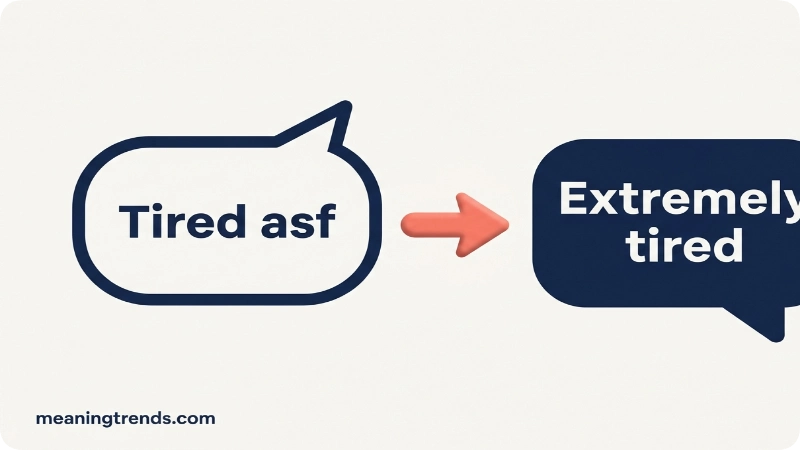
ASF is a slang abbreviation for “as fuck.” It acts as an intensifier, meaning it strengthens the adjective or description that comes before it.
In standard English, you can often replace ASF with “very,” “extremely,” “really,” or “incredibly.”
For example:
- “I’m hungry asf” means “I’m extremely hungry.”
- “That song is good asf” means “That song is really good.”
- “It’s cold asf outside” means “It’s extremely cold outside.”
- “This homework is hard asf” means “This homework is incredibly difficult.”
The abbreviation doesn’t describe one particular emotion. Instead, it makes an existing description more intense.
Someone can use ASF to express something positive, negative, or neutral. A person who writes “I’m happy asf” is emphasizing happiness, while someone who writes “I’m annoyed asf” is emphasizing frustration.
Because the full phrase contains profanity, ASF remains informal even when the abbreviation seems less explicit.
What Does Each Letter in ASF Stand For?
In this texting expression, the letters represent:
- AS: The word “as.”
- F: The first letter of “fuck.”
ASF is an abbreviated spelling of the phrase “as fuck.” It isn’t a separate grammatical expression with three independent words.
The phrase typically comes after an adjective or descriptive word:
Adjective + ASF = strongly emphasized description
For example, “busy asf” communicates a much higher degree of busyness than simply saying “busy.”
You may also encounter “af,” which is another abbreviation for “as fuck.” Both expressions serve essentially the same purpose in casual messaging.
Why Do People Use ASF in Text Messages?
People use ASF because it adds emphasis without requiring a longer sentence. It can make a message feel more expressive, casual, or dramatic.
To emphasize strong feelings
ASF helps communicate intensity.
Consider these two messages:
“I’m tired.”
“I’m tired asf.”
The first communicates tiredness. The second suggests that the sender feels extremely tired.
The same principle applies to happiness, excitement, irritation, and other feelings.
To make a reaction more expressive
People sometimes use ASF when reacting to entertainment, situations, or experiences.
For example:
“That ending was crazy asf.”
The sender is strongly emphasizing how surprising or intense the ending felt. If they enjoyed it depends on the surrounding conversation.
To sound casual or playful
Among people who are comfortable with informal slang, ASF can make an exaggerated reaction sound playful.
For example:
“Why is this cat dramatic asf? 😂”
The laughing emoji and humorous situation suggest that the sender may be joking rather than expressing serious criticism.
However, the abbreviation alone doesn’t establish humor. Context remains important.
How Does Context Change the Meaning of ASF?
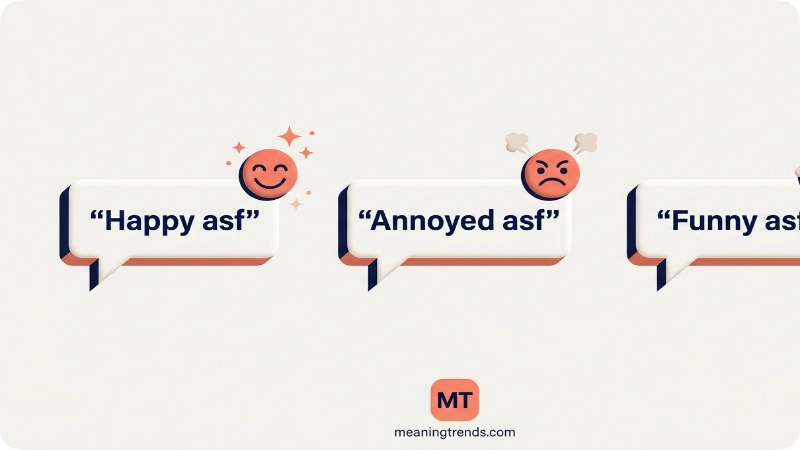
Although ASF has a recognizable slang meaning, the speaker’s attitude isn’t always obvious.
The adjective tells you what is being emphasized. The surrounding conversation helps you understand why.
Positive messages
ASF can strengthen compliments or enthusiastic reactions.
For example:
“Your outfit is cute asf.”
This is a strongly positive description of someone’s outfit. Depending on the relationship and earlier conversation, it may be friendly, admiring, or flirtatious.
Similarly, “That concert was amazing asf” expresses strong approval.
Negative messages
ASF can also emphasize complaints, disappointment, or irritation.
For example:
“This line is long asf.”
The sender is emphasizing the length of the line and may be frustrated about waiting.
Another example is:
“That comment was rude asf.”
Here, ASF strengthens the criticism rather than introducing a separate insult.
Joking or exaggerated messages
Sometimes the wording is intentionally dramatic.
For example:
“I walked upstairs once and now I’m tired asf.”
This could be a playful exaggeration about feeling exhausted after minimal activity.
The humor comes from the situation, not from ASF itself.
Ambiguous messages
A message like “You’re quiet asf today” could express concern, surprise, teasing, or criticism.
You can’t reliably identify the sender’s intention from the abbreviation alone.
If the message feels unclear, a natural response would be:
“Do you mean that in a good way or a bad way?”
Examples of ASF in Text Conversations
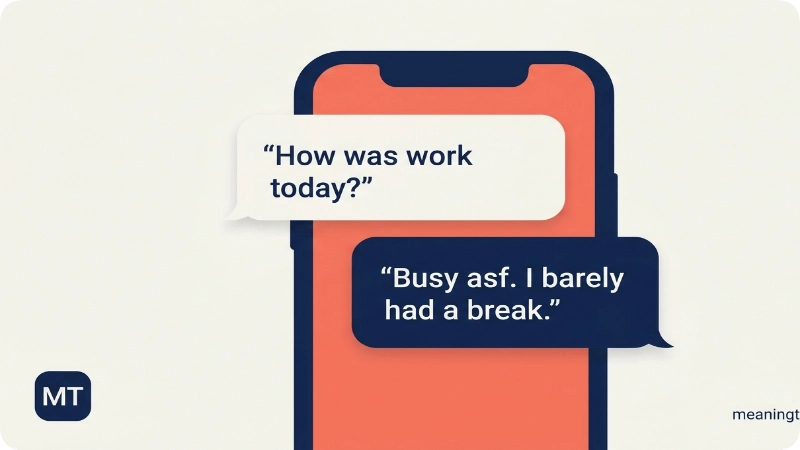
The following fictional conversations show how ASF works in everyday messages.
Example 1: Expressing exhaustion
Person A: “How was work today?”
Person B: “Busy asf. I barely had a break.”
Meaning: Person B had an extremely busy workday and is emphasizing how demanding it felt.
Example 2: Giving a compliment
Person A: “What do you think of my new haircut?”
Person B: “It looks good asf!”
Meaning: Person B is giving an enthusiastic compliment.
Example 3: Reacting to something funny
Person A: “Did you watch that video I sent?”
Person B: “Yeah, it was funny asf 😂”
Meaning: Person B found the video extremely funny. The emoji reinforces the amused tone.
Example 4: Expressing frustration
Person A: “Is the restaurant crowded?”
Person B: “Crowded asf. There’s nowhere to sit.”
Meaning: Person B is emphasizing how crowded the restaurant is, possibly with frustration.
Example 5: Showing excitement
Person A: “Are you ready for the trip?”
Person B: “Excited asf! I’ve been waiting all week.”
Meaning: Person B is extremely excited about the upcoming trip.
Example 6: Expressing uncertainty
Person A: “How was the exam?”
Person B: “Hard asf. No idea how I did.”
Meaning: Person B found the exam extremely difficult.
These examples show that ASF doesn’t have one fixed emotional tone. It intensifies whatever description accompanies it.
Is ASF Rude, Flirty, or Offensive?
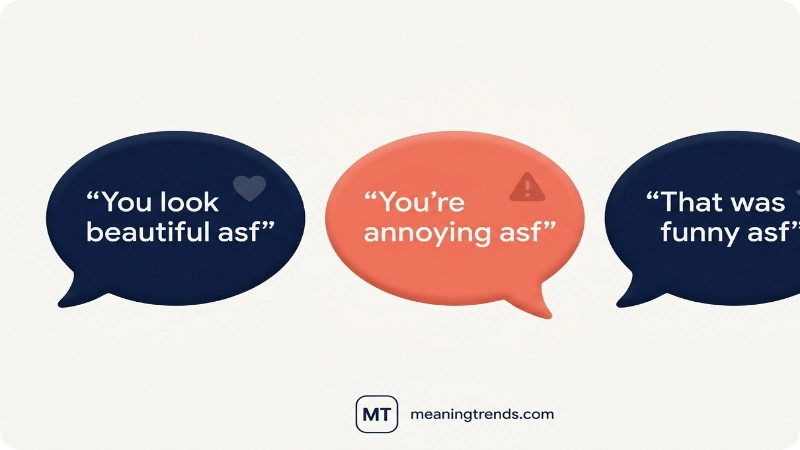
ASF can sound casual, playful, enthusiastic, or rude depending on how it’s used.
The important distinction is between the expression’s literal wording and the speaker’s intention.
Is ASF considered a swear word?
Yes. ASF abbreviates a phrase containing the profanity “fuck.”
Although the shortened spelling may appear less direct than writing the full phrase, it still carries a vulgar meaning.
Some people may find it inappropriate even when the message is friendly.
Can ASF be flirty?
Yes, but ASF isn’t inherently romantic or sexual.
For example:
“You look beautiful asf.”
This could be flirtatious, especially in an established romantic conversation. It could also be an enthusiastic compliment between friends.
The wording alone doesn’t prove attraction.
Can ASF be insulting?
Yes, when it strengthens a negative description directed at someone.
For example:
“You’re annoying asf.”
This may sound harsh or insulting because it intensifies a personal criticism.
Compare that with:
“That game is annoying asf.”
The second sentence criticizes an experience rather than a person.
The target of the description matters as much as the abbreviation.
How Do You Reply to ASF?
You usually don’t need to respond to ASF itself. Instead, respond to the overall message.
If someone says “I’m tired asf,” they’re describing their condition. If they say “That was funny asf,” they’re reacting to something amusing.
Here are some natural replies:
| Message received | Possible reply |
| “I’m hungry asf.” | “Same. What should we eat?” |
| “That movie was scary asf.” | “I know! That ending got me.” |
| “You look good asf.” | “Thank you! That’s sweet.” |
| “I’m stressed asf.” | “What’s going on?” |
| “This is confusing asf.” | “Which part is confusing?” |
| “It’s hot asf today.” | “Seriously, I can’t stand this heat.” |
You can match the sender’s casual tone without repeating the profanity.
If you’re unsure If a comment is a compliment or criticism, ask a simple follow up rather than assuming.
When Should You Use or Avoid ASF?
ASF is best suited to informal conversations where strong slang feels appropriate.
When ASF may fit
You might use ASF in:
- Casual texts with friends.
- Relaxed group chats.
- Informal social media captions.
- Playful conversations with people who use similar language.
For example, “That pizza was good asf” may sound natural in a casual conversation about food.
When to avoid ASF
Avoid it when the situation calls for professionalism, politeness, or careful wording.
Examples include workplace emails, job applications, academic assignments, customer support messages, and formal communications.
Instead of writing:
“The meeting was confusing asf.”
You could write:
“The meeting was extremely confusing.”
The second version communicates the same basic intensity without profanity.
Also consider the recipient. Even in a text message, not everyone appreciates strong language.
What Are Other Ways to Say ASF?
If you want to express intensity without using vulgar slang, several alternatives work well.
| Alternative | Example | Tone |
| Very | “I’m very tired.” | Neutral |
| Really | “That was really funny.” | Casual or neutral |
| Extremely | “It’s extremely cold.” | Strong, standard English |
| Incredibly | “She’s incredibly talented.” | Emphatic |
| Super | “I’m super excited.” | Casual |
| So | “That was so good.” | Conversational |
These alternatives aren’t always identical in emotional force. ASF often feels more blunt or exaggerated, while “very” and “extremely” can sound more controlled.
Choose the wording that fits the audience and the feeling you want to communicate.
What’s the Difference Between ASF, AF, and ASL?
These abbreviations can look similar, but they don’t always mean the same thing.
| Expression | Meaning | Typical use | Key distinction |
| ASF | As fuck | “I’m tired asf.” | Intensifies a description |
| AF | As fuck | “I’m tired af.” | Same basic slang meaning, shorter spelling |
| ASL | Age, sex, location; also American Sign Language | “ASL?” or “I study ASL.” | Meaning depends on context and is unrelated to ASF |
| ASAP | As soon as possible | “Reply ASAP.” | Expresses urgency, not descriptive intensity |
ASF and AF are particularly easy to compare because they perform the same grammatical function in casual text.
ASL is different. In older internet chat contexts, it can be a request for personal details. In other contexts, it refers to American Sign Language. The intended meaning depends on the conversation.
Does ASF Mean the Same Thing on Snapchat, TikTok, and Instagram?
In casual messaging, ASF generally retains its “as fuck” meaning across platforms.
What changes is the surrounding format: a private message, a comment, a caption, or a response to a photo.
ASF on Snapchat
In a Snapchat chat, someone might write:
“I’m bored asf.”
This emphasizes how bored they feel.
If someone responds to a photo with “Cute asf,” they’re strongly complimenting what they see, though the precise intention depends on the relationship.
ASF on TikTok
In a TikTok comment, someone might write:
“This edit is clean asf.”
In that context, “clean” may praise the video’s polished appearance or execution. ASF strengthens the compliment.
ASF on Instagram
In an Instagram comment or direct message, someone might say:
“That view is beautiful asf.”
This emphasizes admiration for the scenery.
There isn’t a separate established ASF definition required for each of these platforms. The usual slang interpretation works when the expression follows a descriptive word.
Can ASF Have Other Meanings?
Yes. The same three letters can represent different expressions in other contexts.
For example, ASF is also used as an abbreviation for the Apache Software Foundation, a nonprofit organization associated with open source software projects.
In that technical context, the letters refer to an organization rather than texting slang.
This distinction matters when you’re reading software documentation, workplace material, or technical discussions.
A useful way to interpret ASF is to examine its grammatical position.
If someone writes “That was difficult asf,” the abbreviation follows an adjective and functions as an intensifier.
If someone writes “The project is managed by the ASF,” the abbreviation refers to an organization in that context.
Don’t assume every occurrence of the letters has the texting meaning.
FAQs About ASF Meaning in Text
What does ASF mean from a girl?
When someone uses ASF after an adjective, it generally means “as fuck,” regardless of the sender’s gender. The person’s identity doesn’t change the definition or prove a particular intention.
What does ASF mean from a guy?
It has the same slang meaning: “as fuck.” If the message is friendly, joking, romantic, or critical depends on the complete conversation.
Is ASF a compliment?
ASF itself isn’t a compliment, but it can strengthen one. “You’re talented asf” is complimentary, while “You’re rude asf” is critical.
Does ASF mean “as freak”?
The established slang expansion discussed here is “as fuck.” Someone might personally use a softer substitute, but “as freak” shouldn’t be assumed to be the standard expansion.
Is ASF the same as AF?
Yes, in their common slang use, both abbreviate “as fuck” and emphasize a description.
Should ASF be written in uppercase or lowercase?
Both “ASF” and “asf” are understandable in informal messages. Capitalization doesn’t reliably change the definition, although uppercase text can sometimes make a message appear more emphatic.
Is ASF appropriate for professional messages?
Generally, no. Because it abbreviates profanity, standard alternatives such as “extremely,” “very,” or “really” are usually better choices in professional communication.
Conclusion
ASF in text usually means “as fuck,” an informal expression that makes a description stronger. It can emphasize excitement, admiration, frustration, exhaustion, or almost any other quality expressed by an adjective. The abbreviation itself doesn’t tell you If a message is positive, negative, serious, or playful. To understand the sender’s intention, consider the surrounding words, the conversation, and your relationship with that person.
When replying, focus on what the sender is communicating rather than the abbreviation alone. If someone says they’re “busy asf,” you can acknowledge their stressful day. If they call something “amazing asf,” you can respond to their enthusiasm. You don’t have to use the same slang yourself.
For formal situations or conversations where profanity may be unwelcome, choose alternatives such as “very,” “really,” or “extremely.” They communicate intensity without the potentially offensive wording.

Alex writes about the words and shortcuts people use in texts, group chats, and social media. Each guide explains the meaning with everyday examples and tips on when to use it