Slang usage verified: October 2026
QUICK ANSWER: In text messages, SMH means “shaking my head.” It’s an informal reaction used to show disbelief, disappointment, disapproval, frustration, or mild exasperation. The exact tone depends on the situation. “You forgot your keys again, smh” can sound genuinely annoyed or playfully teasing, depending on the relationship and conversation.
You might see “smh” after a friend admits to making an obvious mistake, in a comment about something disappointing, or as a stand alone response to something that seems hard to believe. The three letters represent a familiar physical reaction: shaking your head.
That doesn’t mean every “SMH” carries the same emotional weight. A friend who sends “smh 😂” may be joking, while “SMH. This is unacceptable.” is much more clearly disapproving. The surrounding words, punctuation, emojis, and relationship between the people involved matter more than the abbreviation by itself.
What Does SMH Mean?
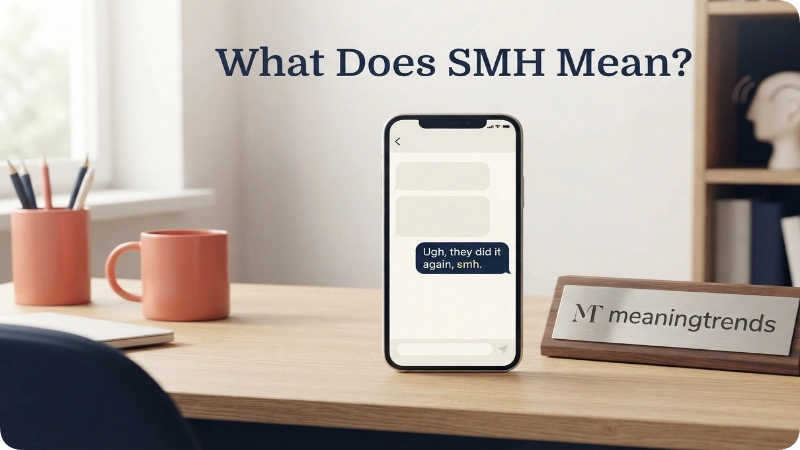
SMH is an internet and texting initialism for “shaking my head.” Dictionaries including Cambridge Dictionary and Collins English Dictionary define it as an abbreviation used in messaging and social media. Cambridge specifically describes its use when someone doesn’t believe or doesn’t approve of something.
In everyday texting, SMH functions as a reaction rather than as a piece of factual information. It can communicate something like:
- “I can’t believe this.”
- “That’s disappointing.”
- “Seriously?”
- “What were you thinking?”
- “That’s frustrating.”
- “Come on.”
Those are approximate English equivalents, not separate expansions of SMH. The established expansion is “shaking my head.”
The expression comes from the idea of physically shaking your head in response to something foolish, disappointing, unbelievable, or disapproved of. Online, the gesture is represented with three letters instead of an actual movement.
SMH can appear at the beginning, middle, or end of a message:
“SMH, you really did that?”
“I missed the train again, smh.”
“You forgot your wallet? SMH.”
It can also stand alone:
“SMH.”
When it appears alone, the reader has to use the previous message and the relationship between the speakers to determine If the reaction is serious, amused, disappointed, or teasing.
What Does Each Letter Stand For?
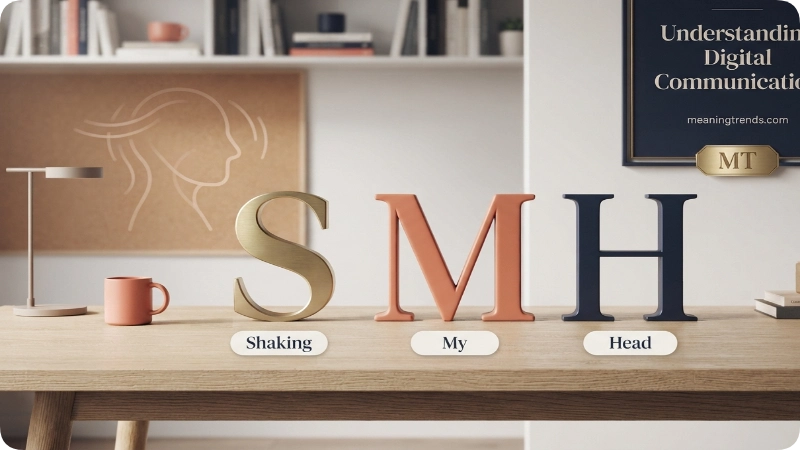
SMH is an initialism: the letters represent the initial letters of the words Shaking My Head.
- S = Shaking
- M = My
- H = Head
Unlike a shortened spelling such as “pls” for “please,” SMH represents a multi word phrase. It is generally read as the individual letters “S M H,” although people can also encounter it simply as a written reaction.
“Shaking my head” is the established meaning in texting and social media dictionaries. Cambridge Dictionary and Collins both give this expansion.
You may encounter other expansions for the same letters in isolated contexts, but they should not automatically replace the standard texting meaning. If someone sends “SMH” in an ordinary text conversation, “shaking my head” is the reading to consider first.
Why Do People Use SMH?
People use SMH because a short abbreviation can represent a reaction that would otherwise take a full sentence to describe.
Instead of writing:
“I can’t believe you forgot your appointment again.”
someone might write:
“SMH.”
The abbreviation works much like a written version of a nonverbal reaction. It can save time while also adding emotional context to a message.
The reaction may be directed at another person’s behavior:
“You left the door unlocked again. SMH.”
It can also be directed at a situation:
“They canceled the event at the last minute. SMH.”
And it can be self directed:
“I put my phone in the fridge. SMH.”
In the last example, the sender is not necessarily criticizing another person. They may be making fun of their own mistake.
This is one reason it’s risky to translate SMH into a single emotion such as “anger.” The abbreviation can express several related reactions, including disbelief, disappointment, disapproval, frustration, or amused exasperation. Cambridge Dictionary describes its use in situations where the writer does not believe or approve of something, while Dictionary.com describes uses involving disappointment, disapproval, frustration, or impatience.
How Does Context Change the Meaning?
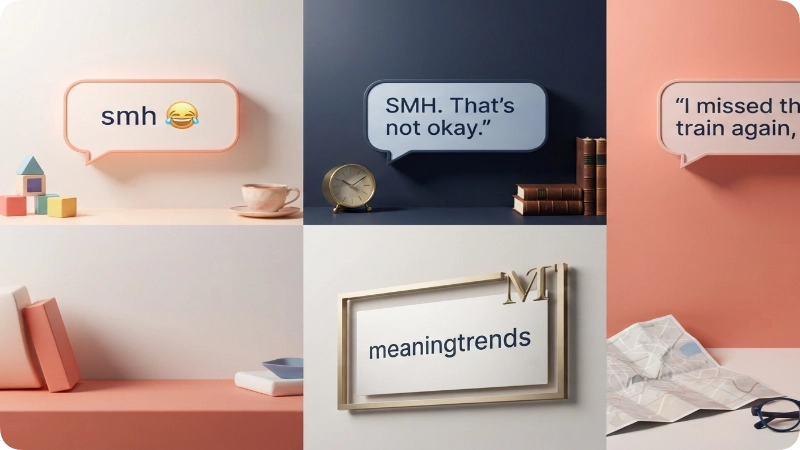
The basic meaning of SMH stays fairly stable, but its tone can change considerably.
When you’re trying to understand a message containing SMH, look at four things: what happened immediately before it, what words accompany it, the relationship between the people, and If the sender uses cues such as laughter or emojis.
When a friend sends it
Among friends, SMH may be playful.
Person A: “I drove all the way to the store and forgot my wallet.”
Person B: “smh 😂”
Here, the response could mean, “How did you manage that?” The laughing emoji makes a playful interpretation more plausible.
Without the emoji, “smh” could still be playful, but the tone is less explicit.
When someone is genuinely disappointed
SMH can also communicate real disapproval.
Person A: “He promised he’d help and then didn’t show up.”
Person B: “SMH. That’s not okay.”
The second sentence makes the reaction much clearer. The sender is not simply joking about an innocent mistake.
When the sender is criticizing themselves
SMH doesn’t always target another person.
Person A: “I studied the wrong chapter for three hours. smh”
Here, the sender is expressing frustration with their own mistake.
When the conversation is already serious
In a serious discussion, SMH can sound sharper.
Person A: “They changed the schedule without telling anyone.”
Person B: “SMH. That’s really frustrating.”
The same abbreviation that sounds playful in one conversation can therefore sound dismissive or critical in another.
One important rule is that SMH tells you about the reaction, not necessarily the sender’s exact motive. The letters alone cannot prove If someone is angry, joking, embarrassed, disappointed, or simply amused.
Examples of SMH in Conversation
Here are illustrative examples showing how the same basic expression can work in different situations.
Example 1: Forgetting something
Person A: “I left my charger at home again.”
Person B: “SMH 😂”
Interpretation: A playful reaction to a repeated mistake.
Example 2: Disbelief
Person A: “He said he didn’t know the meeting was today, even though it was on the calendar.”
Person B: “SMH.”
Interpretation: The sender may be expressing disbelief or disapproval.
Example 3: Self deprecating humor
Person A: “I searched everywhere for my glasses.”
Person B: “Where were they?”
Person A: “On my head. smh.”
Interpretation: The sender is laughing at their own mistake.
Example 4: Frustration
Person A: “The website crashed right when I was about to submit the form.”
Person B: “SMH, that’s frustrating.”
Interpretation: The abbreviation reinforces an explicit statement of frustration.
Example 5: A stand alone response
Person A: “I forgot we already bought the same thing last week.”
Person B: “SMH”
Interpretation: The response likely means something like “I can’t believe that,” but If it is teasing or genuinely critical depends on the relationship and previous conversation.
These examples are illustrative rather than fixed translations. A sender’s use of SMH should always be interpreted with the surrounding conversation.
Is SMH Rude, Flirty, or Offensive?
SMH is not inherently rude, flirty, or offensive. Its tone comes from how it is used.
It can sound mildly critical because the underlying gesture of shaking one’s head can communicate disapproval. Cambridge Dictionary explicitly connects the abbreviation with not believing or approving of something.
Between close friends, that criticism may be harmless teasing:
“You ordered fries after saying you weren’t hungry? SMH 😂”
In a tense conversation, the same abbreviation can feel dismissive:
“You still don’t understand what I’m saying. SMH.”
It is generally not a conventional flirting signal. If SMH appears in a romantic or dating conversation, don’t treat the abbreviation itself as evidence of attraction or rejection. The surrounding words provide the relevant clues.
It can also be inappropriate in situations where a clear, respectful response is needed. If you’re responding to a serious complaint, sensitive disclosure, workplace issue, or formal communication, spelling out your meaning is usually clearer than relying on texting slang.
How Do You Reply to SMH?
There isn’t one required response. Your reply can match the tone you think the sender intended.
If they’re joking, you can play along:
“I know 😂 What was I thinking?”
If they’re reacting to your mistake:
“Fair enough. I messed that one up.”
If you’re unsure If they’re serious:
“Are you joking or are you actually annoyed?”
If you think you’ve been misunderstood:
“Wait, I wasn’t saying that. I meant something else.”
If you want to keep the conversation casual, you can simply continue talking about what caused the reaction.
The important point is not to assume that SMH automatically means serious anger. If the stakes are low, context may make the intended tone obvious. If the conversation matters and the tone is unclear, a brief clarification is safer than guessing.
When Should You Use or Avoid SMH?
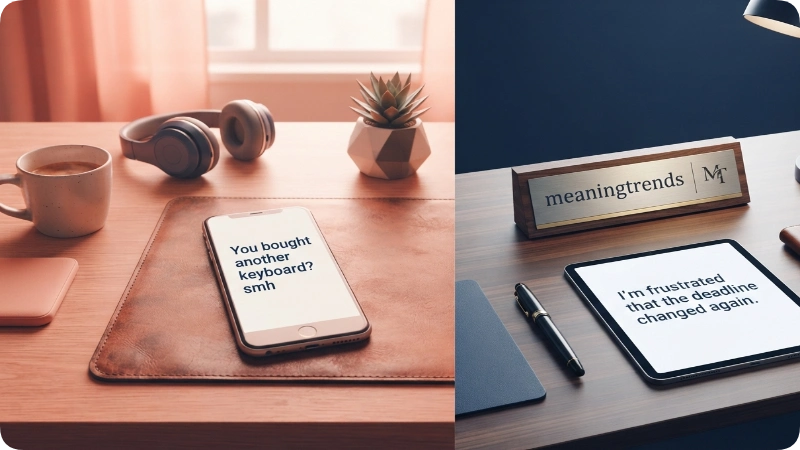
SMH fits informal digital communication. It works naturally in casual texts, group chats, comments, and other relaxed conversations. Collins specifically classifies it as an abbreviation used in messaging and social media.
It may be appropriate when you’re talking with people who already understand internet shorthand:
“You bought another keyboard? smh”
It is less suitable when clarity and formality are important, such as:
- Formal workplace emails
- Academic writing
- Official notices
- Customer service complaints
- Professional applications
- Serious communications where tone could easily be misunderstood
In those settings, replace SMH with the actual reaction you want to communicate.
For example:
“I’m disappointed that the schedule changed without notice.”
is clearer and more professional than:
“SMH.”
You don’t need to avoid informal language altogether. The useful question is If the recipient is likely to understand both the abbreviation and the tone you intend.
What Are Other Ways to Say SMH?
There is no single perfect replacement because SMH can cover several related reactions.
Depending on the context, alternatives include:
- “I can’t believe it.”
- “Seriously?”
- “That’s disappointing.”
- “That’s frustrating.”
- “What were you thinking?”
- “Come on.”
- “I don’t believe this.”
- “That’s hard to believe.”
For a professional setting, choose wording that describes the actual issue rather than trying to preserve the slang.
For example, instead of:
“SMH, the deadline changed again.”
you could write:
“I’m frustrated that the deadline changed again.”
The second version makes the intended feeling explicit.
What Else Can SMH Mean?
In ordinary texting and social media conversation, “shaking my head” is the established meaning.
There are documented alternative interpretations of SMH. Wiktionary, for example, records “scratching my head” as another Internet slang interpretation associated with confusion or incredulity.
However, that does not mean you should automatically interpret every SMH as “scratching my head.” In general texting, the dictionary supported meaning is “shaking my head,” and Cambridge and Collins both give that expansion.
SMH can also refer to unrelated initialisms outside casual texting. For example, an organization or publication may use the same letters for its own name. If SMH appears in a specialized context rather than an ordinary conversation, the surrounding subject can determine which meaning applies.
Common Mistakes and Confusion About SMH
The biggest mistake is assuming that SMH automatically means anger.
It doesn’t. It can signal disbelief, disappointment, disapproval, frustration, or a lighter form of teasing. Cambridge Dictionary describes it in terms of disbelief or lack of approval, while Dictionary.com includes disappointment, disapproval, frustration, and impatience.
Another possible confusion is treating “shaking my head” as a literal statement. Someone who types SMH does not have to be physically shaking their head. The phrase represents the reaction in text.
It’s also easy to mistake the abbreviation for a statement about the sender’s opinion of you. Sometimes it is directed at a person’s action, but it can just as easily be directed at a situation or at the sender’s own mistake.
Finally, capitalization usually isn’t the important clue. “SMH” and “smh” generally represent the same expression. Context carries much more information than capitalization alone.
Where Did SMH Come From?
The exact individual origin of SMH is not firmly established.
Dictionary.com describes SMH as emerging in online and text communication during the 2000s. It also notes an Urban Dictionary entry from 2004 and says the expression spread on Twitter by 2007. Dictionary.com further notes that early notable uses were prevalent among Black internet speech communities. Those details support a documented history of early online use, but they do not establish a single inventor or a single moment when the abbreviation was created.
That distinction matters because Internet slang often develops across communities rather than being invented by one identifiable person. An early dictionary entry is evidence that a term was being recorded by that date; it is not proof that the term was first created then.
The core idea behind SMH is straightforward: a familiar head shaking gesture becomes a compact written reaction. Its modern dictionary treatment reflects that established texting and social media usage.
FAQs
What does SMH mean in text?
SMH means “shaking my head.” It is used as a reaction to something a person finds unbelievable, disappointing, frustrating, disapproved of, or sometimes amusingly foolish.
What does SMH mean from a guy or girl?
The abbreviation itself doesn’t have a different meaning based on the sender’s gender. Look at the words around SMH, the conversation topic, and the relationship between the people involved.
Does SMH mean angry?
Not necessarily. SMH can communicate mild frustration or disapproval, but it can also be playful or self deprecating. The surrounding conversation determines the tone.
Is SMH positive or negative?
It generally signals a negative or disapproving reaction, such as disbelief, disappointment, or frustration. However, friends may use it jokingly, so the emotional intensity can be quite low.
What does “SMH 😂” mean?
The laughing emoji can make an SMH message sound more playful or teasing. It doesn’t guarantee that the sender is joking, but it is a useful contextual clue.
Can SMH be used for your own mistake?
Yes. Someone can write “smh” after admitting their own mistake. In that situation, it can express self directed frustration or amusement.
Is SMH formal English?
No. SMH is informal Internet and texting shorthand. It is generally better to write the full thought in professional, academic, or formal communication.
Is SMH the same as “shaking my head”?
Yes. “Shaking my head” is the established expansion of SMH in ordinary texting and social media use.
Does SMH mean “scratching my head”?
“Scratching my head” is a documented alternative interpretation, particularly associated with confusion or incredulity, but it is not the standard meaning in ordinary texting. “Shaking my head” is the established interpretation.
What should I do if I don’t know what someone means by SMH?
Check the message immediately before it and the sender’s wording and tone. If you’re still unsure, ask directly: “Do you mean you’re annoyed, or are you joking?” That avoids assigning a motive that the abbreviation alone cannot establish.
Conclusion
SMH means “shaking my head” in ordinary texting and social media use. It represents a reaction such as disbelief, disappointment, disapproval, frustration, or mild exasperation. The most important thing to remember is that the abbreviation communicates a general reaction, not a precise emotion or guaranteed attitude toward another person.
Context determines how strong that reaction is. “SMH 😂” between friends may be playful, while “SMH. That’s not acceptable” is much more clearly critical. The surrounding words, previous messages, relationship, and meaningful emojis provide better clues than the three letters alone.
If you’re using SMH yourself, save it for casual conversations where the recipient is likely to understand Internet shorthand. When tone matters, especially in professional or sensitive situations, write the reaction out instead. And if someone sends you SMH and you genuinely can’t tell If they’re joking or upset, a short clarification is better than guessing.

Alex writes about the words and shortcuts people use in texts, group chats, and social media. Each guide explains the meaning with everyday examples and tips on when to use it